

Every December, a strange little theory pops up like a red-and-white toadstool after snowfall.
It goes something like this:
Many of our most beloved Christmas traditions — Santa Claus, flying reindeer, red-and-white suits, evergreen trees, chimneys, elves, gifts, ornaments — all trace back to Arctic shamanic rituals involving the psychoactive Amanita muscaria mushroom.
Is it provable? No.
Is it fun? Extremely.
Is it weirdly coherent once you hear it? Absolutely.
Welcome to the infamous Magic Mushroom Christmas Theory, a delightfully unhinged idea that suggests the origins of Christmas are much stranger and much deeper than you ever imagined.
The Big Reveal
As kids, everyone experiences the same devastating discovery: Santa Claus does not really exist.
But what if — stay with me — he actually does exist? And secretly, he’s been a psychoactive mushroom this whole time?
Ethnomycologist James Arthur, one of the theory’s most enthusiastic proponents, puts it this way:
“The traditional day of reckoning wherein it is revealed Santa Claus is not real, reindeer do not fly, there is no present under the tree (unless placed there by a deceiver), is a disinformation campaign geared towards conditioning the young mind to be unable to accept the [Magic Mushroom Christmas Theory].”1
Classic stuff.
Professor Carl Ruck of Boston University, a scholar of ancient religions and entheogenic traditions, puts it more dryly:
“It’s surprising that it’s taken so long for the popular imagination to encompass who Santa Claus is.”2
Let’s get into it.
The Mushroom at the Center of It All

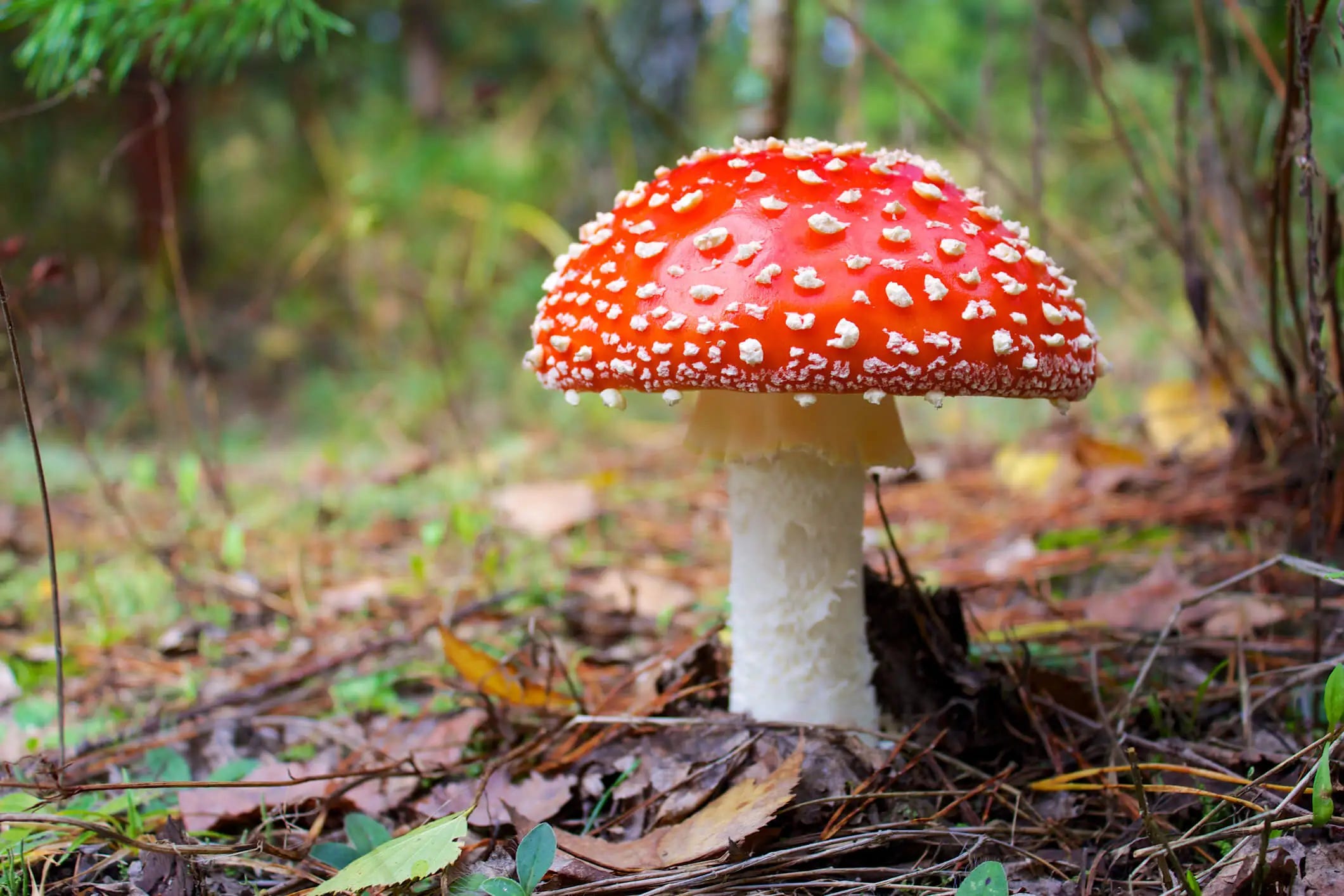
Amanita muscaria, also called the fly agaric, is the iconic fairytale mushroom: bright red cap, scattered white dots, straight out of a children’s book or a Mario level.
It grows naturally under evergreen trees — especially birch and pine — across Arctic and subarctic regions.
For centuries, it reportedly played a role in shamanic rituals among Indigenous peoples of northern Europe and Siberia.3
To these cultures, the mushroom was considered a sacred substance, used for spiritual visions, out-of-body travel to spirit realms, and as a plant-spirit guide in teaching and healing.1
Already, we’re off to a promising start.
Santa as a Shaman
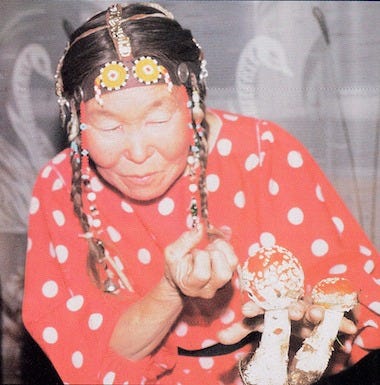
Long ago, Siberian shamans, including Sámi practitioners in Lapland, would harvest Amanita muscaria around the winter solstice, when darkness was deepest and spiritual intervention was most needed.3
Traveling from yurt to yurt, they conducted rituals with the mushroom, reportedly seeing the future, shapeshifting into animals, and flying toward the North Star in search of knowledge.4
Writer and mycologist Lawrence Millman explains “the Sámi people believed that the shaman who ate an Amanita muscaria ended up looking like an Amanita muscaria.”5
Other scholars corroborate that these shamans dressed to honor the mushroom itself, wearing red-and-white ceremonial garments.1
Millman joked that they looked like “a big fat person with red splotches.”
Sound like anyone you know?
Over time, this red-and-white figure becomes mythologized: a wise, otherworldly visitor who arrives once a year, brings precious gifts, and seems to operate outside normal rules of time and space.
Ho. Ho. Ho.
Chimneys & Very Inconvenient Front Doors
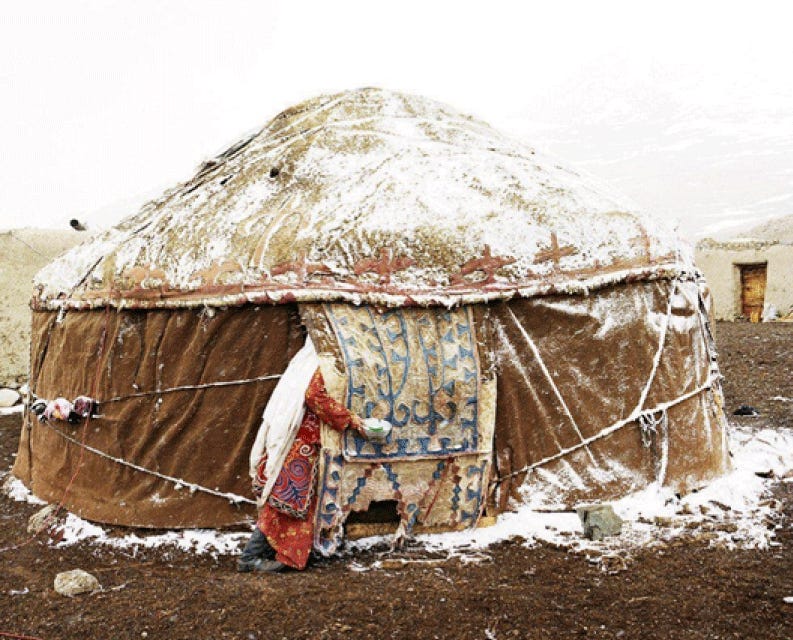
In Arctic winters, snow doesn’t politely accumulate — it buries.
To travel across the frozen landscape, shamans relied on reindeer-drawn sleds. Reindeer were central to Arctic Siberian life, both practically and spiritually.3
Homes were often inaccessible through doors, which meant visitors entered through the roof or smoke hole. In other words: down the chimney.
So picture it:
A red-and-white-clad shaman drops in from above, carrying sacred mushrooms, performing rituals, restoring balance, and then departing by reindeer-drawn sled, just as they arrived.
Strange Gifts, Big Sacks, & Ornaments
Santa brings toys. Shamans brought gifts too, though usually less material.
Millman explains that what shamans brought “were not physical gifts but usually healing and problem-solving, which would be a kind of gift.”5
After the shamans ingested the mushroom, traveled through spirit realms, and delivered insight or guidance, Millman says, “they were rewarded with lots of food.”
Siberian milk and cookies, perhaps?
Anthropologist John Rush, author of Mushrooms in Christian Art, argued that the gifts were the mushrooms themselves. He wrote that shamans “would collect Amanita muscaria (the Holy Mushroom), and then give them as gifts on the winter solstice.”6
Naturally, these shamans used a big sack to carry around the goods.
Raw Amanita muscaria can be toxic, but drying it reduces its toxicity while preserving the psychoactive effects. According to Rush, once the shaman has finished their rounds of delivering mushrooms, the villagers would hang them near the fire to dry. (Yes, like stockings.)
Additionally, mushroom gatherers sometimes placed the fly agaric on tree branches in the forest to dry in the sun. (Yep, like ornaments.)
Flying Reindeer, Or ‘Flying’ Reindeer?
Now for the part that really sends the theory into orbit.
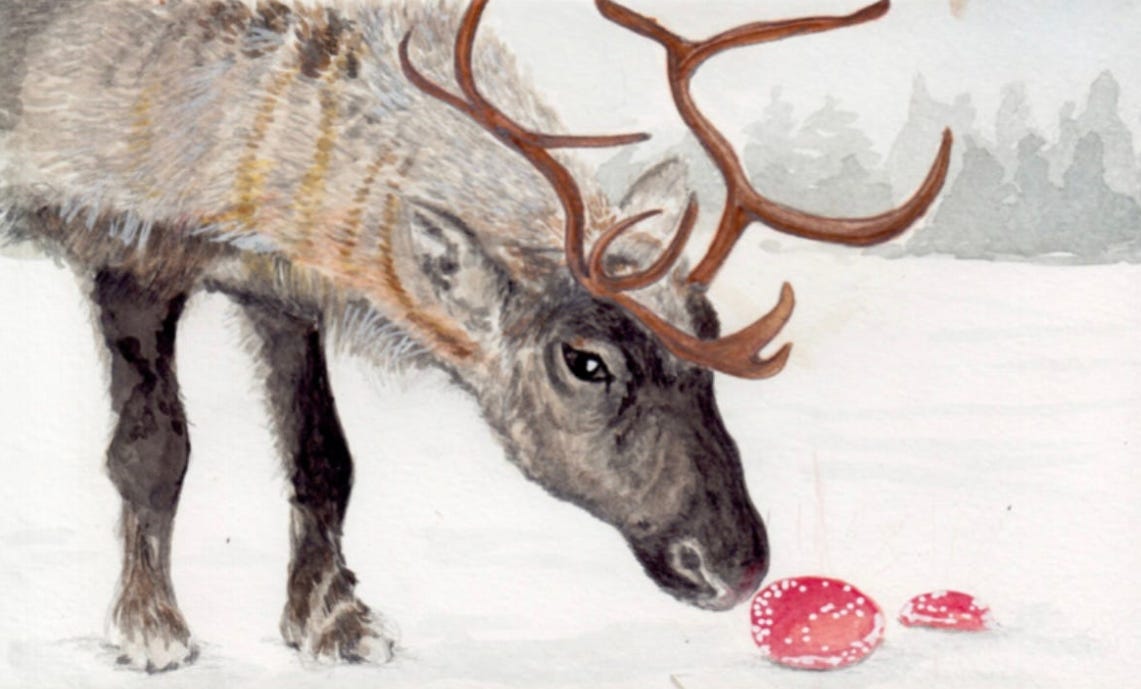
Reindeer love Amanita muscaria. Like, really love it. They actively seek it out.
Andrew Haynes, deputy editor of The Pharmaceutical Journal, has observed reindeer consuming the mushroom, noting they appear to “have a desire to experience altered states of consciousness.”7
Haynes also wrote, “for humans, a common side-effect of mushrooms is the feeling of flying, so it’s interesting the legend about Santa’s reindeer is they can fly.”8
Several accounts describe both shamans and reindeer consuming the mushroom. One method used to reduce toxicity involved drinking the urine of reindeer that had eaten it — strange as it sounds, this preserved psychoactive compounds while filtering out much of the toxins.9
Harvard biologist Donald Pfister explains the idea this way: reindeer appear to “go berserk because they’re eating Amanita muscaria… Reindeer flying — are they flying, or do they only seem to be because you are hallucinating?”10
So imagine watching reindeer — already mythic animals — prance, leap, and behave strangely while you’re deep in an altered state.
Flying reindeer suddenly doesn’t sound so far-fetched.
As for Rudolph’s glowing red nose? Picture a reindeer with a face full of bright red mushrooms. Let’s just say, it’s pretty on the nose.
Under the Tree
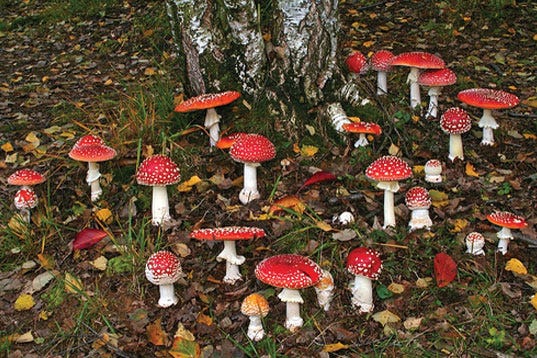
Remember where Amanita muscaria grows: beneath evergreen trees.
In his book Mushrooms and Mankind, James Arthur reflected:
“So why do people bring pine trees into their houses at the winter solstice, placing brightly colored (red and white) packages under their boughs as gifts to show their love for each other and as representations of the love of God and the gift of his Son’s life? It is because underneath the pine bough is the exact location where one would find this ‘most sacred’ substance, the Amanita muscaria, in the wild.”1
In the Arctic winter, snow gives way to mushrooms beneath the pines. “Then and there,” Arthur declares, “you will find the gifts that unlock the key mysteries of the universe.”1
The mushroom-induced gnosis — the felt union of the individual mind with a larger, cosmic intelligence — may be what early mystics attempted to encode symbolically through trees, ornaments, and red-and-white gifts.
Over time, the symbolism remained even as the original meaning faded.
And the Elves?
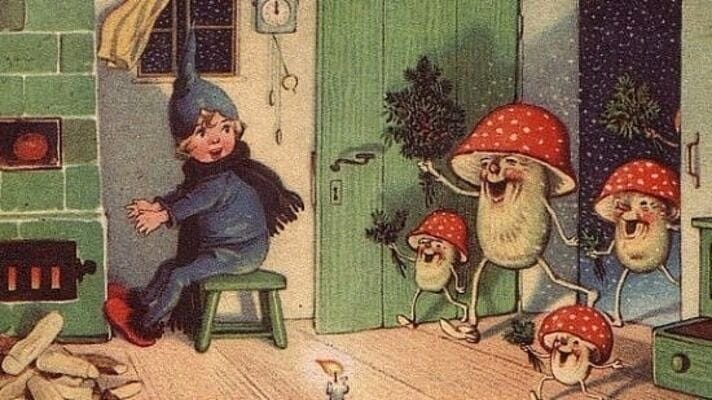
Small, mischievous, semi-invisible forest beings who assist with magical labor?
That one practically explains itself.
So… Is Christmas a Mushroom Holiday?
Probably not. At least not officially.
The Magic Mushroom Christmas Theory has critics, skeptics, and plenty of eye-rolls from historians — and fairly so.11 Cultural myths rarely have single origins, and Christmas is a sprawling blend of pagan ritual, Christian theology, folklore, capitalism, and Coca-Cola branding.
So what do we make of this theory?
Lawrence Millman suggests that because the original Santa-shaman functioned as a spiritual healer, Christmas might be better understood “not as a capitalistic holiday, but as a time when one should think more spiritually about life.”5
Carl Ruck says simply that learning more about folklore traditions surrounding Christmas “makes it more fun.”2
At the very least, the theory reminds us that midwinter was never meant to be about forced cheer or frantic consumption. It was about surviving darkness, seeking meaning, and letting a little magic soften the edges of a hard season.
Whether Santa came from mushrooms, shamans, or marketing departments, the deeper pattern remains the same:
Something strange and magical arrives in the dark of winter, bringing gifts we didn’t know we needed.
And honestly, that’s a pretty great story to keep around.
Have yourself a very merry, psychedelic Christmas!
Much love,
Kyle
🍄🎅🌲
Arthur, James. Mushrooms and Mankind. Creative Arts Book Company, 2000.
Ruck, Carl A.P. Interview in Santa Is a Psychedelic Mushroom, directed by Matthew Salton, produced by The New York Times Op-Docs, 2014.
Wasson, R. Gordon. Soma: Divine Mushroom of Immortality. Harcourt Brace Jovanovich, 1968.
Furci, Giuliana. “The Influence of Hallucinogenic Mushrooms on Christmas,” Fungi Foundation, 2020.
Millman, Lawrence Interview in Santa Is a Psychedelic Mushroom, directed by Matthew Salton, produced by The New York Times Op-Docs, 2014.
Rush, John. Mushrooms in Christian Art. North Atlantic Books, 2011.
Haynes, Andrew. The Pharmaceutical Journal, 2010.
Haynes, Andrew. The Sun, 2010.
Andy Letcher, “Taking the Piss: Reindeer and Fly Agaric,” blog post, 2011.
Donald Pfister (quoted in Richard Harris, NPR, “Did ‘Shrooms Send Santa and His Reindeer Flying?” 2010).
Olivia Campbell, “What does Santa have to do with … psychedelic mushrooms?”, National Geographic, 2023.
To be fair, it's not as if Coca-cola's marketing department were entirely uninspired 😜
Wrote about this here: https://open.substack.com/pub/osherassouline/p/ogsanta Appreciate your references.