

Welcome to The Weekly Archive, a short trip through psychedelic history.
Music, dance, and psychedelics are a recipe for revolution.
This week, we’re exploring the rise and fall of acid house, the Chicago sound that fueled an international youth movement in the late 1980s.
Here are 3 artifacts, 2 quotes, and 1 trip thought for the journey.
Artifacts:
1. DJ Pierre and the $40 Bass Machine

In 1985, a couple of house heads from Chicago stumbled across a piece of equipment in a second-hand store that would kickstart a musical revolution.
DJ Pierre always had a naturally curious mind. By eight years old, he was breaking down and fixing watches just to figure out what made them tick.1
Years later, he and his friend Earl “Spanky” Smith were making house music with their bandmate Herb J under the name Phuture.
For $40, they picked up a Roland TB-303, a little silver box designed to imitate a bass guitar. In Pierre’s estimation, it “did a real crappy job of it.”2 Still, he was curious to hear what else it could do.
With a short bass line repeating, Pierre started twisting the knobs. He turned a low, rubbery gurgle into a thin electronic wail, then drew it back down into a squelch. The sound had a strange, almost cosmic quality, like a radio picking up a signal from somewhere out in space.
Pierre recalled: “It just tickled my mind.”3
Spanky could hear it too. “Pierre, keep doing that,” he told him. They let the machines run and recorded the jam on tape. Pierre later recalled what it felt like to hear that sound for the first time.
“We knew there was nothing out there like what we were coming up with, and we knew what it did for us on the inside… We all knew, man. It was natural and pure.”
There was one DJ in Chicago they thought might play it.
Ron Hardy ran the decks at the Music Box, where a largely Black and Latino crowd knew him for the chances he took with unfamiliar music.
When Phuture brought him the tape, he sat through the whole recording without saying a word. Pierre spent much of that time trying to figure out whether Hardy even liked it.
When the sound finally faded, he looked over at them. “When can I get a copy?”
Pierre recalled that the first time Hardy played it at the club, people stopped dancing and walked off the floor. The second play went much the same way. On the third, people started moving. By the fourth, Spanky spotted a man in the corner doing a handstand, dancing upside down.
“It was as if the music infiltrated every single mind in the Music Box that night because by the fourth time, people were going bananas. Literally — it was surreal.”1
The regulars took to calling it “Ron Hardy’s acid track.” When a friend told Pierre he had a copy, Pierre wanted to hear what everyone was talking about. Out of the speakers came his own bass line. His friend insisted it was Hardy’s until Pierre pulled out his cassette and played it from the beginning.4
When Phuture released “Acid Tracks” in 1987, they kept the name the dancers had given it.
As far as Pierre knew, they’d made a local hit. “We thought it was just popular in Chicago,” he recalled. “We had no idea it started a cultural movement outside of the US.”1
Across the Atlantic, acid house was about to meet ecstasy.
2. The Second Summer of Love
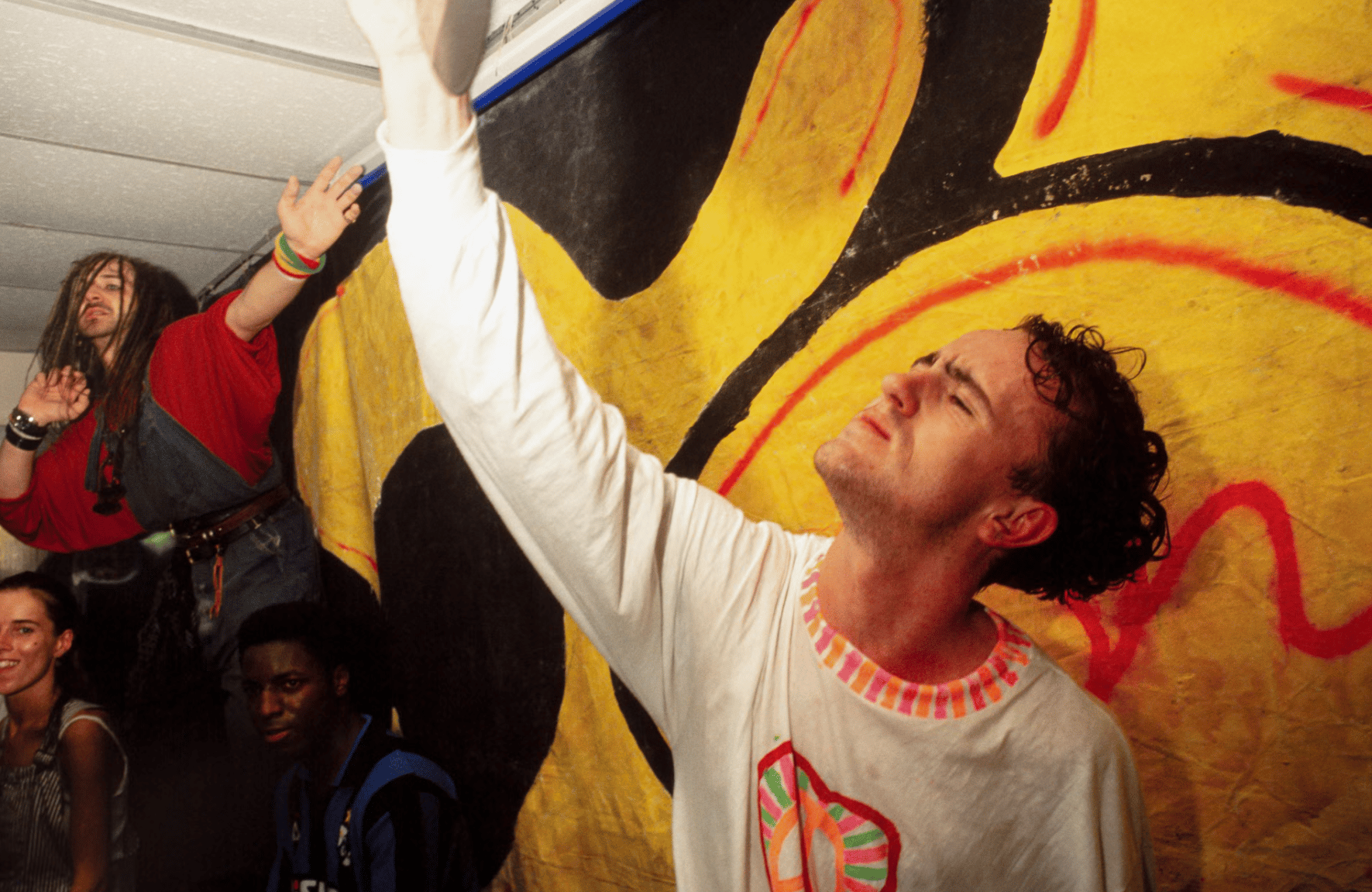
In the summer of 1987, London DJ Danny Rampling went to Ibiza for a friend’s birthday and came home with an idea for a party.
At an open air club called Amnesia, Rampling and his friends took ecstasy. Behind the decks, DJ Alfredo mixed Chicago house with pop records and film scores. What stayed with Rampling was the sight of people who would’ve gone to different clubs back home dancing together under the same sky. He wanted to see if he could get Londoners to do the same.5
Danny and his wife, Jenni, found a basement gym in South London. It held about 300 people, and the owners would let them stay until five. They called their club Shoom.
Danny remembered how they transformed the room.
“We filled the room with apple and cherry flavoured smoke and decorated it with painted banners: smiley face logos and slogans. It was a free state of hedonism.”5
The room shaped how people dressed. In a hot basement where people danced until five, loose T-shirts and baggy dungarees made sense.
Pete Heller, who later became Shoom’s warm-up DJ, first came along with his sister. He was used to London clubs where people put considerable effort into looking cool. Here, suburban kids danced beside pop stars and strangers hugged. Regulars brought each other gifts.
Danny remembered the end of each night especially well.
“People would leave very blissed out and I’d go to the front door and say goodbye to everyone.”5
Despite the name, the drug most closely associated with the acid house scene was MDMA, or ecstasy.
“They kind of went hand in hand and it was a very positive, profound experience for a lot of people,” Danny said of the music and the drug. “But for me, primarily, it was about the music.”5
Heller remembered LSD circulating at those early nights too.
“You did feel like you were part of this new hippy revolution.”5
In spring 1988, the British fanzine Boy’s Own (‘The only fanzine that gets right on one matey’) made an early attempt to put the feeling of ecstasy into words:
‘It takes you up and gives you a feeling of freedom. You know what you’re doing, you just feel more confident of love. People tend to take the drug and dance the night away.”6
Soon the smiley face from Shoom’s walls was showing up across Britain. Shoom had “crystalised the ‘luvved up’ acid house formula,” as writer Caspar Melville put it.7
“Within a couple of years, every town had its own house music club and the baggy look came to define youth culture,” Heller recalled.5
By June 1989, an estimated 11,000 people were dancing at a single rave at White Waltham airfield. Britain came to remember those summers as the Second Summer of Love.
3. The Freedom to Party
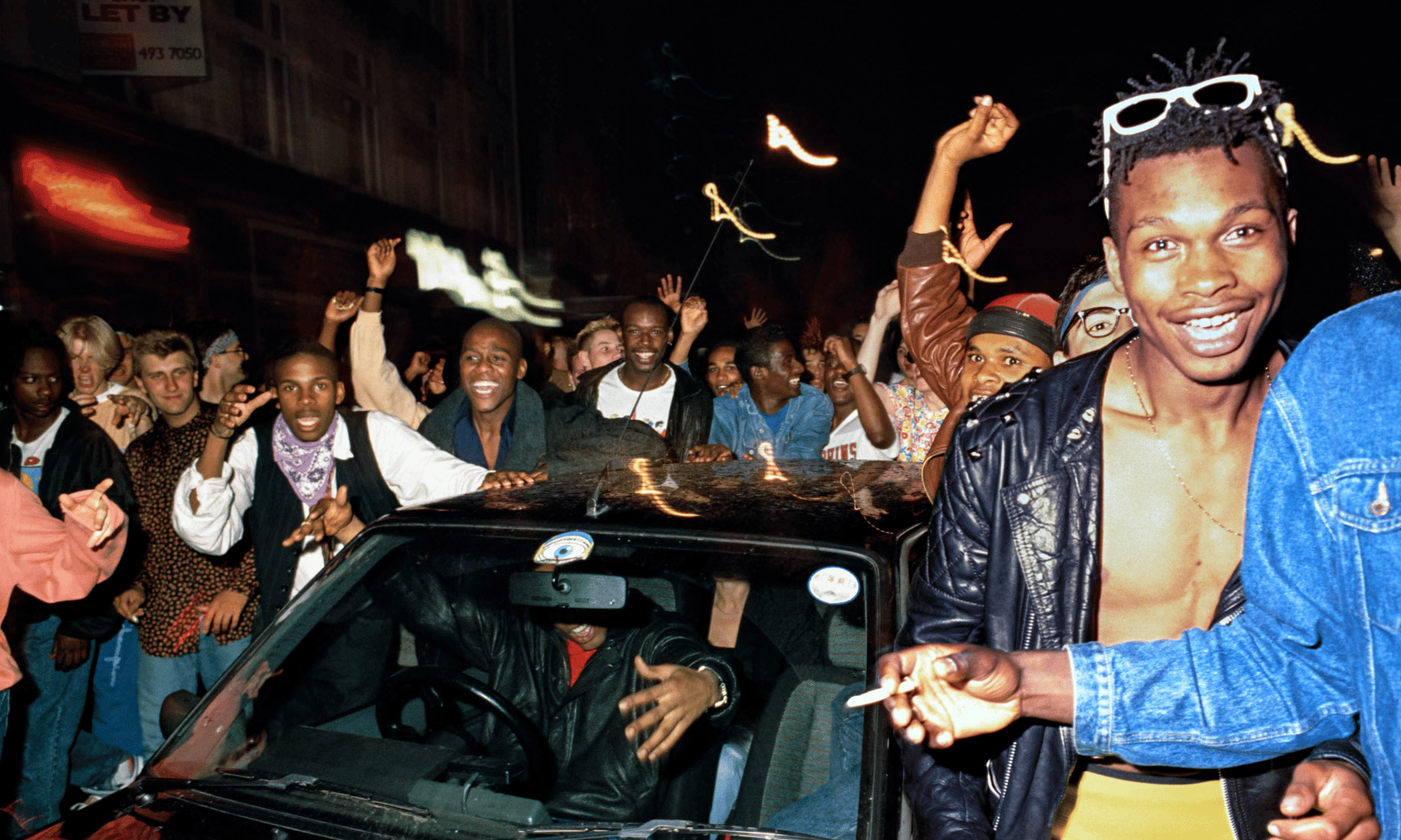
Acid house was Britain’s biggest youth revolution since the ’60s, but the people who built it had little time to enjoy it on their own terms before promoters cashed in and police began shutting down the parties.
For a little while, acid house had felt like a well kept secret.
“It was so new, and so different to anything you had experienced,” explains Paul Roberts from K-Klass. “You wanted to tell a couple of close friends about it and let them into this secret world, but apart from that you wanted to keep it secret and special.”8
In hindsight, many of those early devotees recognized how idealistic they’d been to think they could keep the scene to themselves.
“You’re talking about a trajectory of about 12-16 weeks from being something only a handful of people knew about, to being on the front page of The Sun,” recalled Cymon Eckel of Boy’s Own.
What Eckel and his friends hoped to preserve was the atmosphere they’d found on those early dance floors.
“I think we felt the honeymoon period was over. We weren’t trying to protect the emotion or the idea of acid house. We were just trying to protect the great parties for great people.”
The tabloid interest just poured fuel on acid house’s bonfire. Soon, promoters were looking to cash in on the growing interest.
In August 1988, a young promoter named Tony Colston-Hayter threw a rave at Wembley Studios and invited National TV news crews to film it. He called the party Apocalypse Now. To some of the scene’s early devotees, the name seemed fitting. They’d spent months trying to protect something that felt pure, and here was a promoter turning it into a spectacle for the cameras.
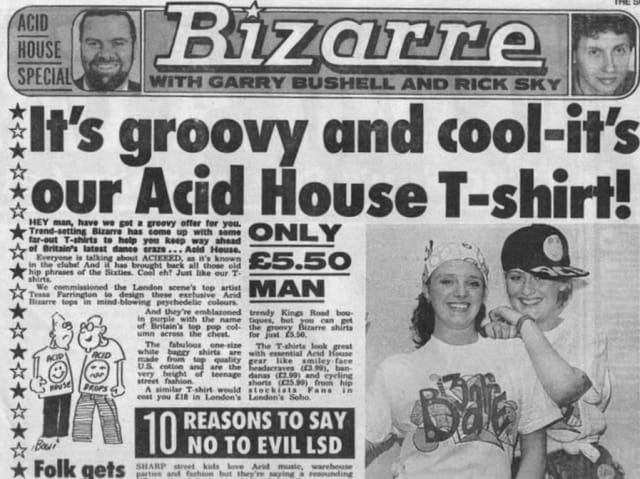
On October 12, the British tabloid The Sun offered its readers an acid house T-shirt for £5.50. A week later, the same paper ran the headline “Evil of Ecstasy.”
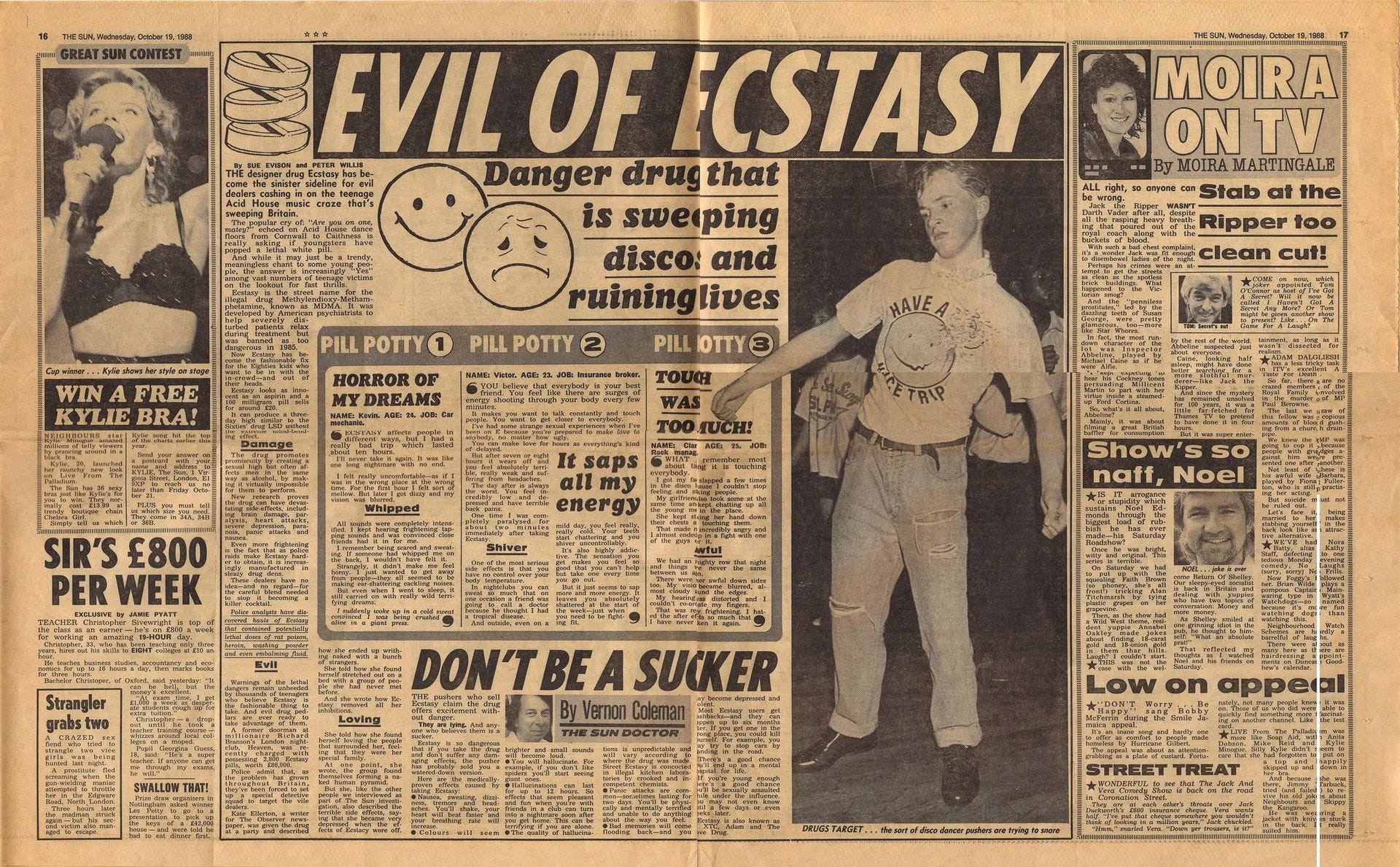
As the tabloids turned against acid house, police began trying to shut down the parties.
For young people who already felt like outsiders in Thatcher’s Britain, the backlash only added to the appeal. Their prime minister had declared there was “no such thing as society.” On the dance floor, they found a movement that felt genuinely countercultural.
When police set up the Pay Party Unit to shut down raves, a movement built around the pleasure of dancing together became political almost by default. Organizers kept locations secret until the last minute, and dancers followed recorded directions to the party. Even getting to the dance floor became a game of cat and mouse with the police.
By late 1989, the crackdown had reached Parliament. Conservative MP Graham Bright introduced a bill aimed at the booming trade in unlicensed raves. The Entertainments (Increased Penalties) Act became law in July 1990. Organizers who put on a party without the required license could now face a £20,000 fine, six months in prison, or both.
The crackdown cut those early parties short, but their influence still echoes across dance floors today.
Quotes:
“There is no powerful faction in our divided world committed to upholding the glories of the feast and dance.”
— Barbara Ehrenreich
“Say, when dancing, you don’t aim at a particular spot in the room; that’s where you should arrive. The whole point of the dancing is the dance.”
— Alan Watts
Trip Thought
A shower thought, but for psychedelics
People have used song and dance for centuries to get out of their heads and into their bodies. Part of what made acid house so powerful was how naturally ecstasy fit into that ritual of finding joy together.
As psychedelics become more widely used in medicine, I hope we remember how much it can mean to dance with other people and feel part of something. That belongs in the future of psychedelics, too.
Community Bulletin
🎬 Help finish A Trip to Transformation. Filmmaker Xavier Rousset’s conversations with his mother are at the heart of this documentary about who gets access to psilocybin. The film follows him through Australia, the U.S., and the Netherlands, and the team is raising funds to finish it. Watch the trailer or chip in.
🧘 Meditation and the Science of Perception. On December 6, meditation researcher Shamil Chandaria is hosting an online guided meditation and discussion about how the mind constructs experience. There’s a live Q&A, and everyone who registers gets the recording. See the event.
🕯️Candles: Psychedelic Candle Co. makes candles designed to accompany psychedelic journeys, using scent as a way to ground the experience and evoke it again afterward. Use code ARCHIVES20 for 20% off. Check them out here
Thanks for reading!
If something resonated with you, or if you have thoughts, questions, or ideas for future editions, I’d love to hear from you.
Just reply to this email. I read every response, and your feedback helps shape where this project goes next.
See you next week!
In psychedelic companionship,
- Kyle Sharp
Sources:
Make psychedelics fun again