

Welcome to The Weekly Archive, a short trip through psychedelic history.
The modern psychedelic movement owes much to Indigenous traditions of healing and spirituality, yet their contributions are often overlooked.
This week, we’re exploring the Indigenous roots of psychedelics.
Here are 3 artifacts, 2 quotes, and 1 trip thought for the journey.
In partnership with

Most meditation apps make you choose between thousands of options, which leads to Netflix-style decision paralysis.
The Way gives you just one path. There are no decisions needed. Just a sequential, lifelong, step-by-step path that gradually builds up your practice.
The Way is entirely taught by one teacher, beloved Zen Master Henry Shukman. It replicates an ancient form of meditation training: one teacher, one system, one path — but in an accessible way.
You can try The Way free for 30 days below.
Artifacts
1. Alfred Smith and the Peyote Supreme Court Case

In 1984, a Native American man was fired from his job for practicing his religion. What followed was a six-year legal battle that reached the U.S. Supreme Court and sparked a national movement for religious freedom.
The man was Alfred Smith, a Klamath Indian who had overcome alcoholism and devoted his career to helping others recover from addiction.1
Smith’s struggles began long before his battle with alcohol.
At seven years old, he was taken from his family on the Klamath reservation and sent to a series of government-run boarding schools, where he was forbidden from speaking his native language or practicing his people’s traditions.
It wasn’t until his mid-50s that Smith began reconnecting with his Indigenous heritage, finding spiritual meaning in the traditions he had been forced to abandon as a child.
“I was spiritually unbalanced, I was starving. Now my spirit’s so happy,” he recalled.1
Central to his newfound faith was peyote, a small cactus containing the psychedelic compound mescaline, revered by the Native American Church as a sacred medicine.
But in 1984, Smith’s religious practice cost him his job.
His employer, an Oregon rehabilitation center, prohibited employees from using illegal drugs. When Smith consumed peyote during a religious ceremony, he was fired.
Oregon then denied his unemployment benefits, ruling that his peyote use constituted workplace misconduct.
For Smith, the decision reopened old wounds.
“Is this going to continue on? Or am I going to put a stop to it, finally, and say: ‘You can’t tell me that I can’t go to religious ceremonies.”1
Smith fought back. After six years of litigation, the case reached the U.S. Supreme Court, which ruled against him on April 17, 1990, in Employment Division v. Smith.
The Court held that generally applicable drug laws could be enforced even when they burdened sincere religious practices, a decision with implications for religious freedom across America.
The ruling ignited a national movement.
On September 29, 1990, Ho-Chunk spiritual leader Reuben Snake stood outside the U.S. Capitol and condemned the decision in an electrifying speech titled Native American Worship With Peyote Is Not Drug Abuse:
“We don’t have a peyote abuse problem in this nation. Yet the widespread fear, bordering on panic, about the tragedy of drug abuse has clouded the minds of the justices. In the name of the war on drugs, our use of our holy medicine is restricted.”2
Native American leaders and religious freedom advocates mobilized, demanding federal protections for ceremonial peyote use.
Four years later, their efforts succeeded.
On October 6, 1994, President Bill Clinton signed amendments to the American Indian Religious Freedom Act, protecting traditional ceremonial peyote use by members of federally recognized tribes.
It was a landmark victory for Indigenous religious freedom, but the fact that this battle was necessary reveals something troubling.
For generations, Indigenous communities had preserved sacred traditions around peyote, only to see their medicine swept into the War on Drugs and treated as a threat to society.
Perhaps the deepest irony is that Smith, a recovering alcoholic who had dedicated his life to helping others overcome addiction, was punished for practicing a religion that helped him heal.
And this is hardly ancient history.
Today, as scientists rediscover the therapeutic potential of psychedelics, Indigenous communities are still fighting for recognition, access to sacred medicines, and respect for their traditions.
Smith’s story raises a question that remains painfully relevant: Who gets to decide what counts as a sacred medicine, and what counts as a dangerous drug?
2. The Mushroom Poetry of María Sabina
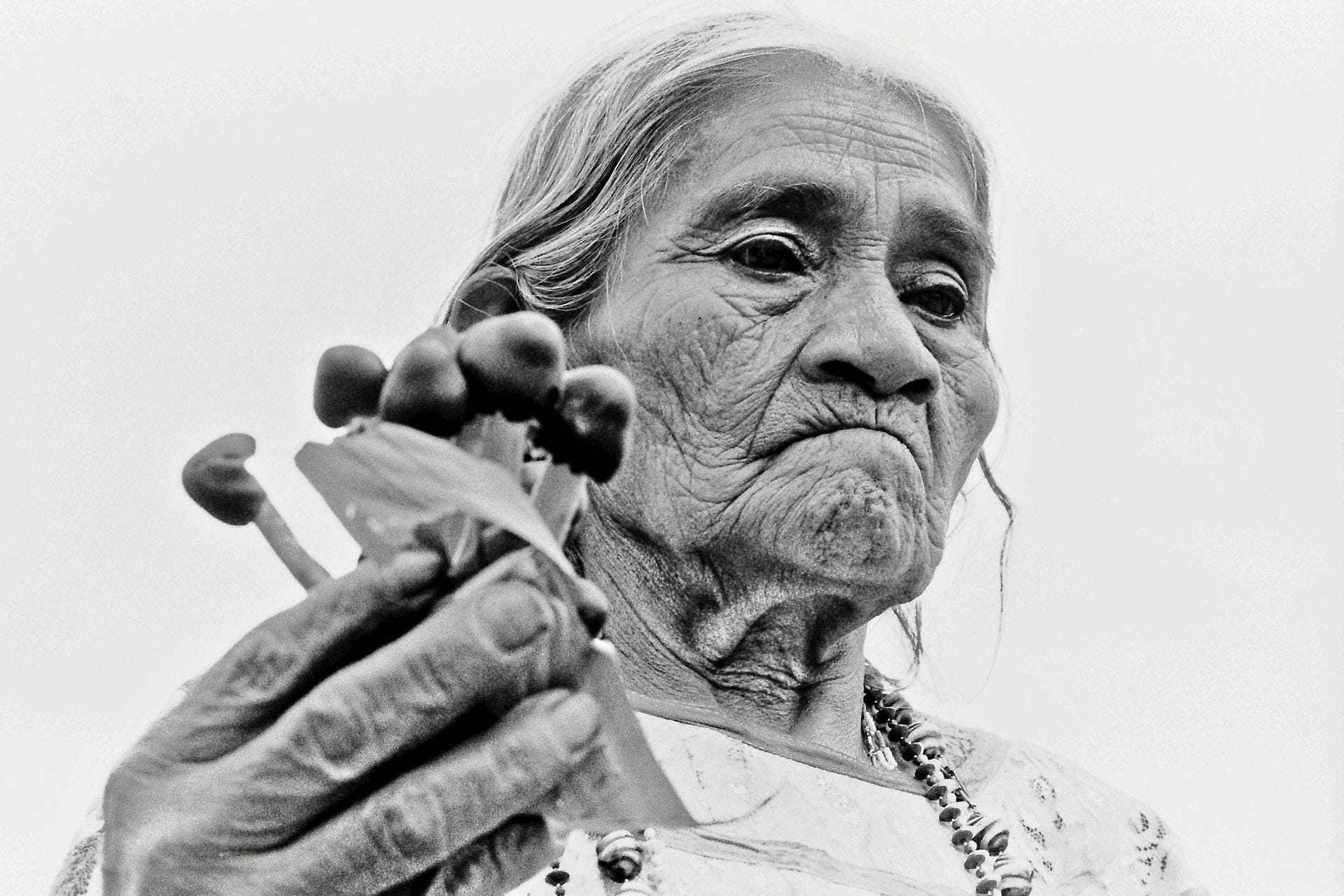
María Sabina was, in the words of the Mexican novelist Homero Aridjis, “the greatest visionary poet in twentieth-century Latin America.”3
Yet Sabina never considered herself a poet in the conventional sense. She understood herself as a healer, whose words came from the sacred mushrooms she served.
Born into the Mazatec village of Huautla de Jiménez, in the mountains of Oaxaca, Mexico, Sabina practiced an ancient healing tradition through veladas – nighttime ceremonies involving Psilocybe mushrooms, prayer, and song.
Her poetry was always spoken or sung, and was deeply rooted in the spiritual traditions of her indigenous community.4
In Mazatec cosmology, the natural world is alive with spiritual presence. Mountains, forests, clouds, and springs are inhabited by beings with whom humans can communicate. Sacred mushrooms belong to this living landscape, offering access to knowledge, ancestors, and spiritual guardians.
Sabina called the mushrooms “niños santos,” or saint children, and believed they spoke through her.
“Language belongs to the saint children,” she explained. “They speak and I have the power to translate.”3
In July 1956, ethnomycologist R. Gordon Wasson recorded one of Sabina’s all-night veladas. Her poetry was later transcribed and translated into English.
In one passage, she sings:
“I am a woman who looks into the insides of things, says
I am a woman who investigates, says
I am a woman wise in medicine, says
I am a mother woman, says”3
The repeated “I am” establishes her authority as a healer. But the curious word “says” reveals how Sabina was attributing each message to the mushrooms.
There’s a striking humility in this perspective. Despite healing countless people and earning international acclaim for her poetry, she understood herself as simply a vessel for wisdom that came from beyond her.
Elsewhere, she sings:
“I am the sacred eagle woman, says
I am the lady who swims, says
Because I can swim in the immense
Because I can swim in all forms”3
Her language moves freely between human identity, nature, and the spiritual cosmos. These extraordinary visions served a deeply practical purpose, helping those who came to her seeking healing.
Sadly, Sabina paid a tremendous price for sharing her tradition with the outside world. After Wasson’s accounts attracted Western attention, outsiders flooded her village seeking psychedelic experiences. She faced hostility from her community, her home was burned, and she spent her final years in poverty.
Still, her recorded songs preserve an extraordinary expression of Mazatec spiritual knowledge.
As modern psychedelic culture increasingly celebrates charismatic healers, spiritual guides, and scientific breakthroughs, Sabina’s poetry offers a valuable perspective.
Her understanding of healing called for humility before the medicine, respect for the natural world, and recognition that the healer was part of a relationship much larger than themselves.
3. The Ayahuasca Visions of Pablo Amaringo
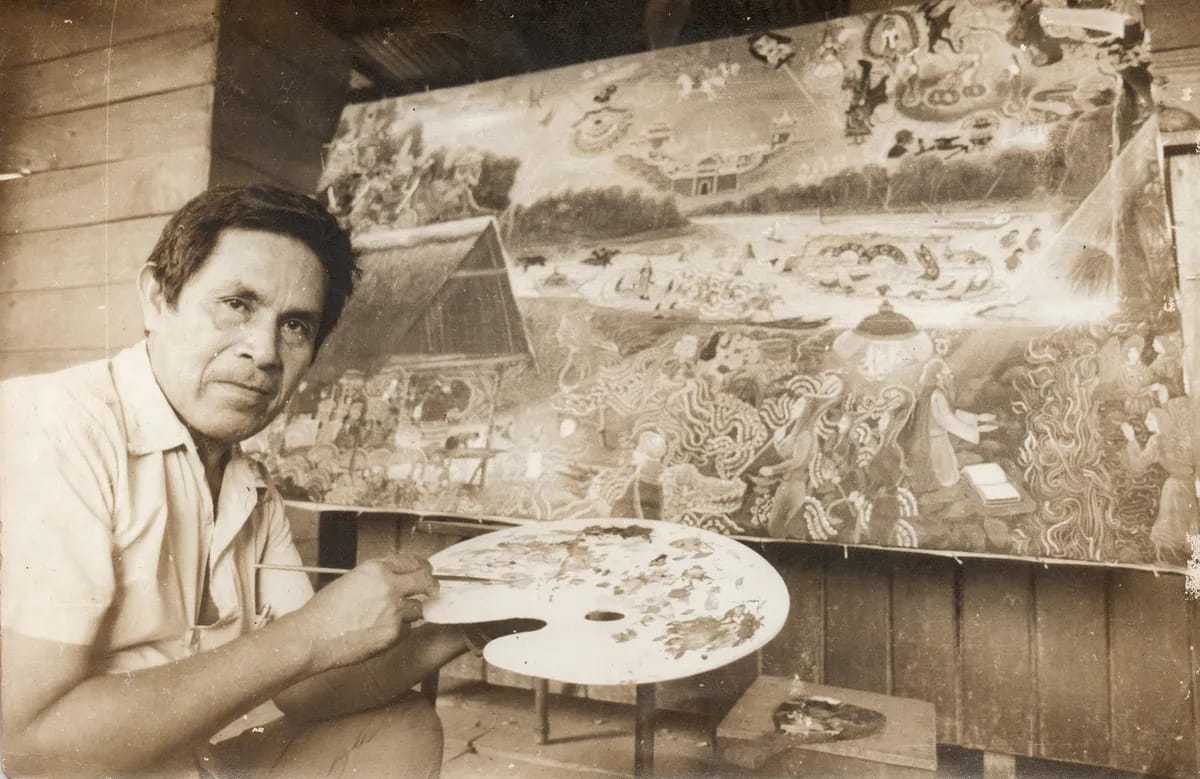
What if you could paint a psychedelic vision decades after experiencing it, down to its smallest details?
That was the extraordinary gift of Pablo Amaringo, a Peruvian Amazonian healer turned visionary artist whose paintings helped introduce the spiritual world of ayahuasca to an international audience.
Amaringo was said to possess a remarkable, almost photographic memory. His elaborate paintings drew from visions he experienced firsthand, sometimes many years earlier.5
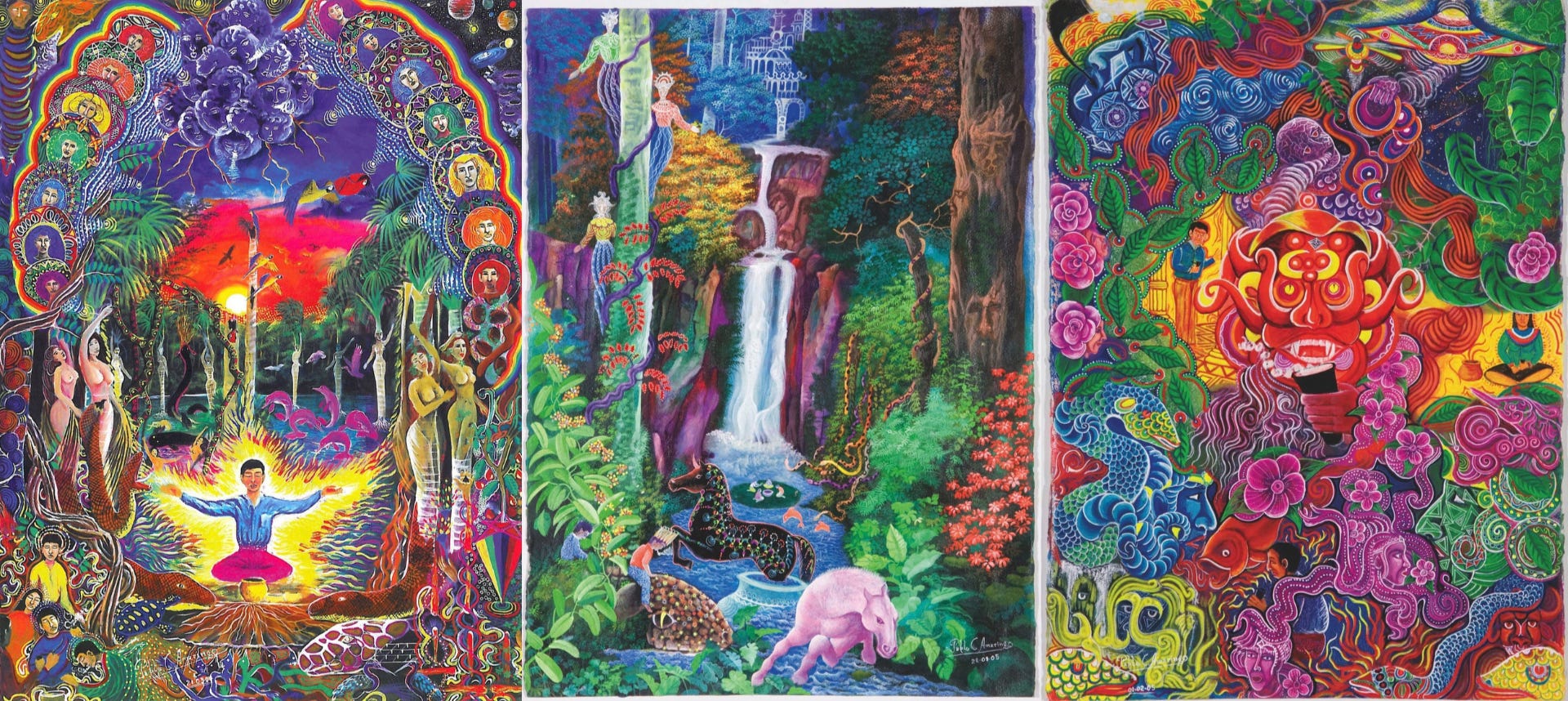
Before becoming an internationally celebrated artist, Amaringo was a vegetalista, an Amazonian healer rooted in Indigenous knowledge of ayahuasca and other medicinal plants.5
He practiced this medicine for years before retiring from healing in 1977. In 1985, anthropologist Luis Eduardo Luna encouraged Amaringo to paint the visions he still remembered from his ayahuasca experiences.
The results were extraordinary.
His paintings became intricate maps of an invisible universe, overflowing with serpents, spirits, celestial architecture, and the astonishing biodiversity of the Amazon.
One of his most remarkable works is Misterio Profundo, or Profound Mystery.
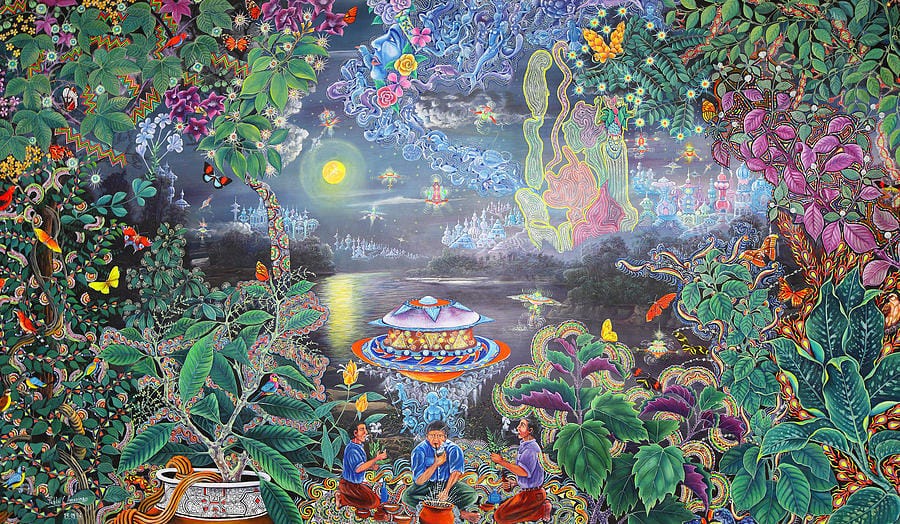
Amaringo explained its meaning:
“This picture embraces all the wisdom and all the plants used by a vegetalista. Without the vegetal we would not be able to discover hidden knowledge of the earth or the spiritual realms beyond.
The celestial cities, palaces and temples beyond the river are not usually visible; however in an ayahuasca vision we are gifted with the ability to see them. In these esoteric schools and temples, the ancient sages and shamans learned of the misterio profundo: the sacred mystery of the plants. Plants have compassion for all life and teach us how to preserve our health and combat disease.”6
The painting captures a central belief of vegetalismo: that plants are teachers, and that ayahuasca can reveal forms of knowledge ordinarily inaccessible to human perception.
Reflecting on what his own visions had taught him, Amaringo explained:
“My visions helped me understand the value of human beings, animals, the plants themselves, and many other things. The plants taught me the function they play in life, and the holistic meaning of all life. We all should give special attention and deference to Mother Nature. She deserves our love.”7
Amaringo’s paintings offer a rare window into an Amazonian worldview in which plants are respected as sources of wisdom and healing.
As ayahuasca spreads around the world, Amaringo’s paintings offer a reminder of what can get lost along the way. The visionary experience is only one part of a much larger tradition, rooted in generations of knowledge about medicinal plants, healing practices, and humanity’s relationship with the natural world.
Quotes
“Treat the earth well. It was not given to you by your parents, it was loaned to you by your children.”
— Crazy Horse
“The movement that made psychedelics a cultural force was not primarily a scientific movement. It was an aesthetic and cultural one. It was about perception, beauty, and transformation — about the conviction that how you experience reality shapes what you believe is possible — and that altering consciousness was a form of political and spiritual act.”
— Bia Labate
Trip Thought
A shower thought, but for psychedelics.
One thing I find fascinating about Indigenous psychedelic traditions is how differently they understand our relationship with the world compared to modern Western science.
In many of these traditions, nature is intelligent, plants are teachers, and spirits are part of reality.
There’s a troubling irony in the fact that Indigenous communities have faced generations of persecution for practicing these traditions, while the modern psychedelic movement now celebrates their medicines, often outside the cultural and spiritual contexts in which they developed.
I’m excited by what we might discover if modern science and Indigenous knowledge were brought into deeper conversation, with genuine respect for the communities that have preserved these traditions.
After all, these traditions invite us to reconsider some pretty fundamental assumptions about the nature of reality and our relationship with the natural world.
Community Bulletin
🧘Meditation App: The Way is a guided meditation program led by Zen master Henry Shukman, designed to help build a deeper, more consistent practice. Use this link for 30 days free.
🍄 Microdosing Summit: Our friends at The Microdosing Collective are hosting their inaugural Microdosing Summit on October 21, 2026, in Austin, Texas. Use code ARCHIVES for 10% off.
🎷 Mushroom Jazz: If you’re in Miami, our friends at Liquid Culture are hosting a Halloween party celebrating 35 years of Mushroom Jazz on October 31. Free tickets are available. Check it out here.
Thanks for reading!
If something resonated with you, or if you have thoughts, questions, or ideas for future editions, I’d love to hear from you.
Just reply to this email. I read every response, and your feedback helps shape where this project goes next.
See you next week!
In psychedelic companionship,
- Kyle Sharp
Sources: