

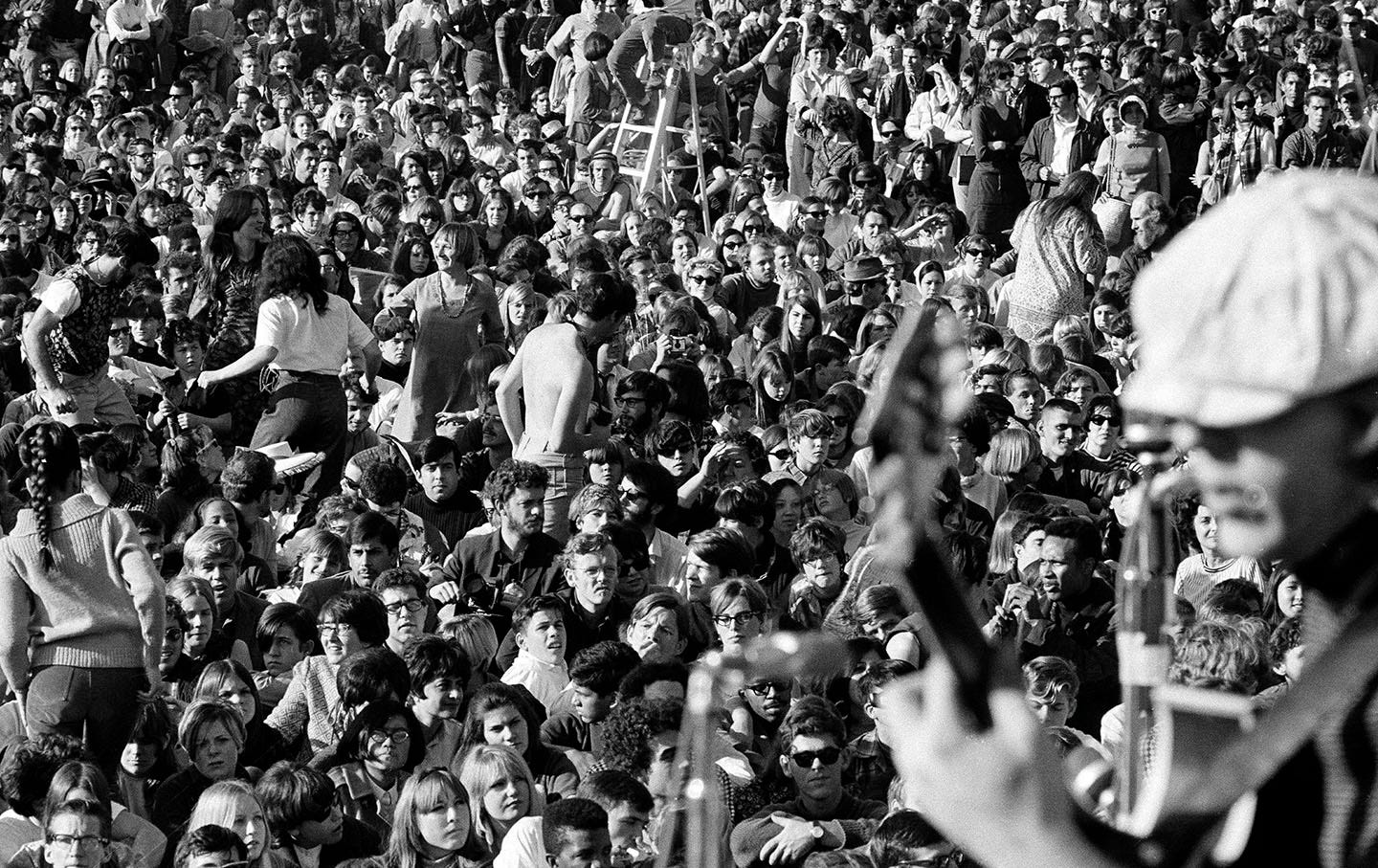
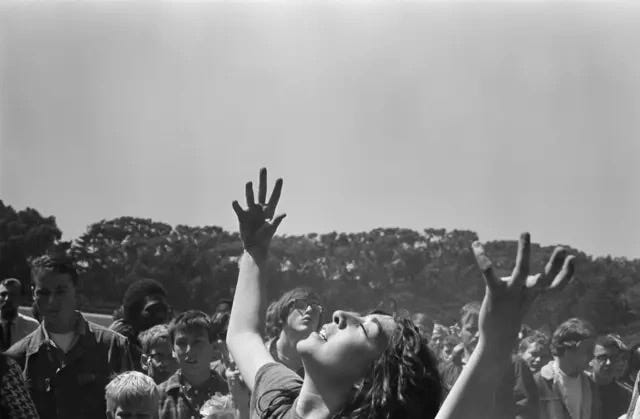
At 1 p.m. on January 14, 1967, on the Polo Fields of Golden Gate Park, the countercultural poet Gary Snyder lifted a conch shell and sounded it into the air.
Thirty thousand people — artists, activists, musicians, mystics — settled onto the grass. What followed was an unprecedented experiment in communal joy and the prelude to the Summer of Love.
It was called The Human Be-In: A Gathering of the Tribes.
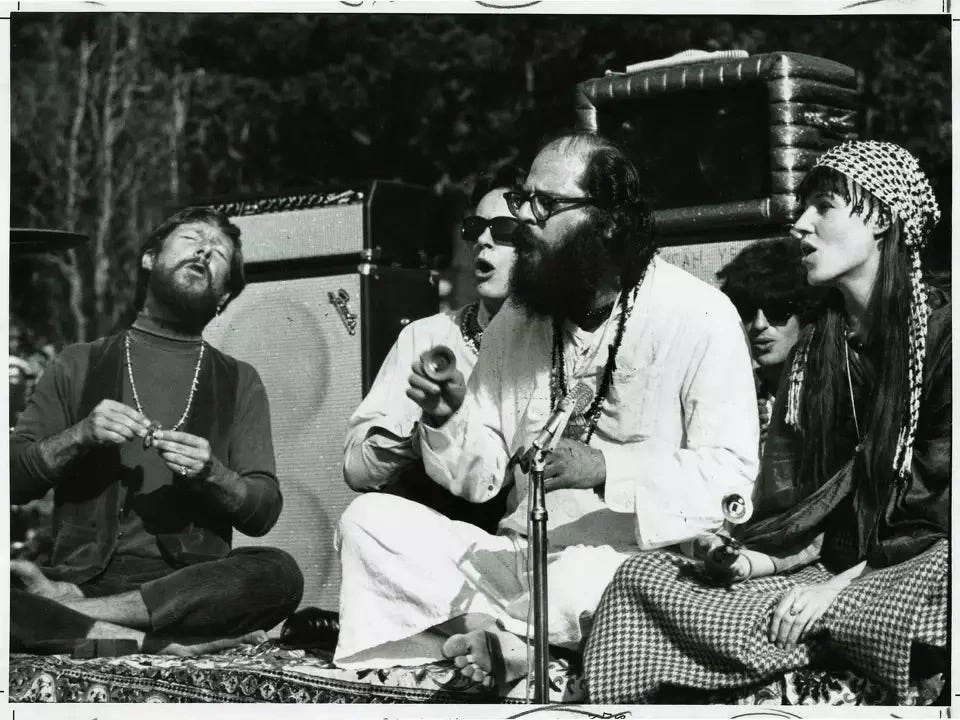
Author Helen Perry, who attended the event, described it this way:
“It was a religious rite in which nothing particular happened. And yet it was a day that marked the end of something and the beginning of something else. There was clearly a renewal of the spirit of man.”1
Writer Hunter S. Thompson sensed the revolutionary charge of the moment:
“There was a… sense of inevitable victory over the forces of Old and Evil. Not in any mean or military sense; we didn’t need that. Our energy would simply prevail. There was no point in fighting — on our side or theirs. We had all the momentum; we were riding the crest of a high and beautiful wave.”2
But that wave would eventually break. The promised victory never arrived.
Allen Ginsberg would later call the Human Be-In “the last purely idealistic hippie event.”3
On the anniversary of the Be-In, it’s worth asking:
What happened that day? What did it spark? And what deeper lesson does it offer now, as we try to shape the next chapter of the psychedelic counterculture?
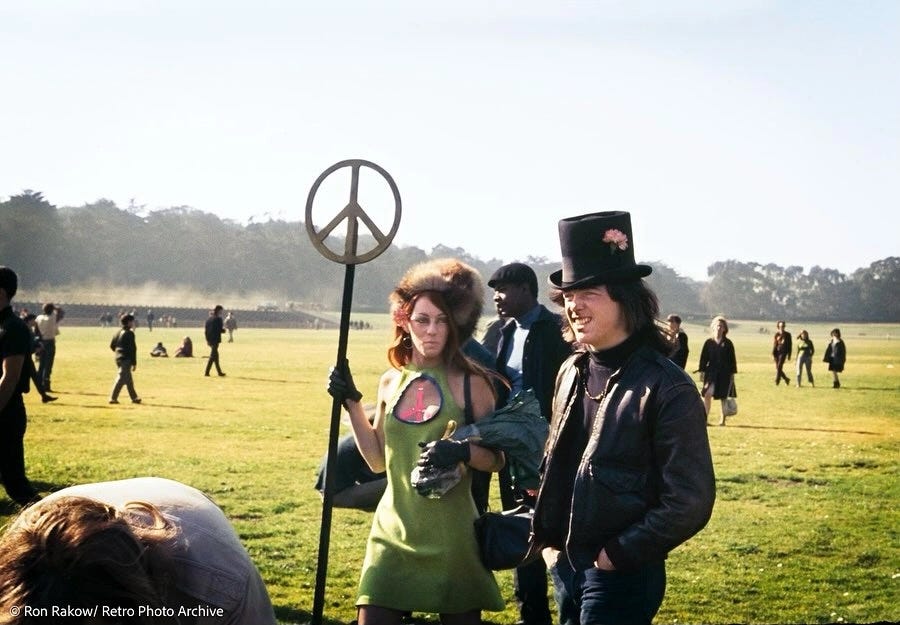
A Movement Comes Together
The Be-In was organized by artist Michael Bowen and poet Allen Cohen to mend a growing rift between two strands of the counterculture: the politically charged Berkeley New Left and the inward-looking, free-spirited world of Haight-Ashbury.
Cohen put it plainly:
“The anti-war and free speech movement in Berkeley thought the Hippies were too disengaged and spaced out… The Hippies thought the anti-war movement was doomed to endless confrontations with the establishment which would recoil with violence and fascism. We decided that to strengthen the youth culture, we had to bring the two poles together.”4
The event was framed as a reunion, uniting disparate currents with shared roots: “Beats, LSD, anti-materialist, idealistic, anarchistic, surreal, Dionysian and transcendental.”5
Michael Rossman, one of the Berkeley radicals, sensed the Be-In’s deeper potential:
“The Movement had expanded beyond all political bounds and recognition, and was on some verge — perhaps premature, but real enough — of carrying us through deep transformation into a new human culture.”5
The Be-In was also a response to the recent criminalization of LSD in California. Rather than stage a traditional protest, the organizers invited people to gather and just be, demonstrating the communal ethos that the law threatened.
And lastly, it was meant as a prototype — a glimpse of what a psychedelic society might look like: non-hierarchical, communal, playful, free.
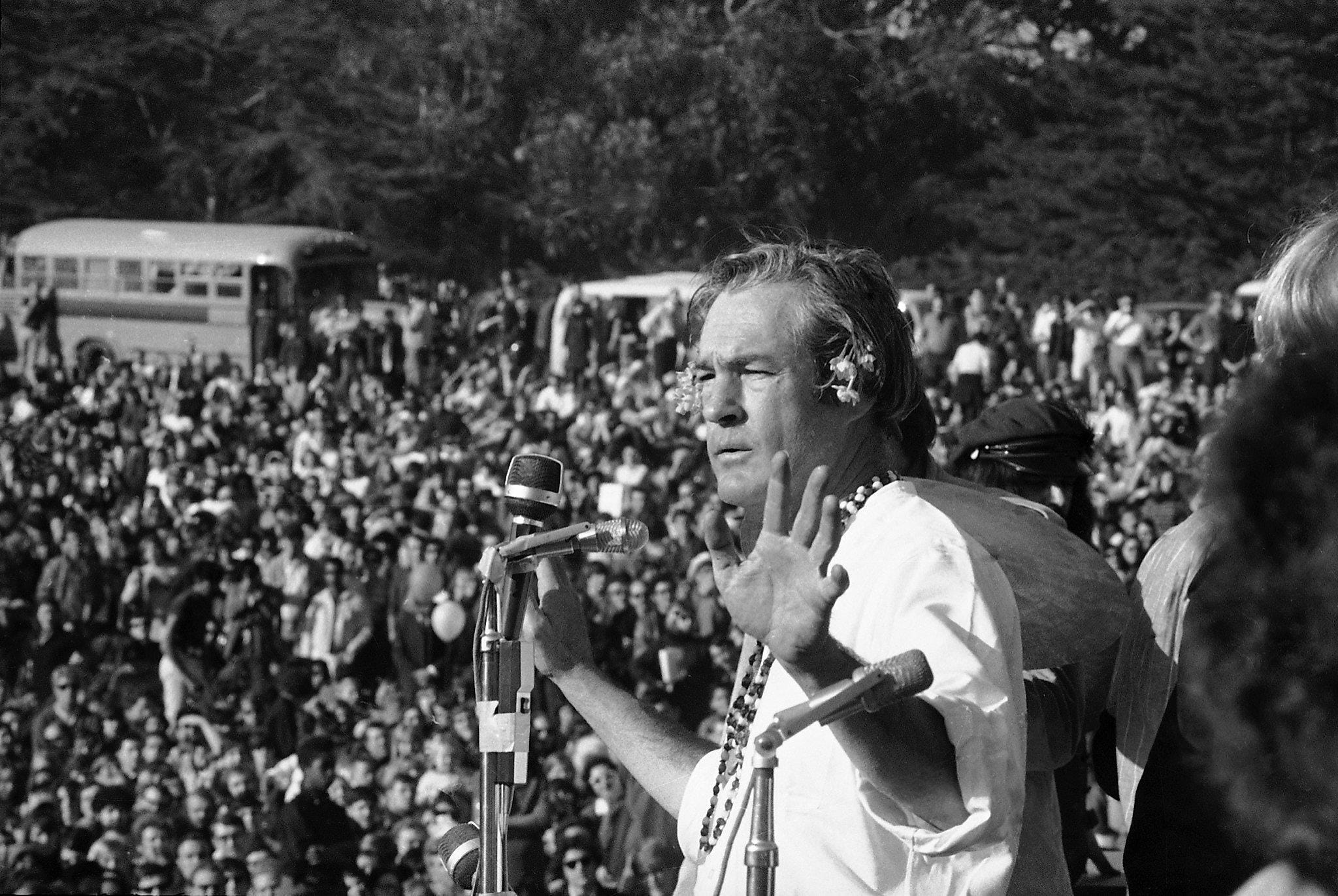
The Day Itself
Helen Perry captured the day’s improbable harmony:
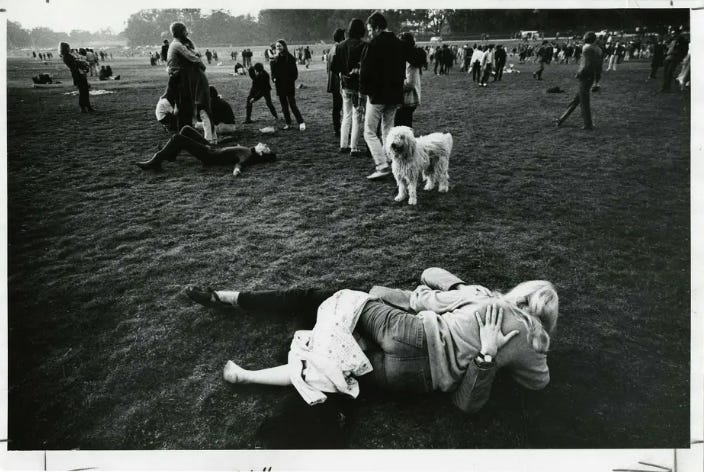
“It was a medieval scene, with banners flying, bright and uncommitted; the day was miraculous, as days can be in San Francisco at their best, and the world was new and clean and pastoral.
People sat on the grass with nothing to do, sometimes moving up near to the small platform where a poetry-reading might be going on, or where a band might be playing. There was no program; it was a happening… Dogs and children pranced around in blissful abandon, and I became aware of a phenomenon that still piques my curiosity: The dogs did not get into fights, and the children did not cry.”1
Poets Allen Ginsberg, Lawrence Ferlinghetti, Gary Snyder, Michael McClure, and Lenore Kandel read aloud.
Jerry Rubin spoke against the Vietnam War. Timothy Leary unveiled his now-iconic slogan: “Turn on, tune in, drop out.”
The Diggers — a Haight-Ashbury anarchist collective — handed out thousands of hits of White Lightning LSD and free turkey sandwiches. A parachutist landed on the field, inspiring one onlooker to remark it was “clearly a fairytale happening… Those of us who were there when it happened were children again.”1
Some believe the parachutist was Augustus Owsley Stanley III, the legendary LSD chemist.6
Jefferson Airplane, the Grateful Dead, and Quicksilver Messenger Service played. Two aspiring actors in attendance, Gerome Ragni and James Rado, would later channel the day into the musical Hair.
Despite the size of the crowd, the scene remained peaceful. “No fights. No drunks. No troubles,” journalist Ralph Gleason noted.5
As the sun set, Ginsberg urged everyone to “practice kitchen yoga”5 and clean the field. They did. The lawn was spotless.
Michael McClure later said:
“The Be-in was a blossom. It was a flower... It didn’t have all of its petals. There were worms in the rose. It was perfect in its imperfections. It was what it was — and there had never been anything like it before.”7
But beneath the beauty, a question was already forming.

After the Ecstasy, What?
If the Be-In was a flowering, it was also a provocation. It showed what was possible — thousands of strangers coexisting in playful, reverent harmony.
But it didn’t answer the harder question underneath: What do you do the next day?
Leary’s slogan — “Turn on, tune in, drop out” — became the movement’s anthem, and its biggest dilemma. While it captured the imagination, it also sowed confusion.
What did “drop out” mean? Was it liberation or abdication? Drop out from what, and into what?
These unanswered questions threatened to undercut the momentum sparked by the Be-In.
One month later, in February 1967, the San Francisco Oracle convened a summit to explore these questions more seriously. On Alan Watts’s houseboat in Sausalito, four countercultural elders gathered: Watts, Timothy Leary, Allen Ginsberg, and Gary Snyder.8
The “Houseboat Summit” marked a tonal shift from ecstatic to strategic. In many ways, it was the psychedelic movement’s first real moment of self-critique, and its initial attempt to translate the ecstasy of the Human Be-In into a blueprint for living.

Two Visions of the Exit
At the center of their conversation was a still-relevant tension: what does it mean to “drop out”?
Leary spoke in grand arcs. He believed psychedelics would trigger a planetary awakening. The details could come later. Just turn on, and the rest would follow.
But Ginsberg, Watts, and Snyder pushed back.
Ginsberg warned that the public feared a counterculture of “freak-out hippies goofing around and throwing bottles through windows.”9
Watts raised the pragmatic concern on people’s minds: “Where’s the bread going to come from if everybody drops out?”9
Snyder declared “it’s agreed we’re dropping out, and there are techniques to do it.”9
More grounded than rhetorical, he insisted that dropping out meant re-learning how to live — frugally, skillfully, and communally.
It meant “cutting down on your needs to an absolute minimum… Don’t be a bit fussy about how you work or what you do for a living” — strawberry picking, carpentry, labor. It meant patience: “sticking with a shitty job long enough to win the bread that you needed,” and mastering “all kinds of techniques of living really cheap.”9 It also meant studying local ecology, honoring Indigenous histories, and understanding the land beneath your feet.
Snyder had already dropped out years earlier. He argued it came down to endurance, self-sufficiency, and simplifying your life.
The Garden of Eden
The debate wasn’t about whether consciousness should change. All four men agreed on that.
Watts articulated the shared premise:
“The absolutely primary thing is that there be a change of consciousness in the individual: that he escape from the hallucination that he is a separate ego in an alien universe, and that we all come to realize, primarily, that each one of us is the whole works.”9
The real question was how to translate that insight into practice.
Leary envisioned psychedelics awakening the youth to “the garden of Eden, which is this planet.”
Snyder agreed but grounded the vision with a dose of realism: “That garden of Eden is full of old rubber tires and tin cans right now, you know?”
Vision alone wasn’t enough. The world was messy and demanded practical skills. Snyder put it succinctly:
“You just can’t go out and grow vegetables, man. You’ve got to learn how to do it.”9

No Boss, No Problem
Leadership posed another challenge.
Watts argued that the counterculture’s strength was its decentralization. “The genius of this kind of underground,” he said, “is that it has no leadership.”
Snyder pointed to tribal structures and Indigenous rites of passage as models for dropping into community rather than simply dropping out of society.
He emphasized extended families, shared labor, and periodic gatherings — ways of living that distribute responsibility rather than centralize it.
He also cited ritualized vision quests from tribes such as the Comanche and the Sioux, where individuals leave society, encounter their deeper selves, and return with clarity and responsibility.9
What if that were the model? Drop out not to abandon life, but to return to it with new eyes.

Integration, Not Escape
Perhaps the most important moment of the summit came when Watts challenged Leary on integration. It was an awesome, psychedelic battle of wits.
Watts recalled Leary once saying:
“You can’t stay high all the time, because when you finally come down from the high, you realize that the ordinary state of consciousness is one with the higher state.”9
Watts called this moment — the come down — “the critical moment of the whole experience.”
“This, to me, has been the most fantastic thing in all my LSD experiences… I suddenly realize that this everyday world around me is exactly the same thing as the world of the beatific vision.”9
So, he asked Leary, “how do you integrate that realization with the drop-out?”
Leary admitted that his slogan had flattened the truth. It needed nuance. His mission had required provocation, but now, maybe it needed direction. He conceded:
“I would agree to change the slogan to: “Drop Out, Turn On, Drop In.”9
Leary laid his cards on the table, acknowledging the challenge of leading a fledgling movement: “I’m competing with Marshall McLuhan. Everything I say is just a probe.”
Why This Still Matters
It’s easy to treat the Human Be-In as a relic — the last great gathering before commercialization, repression, and excess squashed the counterculture.
But that misses the point.
The Be-In was never the answer. It was an opening.
It showed that thousands of strangers could gather peacefully, without fear or hierarchy, and experience something real together. It showed that cultural transformation — even briefly — is possible.
It also exposed how quickly bliss gives rise to responsibility.
Today, in a new psychedelic renaissance, we face similar questions. We have better science, clearer language, and growing institutional support. But the core dilemma remains:
How do we integrate what psychedelics reveal? How do we reshape our lives — and our systems — in light of those truths?
The Houseboat Summit offered a compass:
Balance vision with discipline. Seek altered states, but return with altered practices. Learn to live simply. Share what you have. Gather. Reflect. Repeat.
The Human Be-In was a blossom, as McClure said — brief, imperfect, and alive. But blossoms point toward fruit.
Nearly sixty years later, the question it raised is still ours.
We’ve seen what’s possible. We’ve felt the opening.
Now, where do we go from here?
Perry, Helen. The Human Be-In. 1970.
Thompson, Hunter S. Fear and Loathing in Las Vegas: A Savage Journey to the Heart of the American Dream. 1971.
Goldberg, Danny. “All the Human Be-In Was Saying 50 Years Ago, Was Give Peace a Chance.” The Nation, 2017.
Cohen, Allen. “About the Human Be-In.” www.s91990482.onlinehome.us/allencohen/be-in.html
McNally, Dennis. The Last Great Dream: How Bohemians Became Hippies and Created the Sixties. 2025.
Stafford, Peter, and Bruce Eisner. “Psychedelic Pioneers—Who Turned On Whom?” High Times, October 1977.
McClure, Michael. Introduction to The Summer of Love: Haight-Ashbury at Its Highest, by Gene Anthony. 1980.
The San Francisco Oracle, vol. 1, no. 7. 1967.
Watts, Alan, Timothy Leary, Allen Ginsberg, and Gary Snyder. “The Houseboat Summit.” Organism.Earth, February 1967. Available at https://www.organism.earth/library/document/houseboat-summit
We had be-in/love ins every Sunday in Griffith Park in LA during this time frame. It wasn't exclusive to SF.
Great read! People say this movement was a failure, but the fact that I tuned in to it in the last decade and it completely changed my life and perspective shows it was just a seed being planted and the movement continues to grow as more minds interact with these idea and are influenced by them.