

Welcome to The Weekly Archive, a short trip through psychedelic history.
The psychedelic counterculture of the 1960s did not emerge in isolation.
This week, we’re exploring the cultural currents that prepared the ground for its experiments in consciousness and creativity.
Here are 3 artifacts, 2 quotes, and 1 trip thought for the journey.
Artifacts
1. Jack Kerouac’s On the Road, 1951
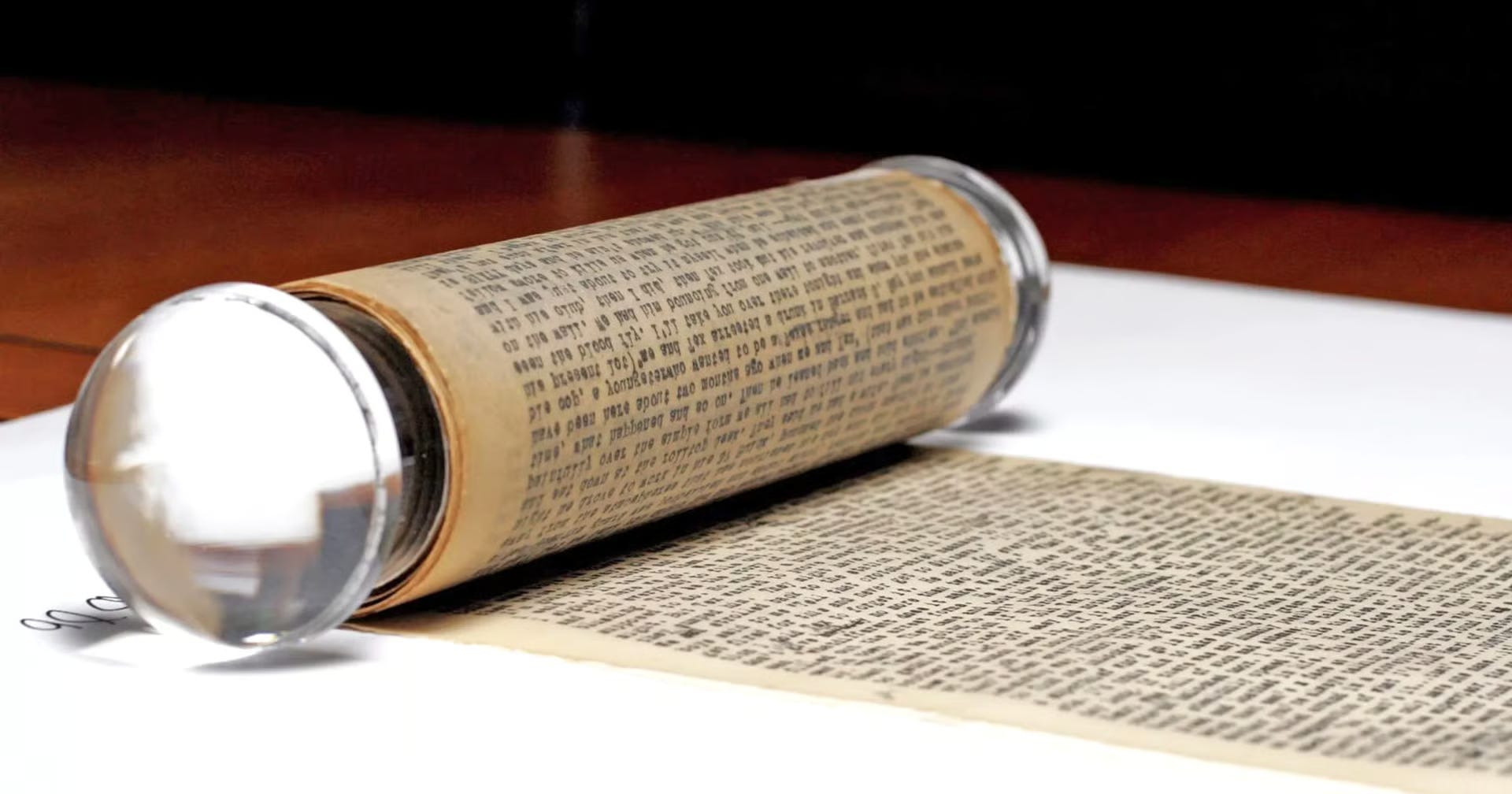
In April 1951, Jack Kerouac typed the first full draft of On the Road on a continuous roll of paper nearly 120 feet long.
He had taped sheets together so he could write without stopping to change pages. The resulting scroll embodied his ideal of “spontaneous prose,” a style meant to move like jazz: improvisational, rhythmic, and responsive to the moment.
On the Road was not a psychedelic text in the later sense. But it helped create the cultural conditions in which the psychedelic movement could flourish.
Published in 1957, the novel follows Sal Paradise, Kerouac’s fictional alter ego, and Dean Moriarty, based on his friend Neal Cassady, as they crisscross America in search of experience. They hitchhike, chase jazz, fall in love, sleep wherever they can, work when necessary, and repeatedly abandon stability for whatever might be waiting beyond the next horizon.
Kerouac captured their spirit in one of the novel’s most famous passages:
“The only people that interest me are the mad ones, the ones who are mad to live, mad to talk, mad to be saved, desirous of everything at the same time, the ones that never yawn or say a commonplace thing but burn, burn, burn like fabulous yellow roman candles exploding…”1
That desire for “everything at the same time” lies at the heart of On the Road. Sal and Dean were searching for an ecstatic intensity that ordinary American life seemed unable to provide.
Postwar America offered a fairly narrow script for a successful life: find stable work, settle down, start a family, and enjoy the comforts of an expanding middle class. Yet many of Kerouac’s generation had begun to suspect that faithfully following this script did not necessarily deliver the fulfillment it promised.
As Kerouac observed:
“This is the story of America. Everybody’s doing what they think they’re supposed to do.”1
Although On the Road contains no LSD, it helped popularize the idea that the life prescribed by mainstream society represented only a narrow range of human possibility. The hippie pilgrimages of the 1960s toward San Francisco, Mexico, India, and beyond carried that search into a new generation.
Kerouac was ultimately ambivalent about the hippies who followed him. Still, the connection between On the Road and the psychedelic counterculture is hard to miss. Neal Cassady (the muse for On the Road) would later become the driver of the Merry Pranksters’ psychedelic bus, carrying the Beat search for freedom directly into the acid era.
Jerry Garcia, one of the defining musicians of the psychedelic era, later acknowledged the connection:
“I can’t separate who I am now from what I got from Kerouac. I don’t know if I would ever have had the courage or the vision to do something outside with my life, or even suspected the possibilities existed, if it weren’t for Kerouac opening those doors.”2
Before the psychedelic generation dropped acid and went looking for another reality, Kerouac had already given them permission to get in the car and go looking for another life.
2. John Cage’s 4′33″, 1952
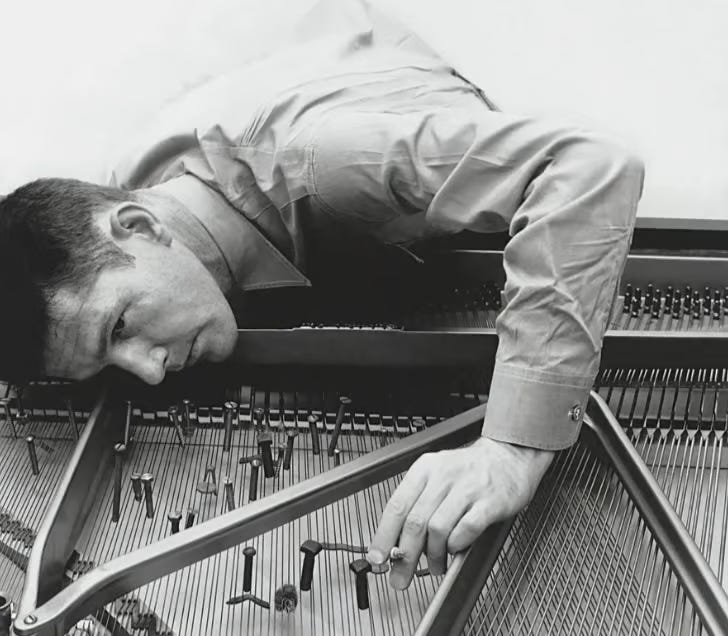
On August 29, 1952, David Tudor walked onto the stage at the Maverick Concert Hall in Woodstock, New York, sat down at the piano, and proceeded to play nothing for four minutes and thirty-three seconds.
Tudor was performing 4′33″, an experimental composition by composer John Cage. The piece had three movements, marked by the pianist simply opening and closing the lid of the piano.
It has been called the “silent piece,” but its purpose was to challenge the very notion of silence.
“There’s no such thing as silence,” Cage said, recalling the première. “You could hear the wind stirring outside during the first movement. During the second, raindrops began pattering the roof, and during the third people themselves made all kinds of interesting sounds as they talked or walked out.”3
Once the audience began paying attention, the surrounding world became the music.
This was the deeper provocation of 4′33″. Cage was challenging the assumption that music had to be deliberately composed, played on instruments, or even produced by a musician.
It was an admittedly bizarre piece, but 4′33″ was an invitation to perceive ordinary reality differently. The mute manifesto anticipated one of psychedelia’s central ideas: transformation does not necessarily require another world. It may begin by noticing this one more completely.
Cage had arrived at this idea partly through an experience in an anechoic chamber at Harvard, a room designed to absorb nearly all reflected sound. He entered expecting to hear nothing.
Instead, he heard two sounds: one high and one low. According to Cage, an engineer told him the high sound was his nervous system and the low one his blood circulating.4
Cage drew a radical conclusion: wherever we are, something is happening.
Before psychedelia made altered perception a mass cultural phenomenon, Cage was already asking a pretty psychedelic question: What if the ordinary world is only ordinary because we’ve stopped noticing it?
3. Allen Ginsberg’s Howl, 1956
Before the counterculture had rock concerts, it had poetry readings.
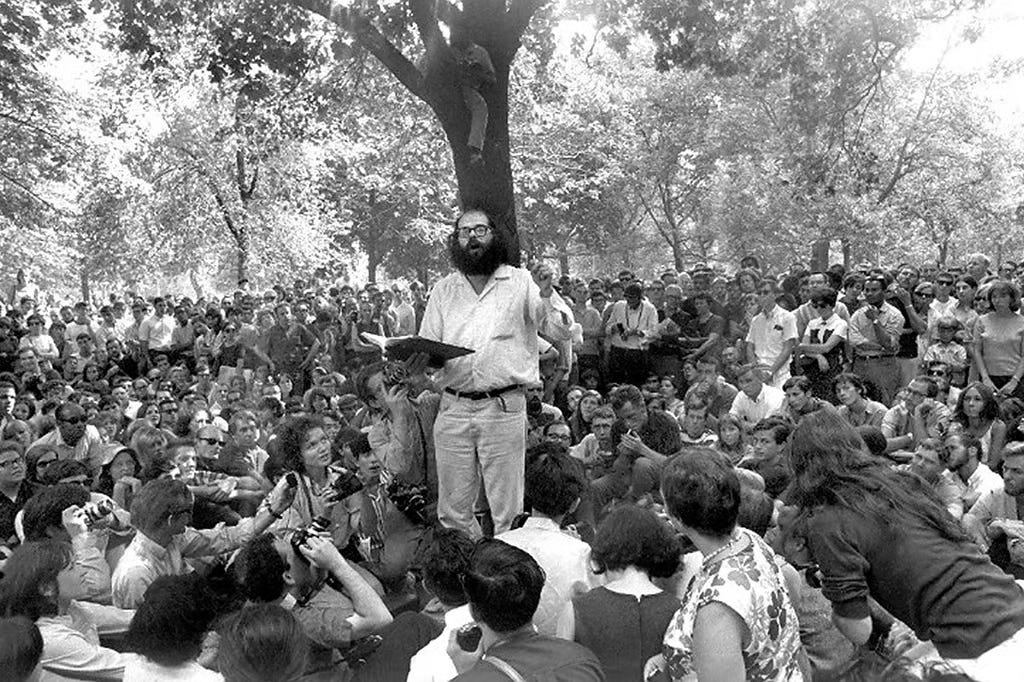
On October 7, 1955, Allen Ginsberg stood before a crowd at San Francisco’s Six Gallery and read “Howl” publicly for the first time.
He began with one of the most famous openings in American poetry:
“I saw the best minds of my generation destroyed by madness… angelheaded hipsters burning for the ancient heavenly connection to the starry dynamo in the machinery of night.”5
The poem unfolded in long, breath-driven lines filled with sex, drugs, and spiritual yearning. Ginsberg wrote about people whom respectable America preferred to keep out of sight and treated their experiences as worthy of poetry.
The audience responded accordingly.
Jack Kerouac sat near the stage shouting “Go!” as Ginsberg read.6 The room grew increasingly electric.
Poet Lawrence Ferlinghetti was in the crowd. He immediately recognized what had happened. Afterward, he sent Ginsberg a telegram echoing Ralph Waldo Emerson’s famous response to Walt Whitman: “I greet you at the beginning of a great career. When do I get the manuscript?”
Ferlinghetti’s company City Lights published Howl and Other Poems the following year as a small paperback.
Then the authorities got involved.
U.S. Customs seized 520 copies arriving from England. Police later arrested City Lights manager Shigeyoshi Murao for selling the book and charged Ferlinghetti with publishing obscene material.
The resulting trial turned an obscure Beat poem into a national argument over what Americans were allowed to say, print, and imagine.
In October 1957, Judge Clayton Horn ruled that Howl had “some redeeming social importance” and therefore could not be considered obscene.7 The decision became an important victory for literary freedom and helped clear space for the more confrontational culture that followed.
The psychedelic movement was still years away but Howl anticipated many of the ideas that would soon define it.
The poem rejected materialism and conformity. It explored drugs, sexual freedom, jazz, mysticism, madness, and altered states of consciousness. It treated outsiders and unconventional ways of experiencing the world as worthy of serious attention.
Ginsberg eventually became one of the great connective figures between the Beats and the psychedelic generation.
Twelve years after the Six Gallery reading, he sat alongside Timothy Leary, Gary Snyder, and other countercultural figures at the Human Be-In in Golden Gate Park, where some 30,000 people gathered for a day of music, poetry, and psychedelics.
Quotes
“I can't understand why people are frightened of new ideas. I'm frightened of the old ones.”
— John Cage
“The line between art and life should be kept as fluid, and perhaps indistinct, as possible.”
— Allan Kaprow
Trip Thought
A shower thought, but for psychedelics.
It often seems like history moves in spirals.
Each generation finds itself wrestling with ancient questions, carrying whatever the last generation managed to learn. We keep passing the torch forward, circling the same mysteries, hopefully a little higher each time.
As the psychedelic movement comes around again, what will we learn from the past and what will we discover for ourselves?
Community Bulletin
🎬 Documentary: Unbecoming, a new original documentary from Muse Storytelling, follows two people through a powerful 5-MeO-DMT protocol. The world premiere is Tuesday, September 22, and you can watch it live online. Learn more and join the premiere here.
🍄 Microdosing Summit: Our friends at The Microdosing Collective are hosting their inaugural Microdosing Summit on October 21, 2026, in Austin, Texas. Use code ARCHIVES for 10% off.
🕯️Candles: Psychedelic Candle Co. makes candles designed to accompany psychedelic journeys, using scent as a way to ground the experience and evoke it again afterward. Use code ARCHIVES20 for 20% off.
Thanks for reading!
If something resonated with you, or if you have thoughts, questions, or ideas for future editions, I’d love to hear from you.
Just reply to this email. I read every response, and your feedback helps shape where this project goes next.
See you next week!
In psychedelic companionship,
- Kyle Sharp