

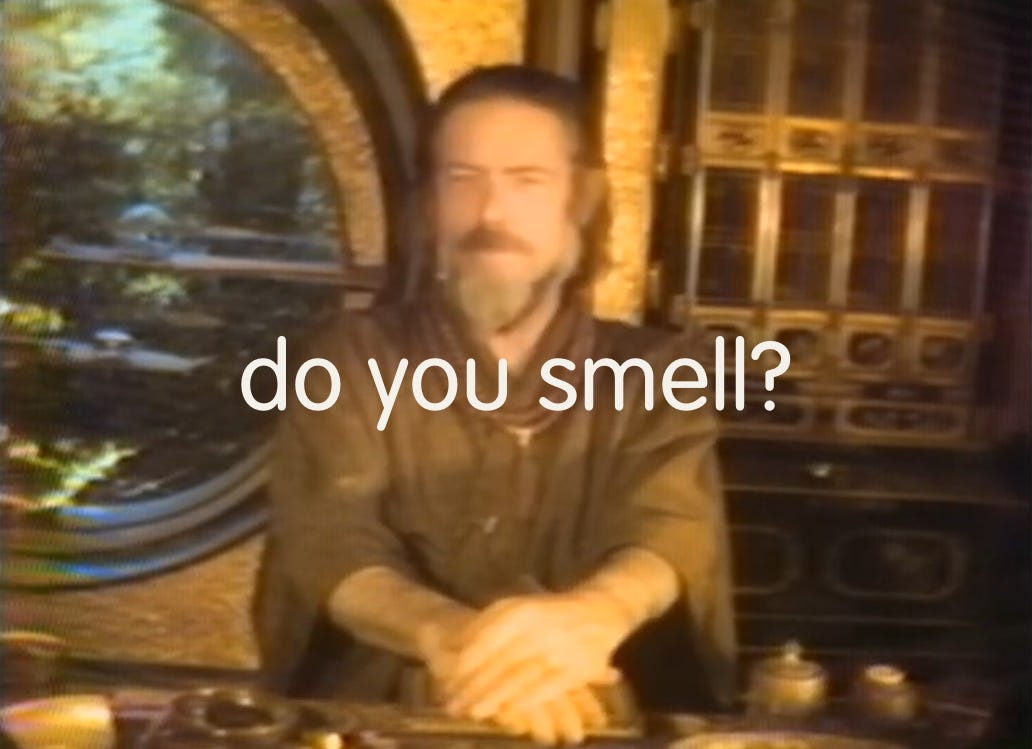
In 1972, Alan Watts sat before a Buddhist altar and delivered an iconic lecture with a delightfully odd title: Do You Smell?
The philosopher and comparative religion scholar demonstrated the use of incense and pointed out something peculiar about how we talk about spiritual life:
“When people talk about very deep things, they never talk about the sense of smell. They talk about touch, vision, taste, and hearing… We hear about the ‘vision of God.’ The prophets hear ‘the word of the Lord.’ The psalms say, ‘Oh taste and see how excellent the Lord is.’ But no one ever had the idea of smelling God—of having not just the beatific vision, but the beatific smell.”1
Despite its transformative power, Watts lamented, “the sense of smell is our repressed sense.”
Years earlier, Helen Keller noticed the same phenomenon:
“Smell is a potent wizard that transports us across a thousand miles and all the years we have lived… [And yet] for some inexplicable reason, the sense of smell does not hold the high position it deserves among its sisters. There is something of the fallen angel about it.”2
For thousands of years, scent has not only been powerful in its own right — it has also been used alongside psychedelic substances and spiritual practices to shape altered states of consciousness.
Yet in modern Western culture, both smell and psychedelics have been marginalized: one dismissed as primitive or decorative, the other feared as destabilizing or dangerous.
In this essay, we uncover the historical relationship between scent and altered states, explore why smell so powerfully shapes memory and emotion, and consider how scent can support psychedelic experiences and integration today.
The Repression of Smell—and Altered States
At the turn of the twentieth century, Sigmund Freud offered one explanation for why smell fell from philosophical grace.
He argued that olfaction was repressed because of its primal, sexual, and emotional power, which threatened the detachment and decorum that civilization depends on.3,4
Freud observed fragrance’s power intuitively, but neuroscience now helps explain it biologically. Smell is not just another sense — it’s an anomaly.
Every other sense routes through the thalamus — a kind of sensory mixing board that filters, prioritizes, and dampens information before it reaches conscious awareness. The thalamus is why you stop noticing the feel of your clothes or the hum of a room.5
Smell bypasses this system entirely.
Olfactory signals travel straight to the limbic system, the brain’s memory and emotional center. This means scents act directly on memory, mood, and meaning before the intellect can intervene.5
This unmediated power may be precisely why smell has been culturally sidelined. As Freud suggested, civilization requires that we mute forms of experience that are too immediate, too intimate, too capable of dissolving social restraint.3
Psychedelics produce a similar effect and have met a similar response. Throughout Western history, individuals who accessed altered states were tolerated at best and persecuted at worst. Watts described this dynamic bluntly:
“The Catholic Church in particular, and other churches in lesser ways, have ignored, excluded, or actively persecuted people that we call mystics — those who have had a change of consciousness which in effect induces the realization that you yourself… are a direct manifestation of the ultimate reality, or what Paul Tillich called ‘The Ground of Being,’ his decontaminated phrase for the word ‘God.’”6
Institutional religion, especially in Europe, excluded mystics because direct experience of the divine leaves little room for hierarchy or mediation.
Terence McKenna articulated the same tension in modern terms:
“Psychedelics are illegal not because a loving government is concerned that you may jump out of a third story window. Psychedelics are illegal because they dissolve opinion structures and culturally laid down models of behaviour and information processing. They open you up to the possibility that everything you know is wrong.”7
Smell and psychedelics share this dissolving quality. Both bypass the intellect and engage the body directly. Both loosen conceptual frameworks. Both make meaning visceral rather than theoretical.
When these two repressed forces are brought together, their impact is amplified.
For this reason, as we fight back against the war on psychedelics, it may also be time to dissent against the de-scenting of society.
Holy Smokes: Incense & Entheogens
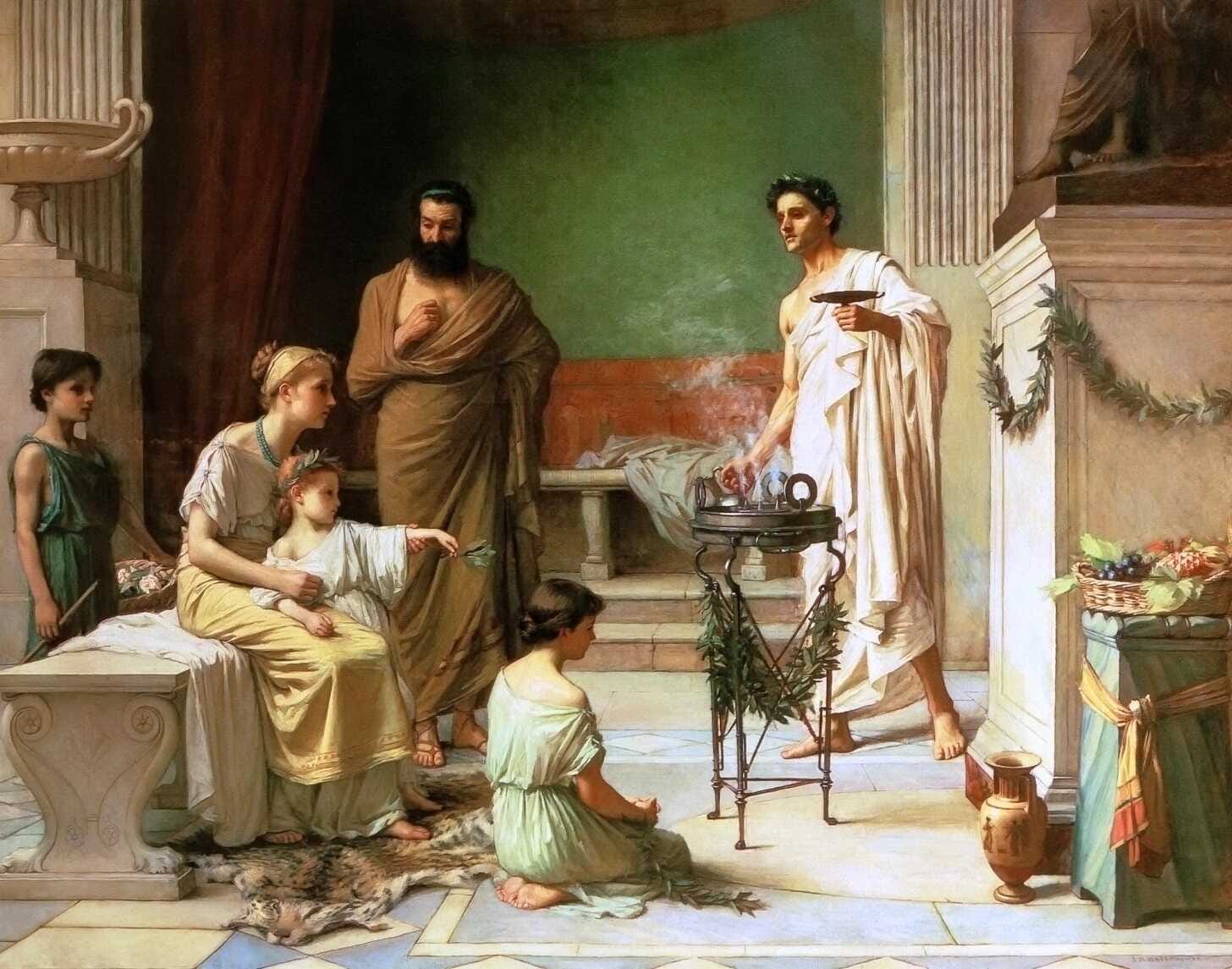
The use of scent alongside psychoactive substances is not a modern innovation. It is a recurring feature of religious, spiritual, and medicinal traditions across cultures.
Consider the Eleusinian Mysteries, which began around 1600 BCE and took place annually for nearly two thousand years. Initiates drank kykeon, a potion widely believed to have contained ergot — a psychoactive precursor to LSD.8 The Homeric Hymn to Demeter, which inspired the mythic structure of the Mysteries, speaks of “the stronghold of fragrant Eleusis.”8 Although the rituals were sworn to secrecy, scholars widely believe they involved incense — likely storax and frankincense — to purify the space and help shift consciousness.9
Frankincense itself, derived from Boswellia species, appears across Egyptian, Greek, Jewish, Christian, and Islamic ritual contexts. The ancient Greek philosopher Pythagoras was said to use frankincense to enable him to prophesy. Other Greek mystery traditions — including the Dionysian and Orphic cults — combined scent, music, fasting, and entheogens to induce altered states oriented toward transformation and rebirth.9
In these traditions, incense was not symbolic decoration. It was a functional element of altered-state technology. Ancient medical papyri refer to “magical smokes,” reflecting a period when medicine, religion, and psychology were not yet separate disciplines but overlapping ways of understanding consciousness.9
The prophet Muhammad prescribed incense for worship that included harmal and frankincense.9 Early Christian theologians such as St. Ephrem the Syrian described paradise in explicitly olfactory terms, calling it a “treasure of perfumes” and a “storehouse of scents.” For St. Ephrem, fragrance was not merely a metaphor — it was a way of knowing, a “non-cognitive yet revelatory” experience of the divine.9
Across cultures, scent has functioned as a bridge between perception and meaning, between the body and the sacred.
Modern Day: Follow Your Nose

Contemporary research is beginning to confirm what ancient traditions seemed to understand intuitively: scent and altered states are natural allies.
In Fragrance and Wellbeing (2013), Dr. Jennifer Peace Rhind described how scents contribute to quality of life:
“They can stabilise, enhance and modify our moods, decrease anxiety and tension, evoke autobiographical memories and give us a benchmark of our somatic selves, and aid us on a spiritual journey.
However, it is their complex relationship with our emotional world, their relationship with trance states, and their ability to bring about altered states of consciousness that is perhaps the real key to their role in enhancing wellbeing.”9
Rhind’s insight — that scent’s power lies in its relationship to altered states — sets the stage for its emerging role in psychedelic therapy.
In a 2024 review, psychiatrist Dr. Florian Birkmayer explored the synergistic potential of essential oils in psychedelic-assisted therapy. He proposed that scent can offer a bottom-up, body-first signal of safety within the often disorienting, boundary-dissolving states psychedelics induce.5
Oils such as vetiver, cedarwood, and sandalwood, he suggests, may help journeyers stay tethered to the body when dissociation or overwhelm threatens to pull them into cognitive loops or freeze states.
Birkmayer emphasizes that scent can support neuroception of safety — that primal, pre-verbal sense that it’s okay to be in your body, right here, right now. This echoes Gabor Maté’s observation:
“Healing doesn’t just happen through insights — it happens through the body feeling safe enough to stay present to them.”10
Seen this way, scent is not a decorative add-on. It is a subtle co-regulator, well suited to the tender terrain of psychedelic work.
Hanifa Nayo Washington, co-founder of the Fireside Project, a psychedelic risk-reduction organization, has emphasized scent’s ability to mitigate distress during journeys, noting that “often, when we are in challenging experiences, we can change what’s happening in our setting… we could light a candle and change the scent.”11
Beyond promoting safety and grounding, scent may also amplify the perceptual richness of psychedelic experience.
Dr. Birkmayer suggests that working with aroma in altered states should involve “smelling an oil as if in meditation and opening our awareness to their effects on our psyche, being attuned to shifts in physical sensations, emotions, and mental and spiritual patterns.”
In other words, scent becomes not just a background feature, but an object of attention in its own right.
Both psychedelics and meditation are known to evoke synesthesia — a neurological phenomenon in which the senses begin to overlap, so that sounds may appear as colors or smells may take on visual form. Introducing scent into these states may also deepen this cross-sensory dialogue.
As Dr. Jennifer Peace Rhind suggests:
“If scent is used as the perceptual experience, perhaps there will be much greater opportunity for synaesthetic experiences.”9
She goes on to speculate that meditation with scent “might just promote more vivid and spontaneous imagery, sounds, music and tactile sensations than meditation without scent.”9
Taken together, these perspectives suggest that scent does more than just smell nice. It can help ground the body, signal safety, invite depth, and actively enrich the sensory field of the psychedelic experience.
Scents, Rituals & Integration

If scent has always played a role in shaping inner states, it has rarely appeared alone. Across traditions, fragrance is usually paired with simple ritual objects that help anchor attention in the body and the present moment. One of the most common of these is incense — and, alongside it, the candle.
The spiritual teacher Ram Dass encouraged practitioners to create what he called an “Om Home” — a dedicated space for reflection and practice that makes use of these fragrant tools.
In Be Here Now (1971), he writes:
“Create a quiet corner in your home… a launching pad to the infinite… a shrine… Bring to it that which is simple and pure: a mat, perhaps a candle… possibly some incense.”12
Within this kind of container, aroma and flame work together — scent shaping the atmosphere, light steadying the gaze.
One of the practices Ram Dass frequently recommended within this setting was candle-focused meditation as a way to train attention and observe attachment.
In Journey of Awakening (1978), he writes:
“Place a candle in front of you a foot or so away and focus on the flame… In each case you notice the thought, let it go, and merely come back to an awareness of the candle flame.”13
This practice of returning is profoundly useful in psychedelic integration. We often have meaningful experiences, yet struggle to carry them into everyday life. Simple daily rituals like this one, especially when paired with scent, may offer a surprisingly practical bridge.
Consider what’s often called the Proustian phenomenon — the observation, named after Marcel Proust, that smells have a unique ability to bring up vivid, emotionally charged memories.
In the field of olfactory conditioning, it’s been demonstrated that a smell paired with a positive emotional state could later reproduce that same state — even without conscious awareness of the conditioning.14
This suggests a powerful possibility: if a particular scent accompanies a meaningful psychedelic experience, that same scent may later help evoke the emotional and somatic memory of insight, calm, or openness — without needing to re-enter the full altered state.
At a time when psychedelic integration remains one of the field’s greatest challenges, scent may offer a gentle, embodied way to recall what was learned and bring it back into daily life.
In practice, this might look as simple as returning each day to Ram Dass’s candle meditation — lighting a scented candle or a stick of incense, and letting smell and flame quietly reinforce the habits of attention, calm, and presence.
A Return to the Senses
Psychedelics and scent share a long, intertwined history. Both operate beneath language. Both engage memory, emotion, and embodiment directly. And both have been marginalized for challenging dominant ways of organizing experience.
Reintegrating scent into psychedelic practice is, in many ways, a return to historical ritual, to the body, and to the understanding that insight is not purely cognitive, but sensory, relational, and situated.
In a culture that increasingly recognizes the importance of set, setting, preparation, and integration, fragrance deserves careful consideration. Whether through incense, essential oils, or candles, scent offers a subtle but powerful way to shape consciousness and carry insights with us.
If psychedelics invite us into new ways of seeing, scent may help us stay there.
J.R King, ‘Have the Scents to Relax?’, World Medicine, 1983.
I have literally just finished writing a book, Sacred Aromatics: Ritual and Healing in Non-Ordinary States which will be published in September, 2026. What a great post, thank you!
Fantastic. Especially control angle. Naturally if human behavior is less enlightened, we are easier to control. On the other hand, we don’t know of theres are dangerous boundaries on the freedom side. Still, clearly we are too deep in the control trap.