


Welcome to The Weekly Archive, a short trip through psychedelic history.
Psychedelics and meditation offer two different routes to altered states of consciousness.
This week, we’re exploring what happens when those paths cross.
Here are 3 artifacts, 2 quotes, and 1 trip thought for the journey.
In partnership with

To many, psychedelics and meditation are like peanut butter and jelly.
Psychedelics can give us a glimpse of a different way of being, while meditation gives us a daily practice for returning to it.
For the past few weeks, I’ve been using The Way to deepen my own meditation practice. It’s a structured training program guided by Zen Master Henry Shukman, who’s been practicing for over 35 years.
The meditations have helped me reconnect with the same sense of presence, ease, and oneness that I cherish in psychedelic journeys.
If you want to carry psychedelic insights forward, meditation could be the move.
You can try The Way free for 30 days below.
Artifacts
1. Ram Dass and the Problem of Coming Down
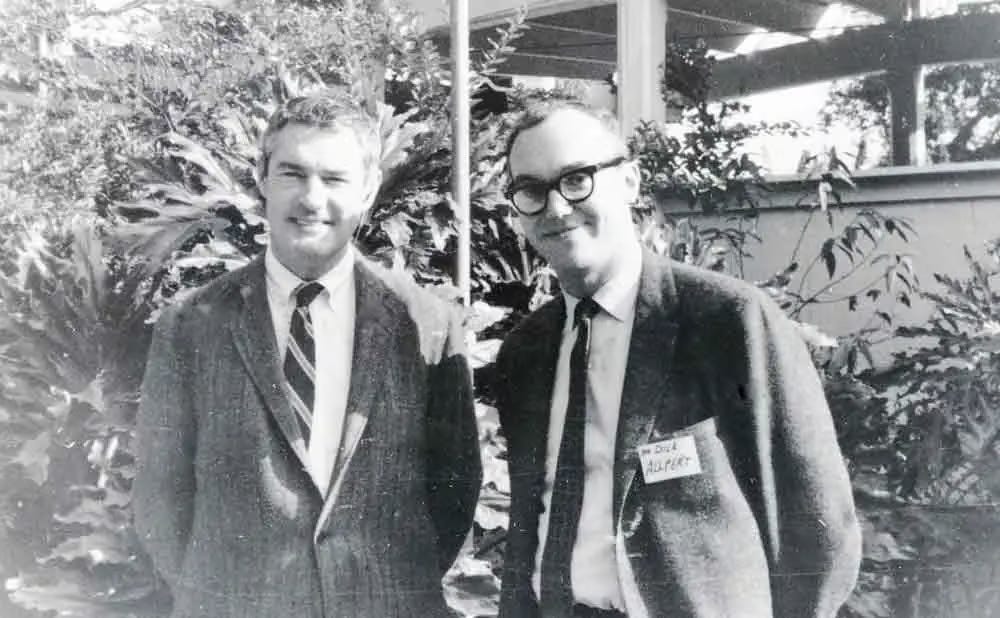
By 1966, Richard Alpert had a problem. Psychedelics had shown him states of consciousness he could barely have imagined, but they had failed to answer a more difficult question: how do you stay there?
Years earlier, his first psilocybin experience with Timothy Leary had dismantled his familiar identity as a Harvard professor. In his words:
“Psychedelics revealed the possibility that I wasn’t who I thought I was.”1
He remained deeply grateful for that opening. But after years at the center of Harvard’s psychedelic experiments, Alpert began noticing a pattern. Everyone kept having extraordinary experiences. Then everyone came down.
“By 1966, I looked around and saw that everybody who was using psychedelics really wasn’t going anywhere… We had the maps, but we couldn’t read them.”2
So, Alpert went to India looking for “somebody who knew how to read the maps.”2
There, he met Neem Karoli Baba, the Indian saint he would call Maharajji. Ram Dass later described the meeting simply:
“I met a being who didn’t come down.”1
The encounter changed the direction of his life. Alpert became Ram Dass, which means “servant of God,” and began immersing himself in devotional practice, meditation, and yoga.
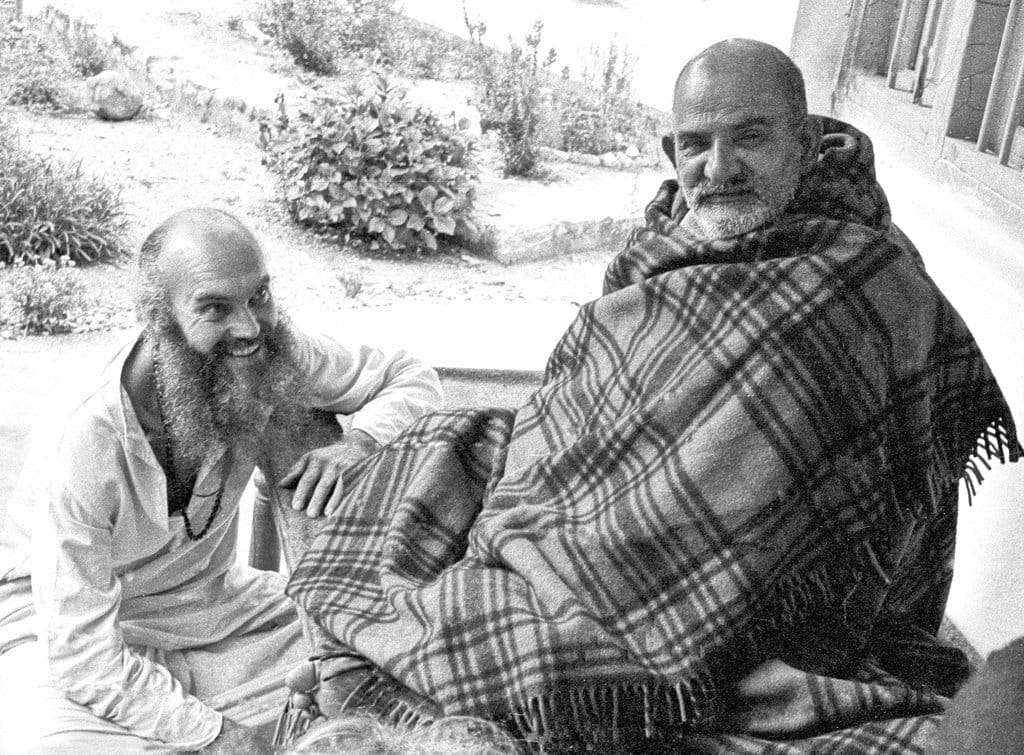
Still, he had brought some unfinished business to India: a bottle of LSD.
Ram Dass had traveled with psychedelics partly because he wanted to find someone who understood what they were actually doing.
According to his account, Maharajji swallowed an enormous dose of LSD – 900 micrograms – and it showed no effect at all.3
Years later, Ram Dass asked his guru whether he should ever take LSD again.
Maharajji did not dismiss it. Under the right circumstances, he said, “it could be useful.”3
But his view was more nuanced than simple acceptance or rejection. Speaking about psychedelic experience, Maharajji explained:
“It would allow you to come in and have the Darshan [divine sight] of Christ, but you can only stay two hours and then you have to leave… It would be better to become Christ than to visit him.”3
Ram Dass later said the distinction landed immediately:
“LSD showed you an analog of the thing itself, but something in the way we were using it couldn’t bring us to the thing itself.”2
That became one of the central tensions of his spiritual life. Psychedelics could provide the glimpse, but something else was needed to stabilize the benefits.
Yet Ram Dass never felt compelled to renounce psychedelics.
By 1996, he described using them occasionally, partly as a way of testing whether his spiritual practice had simply become another hiding place for the ego:
“I use one method against another continually as a check and balance to see where I’m conning myself.”4
He had also become far less dependent on them:
“I will go for two years of deep practice, and then I’ll be interested to see where I am in relation to psychedelics. I’m at the point now where, if I never had them again, it would be fine, and if I have them again, it’ll be wonderful. I may take mushrooms next week, and I may not. I don’t know and I don’t care. That’s a different set from which to do them, instead of ‘I need them to find reality.’”4
That may be the more useful way to understand Ram Dass’s journey from psychedelics toward meditation.
One opened a doorway that he might never have known existed. The other became a way of learning how to live on the other side of it. And both kept a place in his spiritual life.
2. Zig Zag Zen: Buddhism and Psychedelics
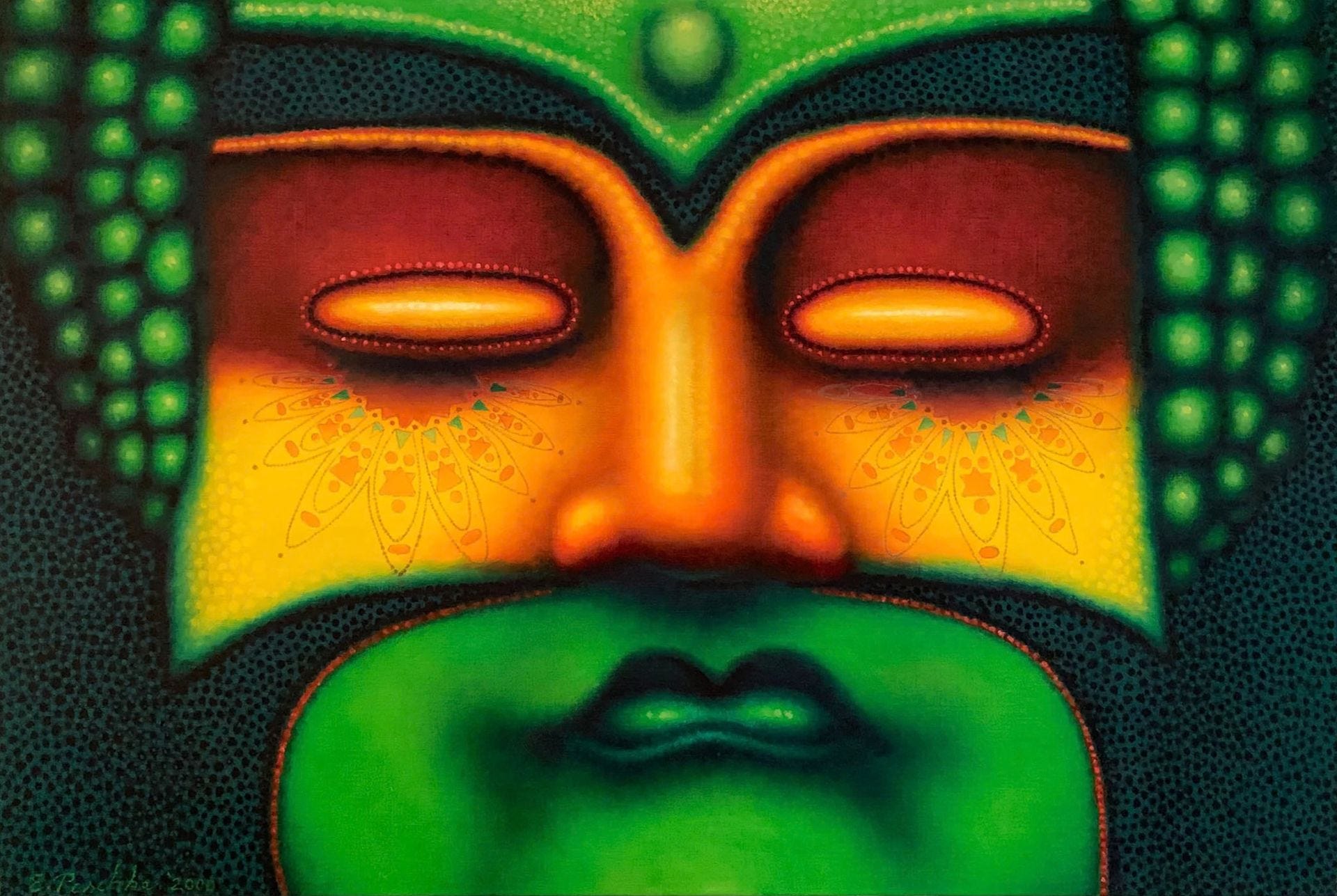
Zig Zag Zen: Buddhism and Psychedelics is a collection of essays by Buddhist teachers, scholars, and practitioners circling one central question:
What role, if any, should psychedelics play on the Buddhist path?
The question gets complicated quickly.
Across many Buddhist traditions, practitioners follow the Five Precepts, ethical training guidelines meant to reduce suffering and cultivate greater awareness. They include commitments to refrain from killing, stealing, sexual misconduct, false speech, and intoxicants that lead to heedlessness.
That last precept raises an obvious question for psychedelics.
Some Buddhists see it as a clear prohibition. Others argue that if a substance can increase awareness, it may not qualify as an ordinary intoxicant.
That tension gives Zig Zag Zen its energy. As editor Allan Badiner writes:
“Ultimately, Buddhism and psychedelics share a concern with the same problem: the attainment of liberation for the mind.”5
From that perspective, it’s no wonder that psychedelic exploration has led so many Western seekers toward Buddhism.
In one of the book’s essays, psychologist Charles Tart described his own version of that familiar path:
“The aridity of conventional religion, the struggle to preserve something sacred against the powerful tide of materialism and cynicism, the frustration with spiritual practices that didn’t seem to work… the sudden opening with psychedelics, then the renewed commitment to meditation and other practices because of an experience-based confidence that there is something real in the spiritual realm to strive for.”
Tart also observed that “having seen the possibilities through psychedelics, one then had to adopt a regular spiritual practice in life in order to manifest them.”
Psychiatrist Roger Walsh draws a similar line between having an experience and becoming a different kind of person. Quoting theologian Huston Smith, he writes:
“If drugs appear to induce religious experiences, it is less evident that they can produce religious lives.”
That may be the central tension of the book. A psychedelic experience can feel like enlightenment. Buddhist meditation is more concerned with whether that insight survives contact with ordinary life.
Psychiatrist Rick Strassman warns that insight alone can easily become another form of ego:
“The wisdom of the psychedelic experience, without the accompanying and necessary love and compassion cultivated in a daily practice, may otherwise be frittered away in an excess of narcissism and self-indulgence.”
Still, several contributors believe psychedelics can remain useful even after a meditation practice has taken root.
Author Myron Stolaroff writes:
“I personally have found that appropriately understood and used, psychedelics can play a significant role in deepening and accelerating the progress of one’s meditative practice.”
Others are more skeptical. Zen teacher Brad Warner argues that chasing extraordinary states can become its own distraction:
“What I am working on in meditation involves every single moment of life. So-called ‘peak experiences’ can be fun. But they no more define what life is about than so-called ‘mundane experiences.’”
Lama Surya Das offers a related warning:
“The intensity of drug-enhanced experiences can also stunt our ability to appreciate everyday spirituality.”
And then there is Ram Dass, who offers perhaps the cleanest middle position:
“I don’t see psychedelics as an enlightening vehicle, but I do see it as an awakening vehicle… It awakens you to the possibility.”
That distinction gets to the heart of Zig Zag Zen.
The book never settles on a single answer to whether psychedelics belong in Buddhist practice. Instead, it explores what psychedelics might add to spiritual practice, and where their limitations are.
3. A Meditation Retreat Becomes a Psilocybin Study
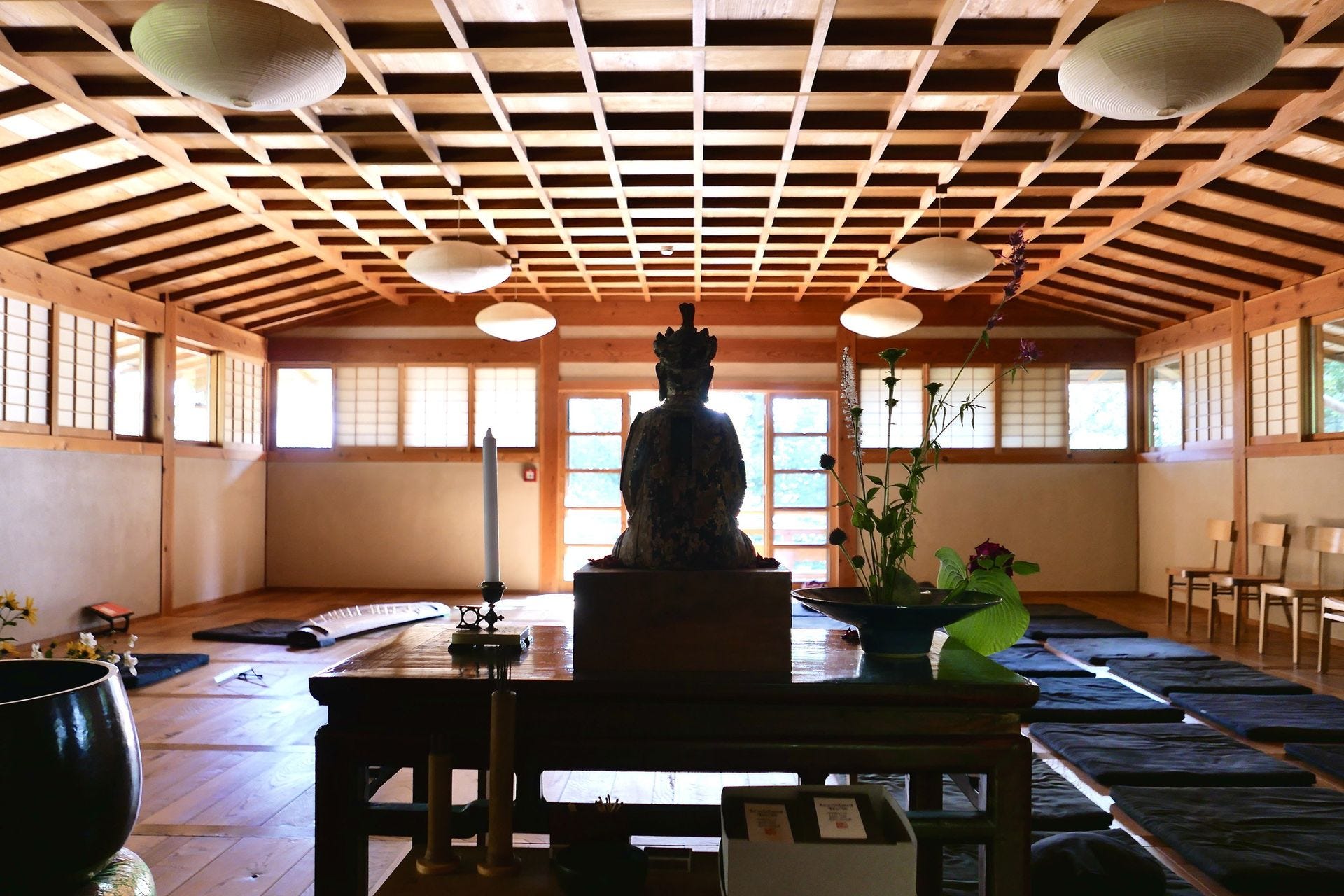
In a study published in 2019, researchers turned a five-day meditation retreat into a psychedelic experiment.6
Thirty-nine experienced meditators lived together at a meditation center in Switzerland, practicing under the guidance of a Zen teacher. On the fourth day, each participant received a capsule. Half contained psilocybin. Half contained a placebo. Neither the meditators nor the researchers working with them knew who received what.
The researchers were interested in the striking overlap between psychedelics and meditation. Both can dissolve the ordinary sense of being a separate self and give rise to feelings of profound connection.
So what happens when you combine them?
The psilocybin group reported deeper meditation and stronger alterations of consciousness, including unity, bliss, and what the researchers called “positively experienced self-dissolution.” Despite receiving a relatively high dose, participants experienced little anxiety.
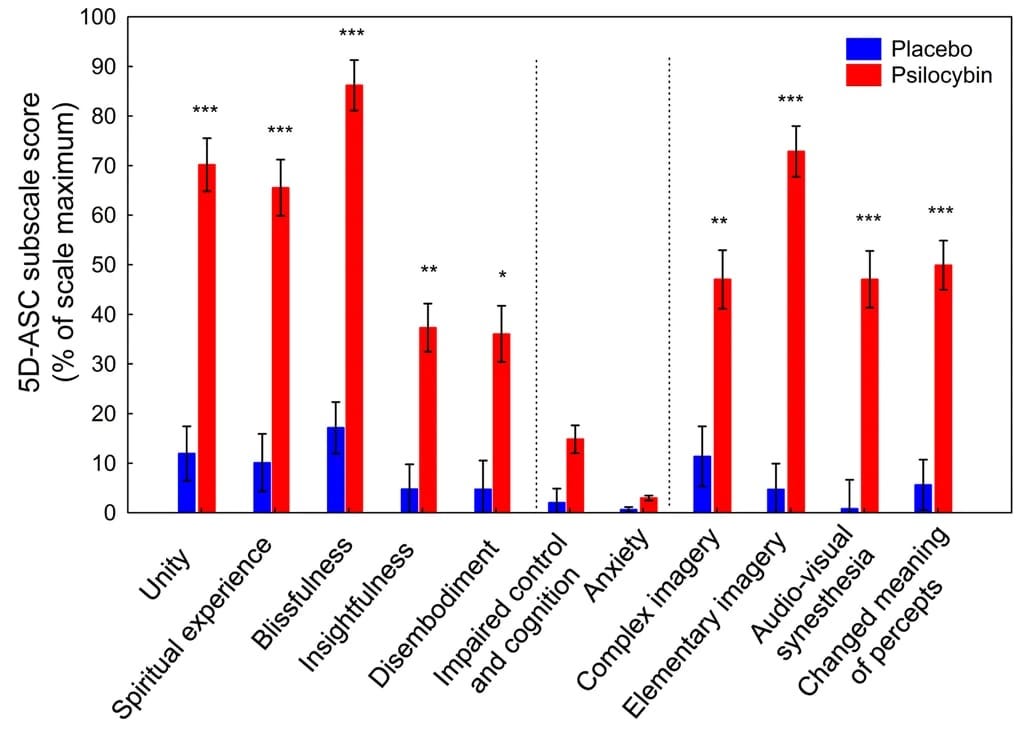
Their meditation training and the retreat setting may help explain why.
Meditation cultivates the ability to observe thoughts and emotions without immediately reacting to them. Researchers found that greater nonjudgmental acceptance was associated with stronger mystical-type experiences, while the ability to reframe emotions was associated with less anxiety and distress.
These findings suggest that skills developed through meditation may help people navigate the intensity of a psychedelic experience.
The effects also appeared to extend beyond the retreat. Four months later, the psilocybin group reported greater positive changes in their attitudes and behavior, including increased self-acceptance, appreciation for life, and sense of purpose. People close to the participants also observed some of these changes.
But perhaps the study’s most interesting finding came from the placebo group.
Three meditators who received no psilocybin still met the researchers’ criteria for a strong mystical-type experience. Their experiences closely resembled the mystical experiences reported by participants on psilocybin, with one important difference: they arose with virtually none of the anxiety, cognitive impairment, vivid visual effects, or reduced alertness associated with the drug.
Meditation, in other words, could sometimes reach similar territory under its own power. It just did so much less frequently.
With only 39 experienced meditators, the study was small and cannot tell us how the combination would affect beginners or people outside a structured retreat. Still, it offers a fascinating picture of psychedelics and meditation as two routes through overlapping terrain.
Psilocybin appeared to make the deeper states more accessible. Meditation may have provided the skills for navigating them. And a few meditators showed that the destination did not necessarily require a drug at all.
Quotes
“The ultimate achievement of liberation must occur through interior development that does not depend on the use of a plant or a chemical, although these may help in discovering the way.”
— Myron Stolaroff
“What is most important about psychedelics is not the psychedelic experience itself but what you do with it afterward.”
— Alexander Shulgin
Trip Thought
A shower thought, but for psychedelics.
In my experience, psychedelics and meditation are deeply synergistic.
When I first started meditating and studying Buddhist philosophy, I kept running into esoteric ideas like ‘the self is an illusion’ and ‘all things are empty.’ I understood the words intellectually, but they didn’t really click. Meditation itself was frustrating too. I would sit down, try to quiet my mind, and mostly encounter more chatter. I was amazed by how often I got lost in thought.
Then I had my first intentional high-dose psychedelic experience. For the first time, I felt like I understood what those teachings were pointing toward. The mental chatter subsided, I got some space from my usual sense of self, and I felt unusually at ease and connected to everything around me.
It gave me a glimpse of the territory my meditation training had been describing, and that glimpse made me want to keep practicing.
Meditation has since changed psychedelics for me too. It gives me more capacity to stay present inside intense experiences, investigate what is happening, and carry some of those insights back into ordinary life.
I see them as two invaluable teachers on the same strange path: expanding awareness and exploring the beautiful mystery of being conscious at all.
Community Bulletin
🧘Meditation App: The Way is a guided meditation program led by Zen master Henry Shukman, designed to help build a deeper, more consistent practice. Use this link for 30 days free.
🍄 Microdosing Summit: Our friends at The Microdosing Collective are hosting their inaugural Microdosing Summit on October 21, 2026, in Austin, Texas. Use code ARCHIVES for 10% off.
📚Books: Our friends at Synergetic Press publish psychedelic classics including Zig Zag Zen: Buddhism & Psychedelics, Mystic Chemist, and Birth of a Psychedelic Culture. Use code ARCHIVES20 for 20% off.
Thanks for reading!
If something resonated with you, or if you have thoughts, questions, or ideas for future editions, I’d love to hear from you.
Just reply to this email. I read every response, and your feedback helps shape where this project goes next.
See you next week!
In psychedelic companionship,
- Kyle Sharp
Sources: