

Welcome to The Weekly Archive, a short trip through psychedelic history.
In the 1960s, psychedelia spread through LSD and music. It also spread through ink and newsprint, carried from city to city by a network of underground newspapers.
This week, we’re exploring the psychedelic press and the analog network that carried its ideas across the world.
Here are 3 artifacts, 2 quotes, and 1 trip thought for the journey.
Artifacts
1. The San Francisco Oracle
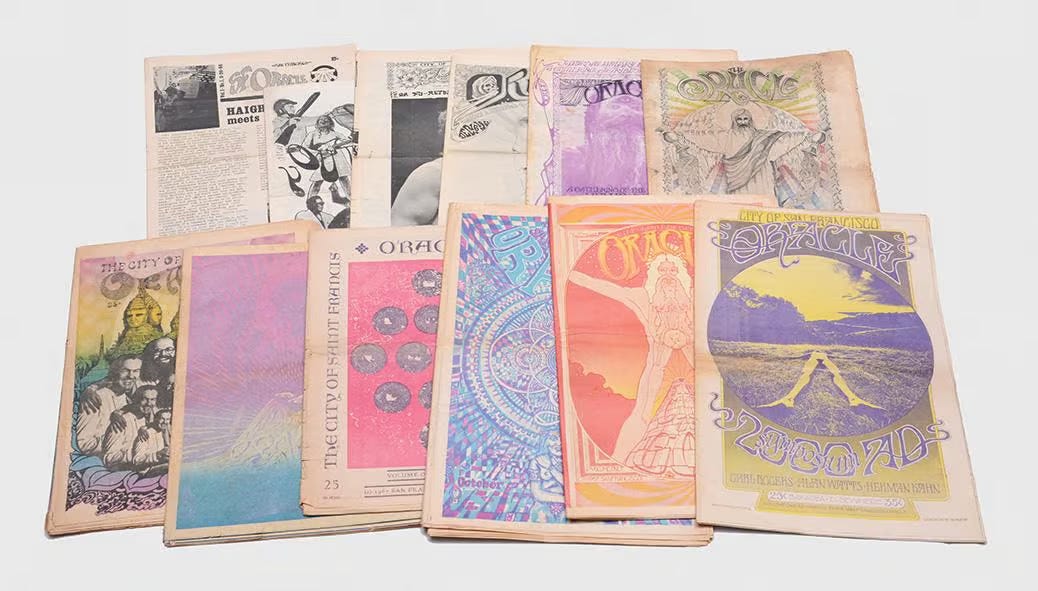
The San Francisco Oracle emerged in Haight-Ashbury in September 1966, just as the neighborhood was becoming the symbolic center of the psychedelic movement.
Edited principally by poet Allen Cohen, with Michael Bowen serving as an early art director, it published only twelve issues before folding in early 1968. Yet by its seventh issue, print runs had climbed to nearly 125,000 copies.1
The Oracle did more than report on psychedelic culture. It tried to reproduce the perceptual experience of psychedelia on paper.
Its pages layered poetry, curved typography, mystical symbols, illustrations, and photographs into designs that often resisted conventional reading.
Beginning with issue six, its printers used a technique called split-fountain printing, placing multiple colors in the same ink fountain so they blended across the page in a single press run. The result was the radiant rainbow gradient that became synonymous with psychedelic graphic design.
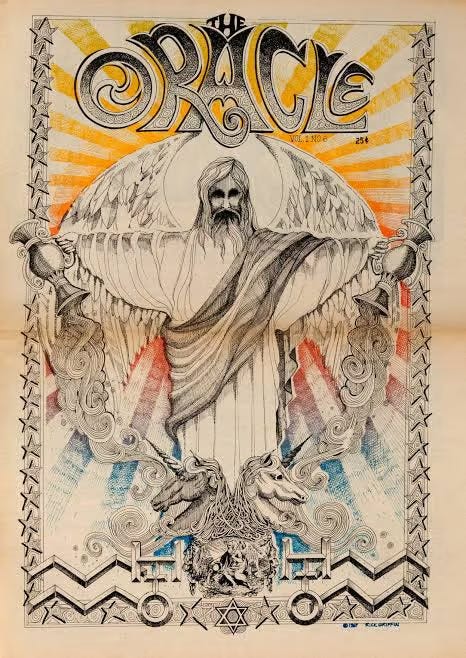
Its contents were equally eclectic. The Oracle published poetry, Eastern philosophy, ecology, astrology, psychedelic ideas, and conversations with figures including Timothy Leary, Allen Ginsberg, Alan Watts, and Gary Snyder.
One of its most extraordinary artifacts appeared in February 1967, when the Oracle sponsored the “Houseboat Summit” aboard Alan Watts’s ferryboat in Sausalito.
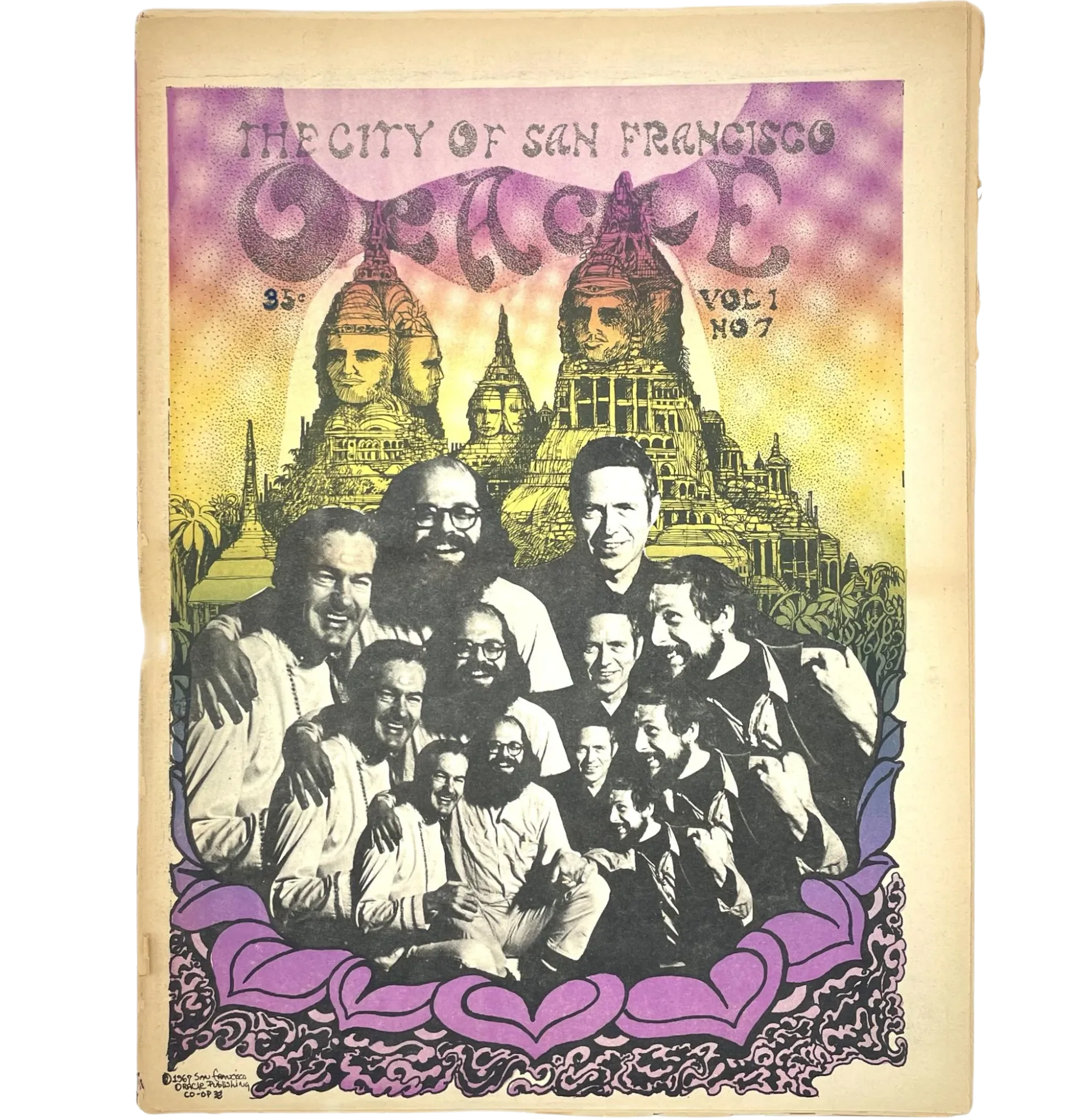
Watts, Leary, Ginsberg, and Snyder gathered to debate a question running through the psychedelic movement: Should people drop out from conventional society and build alternatives, or remain engaged and try to transform it?
The Oracle was already doing a little of both.
Cohen and Bowen had helped organize the Love Pageant Rally in Golden Gate Park on October 6, 1966, the day California’s LSD prohibition took effect. The gathering helped set the stage for the Human Be-In three months later, an event conceived partly to bridge the political radicals of Berkeley and the psychedelic community of the Haight.
The editors were simultaneously chronicling the psychedelic movement and helping construct it.
For a movement trying to imagine a new way of living, the Oracle gave that imagination a form people could hold in their hands.
2. The East Village Other
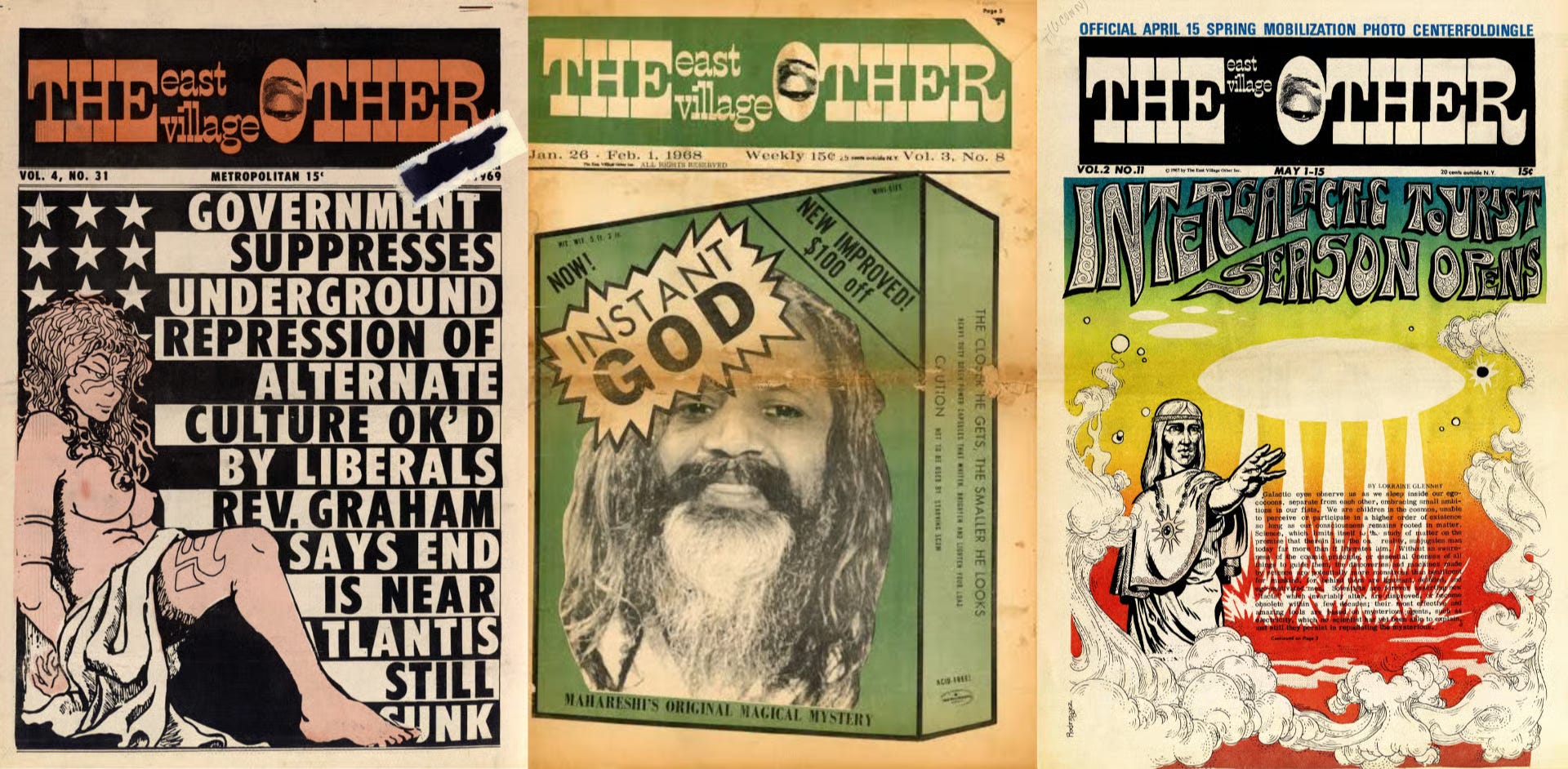
Three thousand miles away, New York was developing its own psychedelic underground.
The East Village Other, or EVO, began publishing in New York in October 1965. Its founders included Walter Bowart, Allen Katzman, Sherry Needham, John Wilcock, and novelist Ishmael Reed, who is generally credited with suggesting the name.2
Where the Oracle often felt mystical and utopian, EVO was more irreverent, urban and politically unruly. It mixed psychedelics with avant-garde art, sexual liberation, antiwar politics, neighborhood reporting, satire and underground comics.
At its height, circulation reached approximately 65,000 copies, and it survived until 1972.3
Early issues employed collage, absurdist headlines and invocations of an “Intergalactic World Brain.”4 It treated journalistic neutrality with suspicion. The writers were participants in the culture they covered and made little effort to disguise their perspectives.
That sense of participation was central to the underground press. Readers were not simply consuming reports about a distant movement. They were being addressed as members of it.
In May 1966, EVO began publishing a Timothy Leary column that was soon carried by several other underground papers.
EVO also became an early home for underground comix, publishing artists including Robert Crumb, Art Spiegelman, and Trina Robbins. In 1969, it launched Gothic Blimp Works, an entire tabloid devoted to the form.
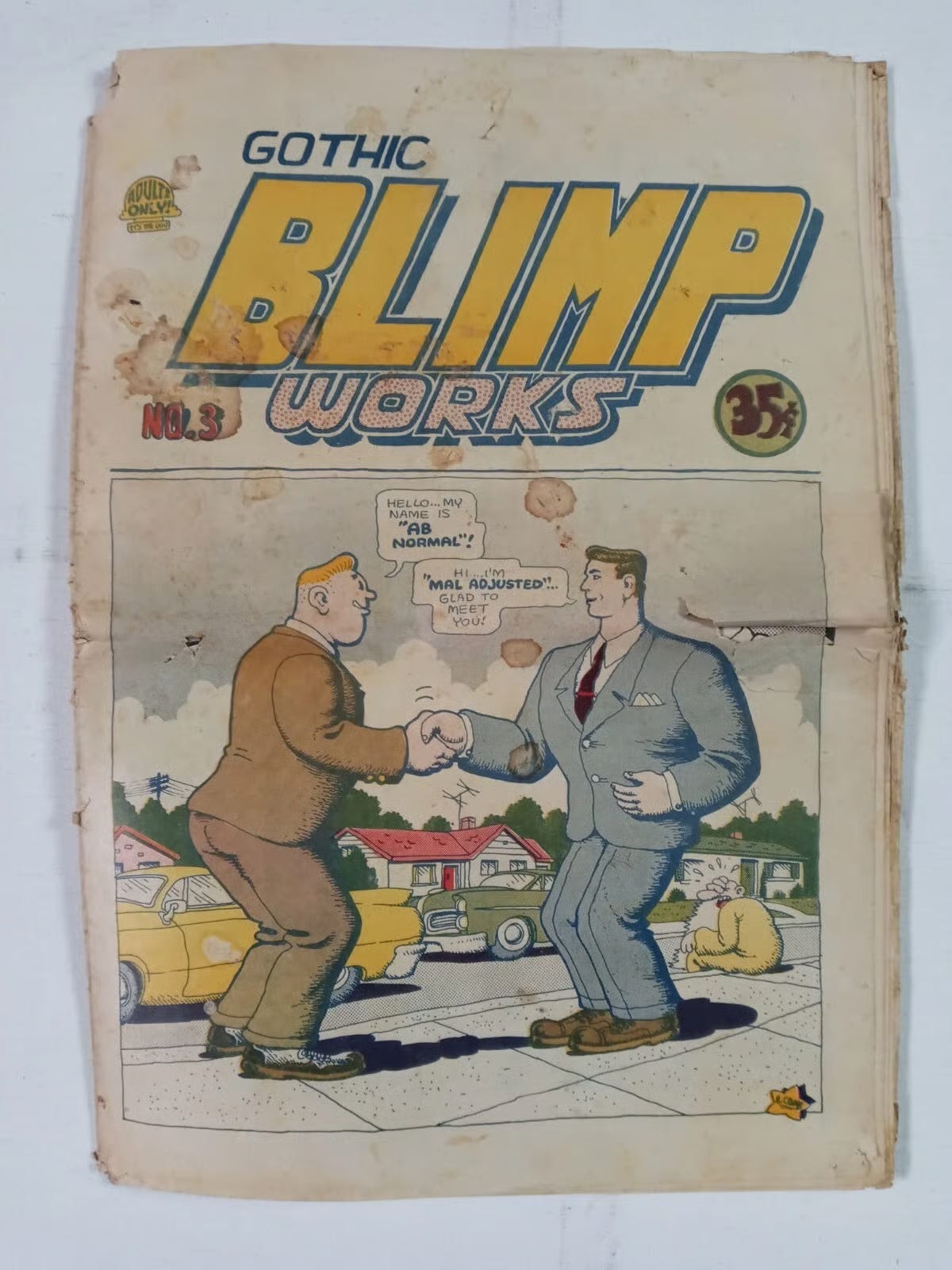
Long before some of these artists entered museums and art-history books, their work traveled through cheap newsprint.
EVO even became a record label of sorts. In 1966, it released The East Village Other Electric Newspaper, a collage of poetry, music, and experimental sound that included an early recording connected to the Velvet Underground.5
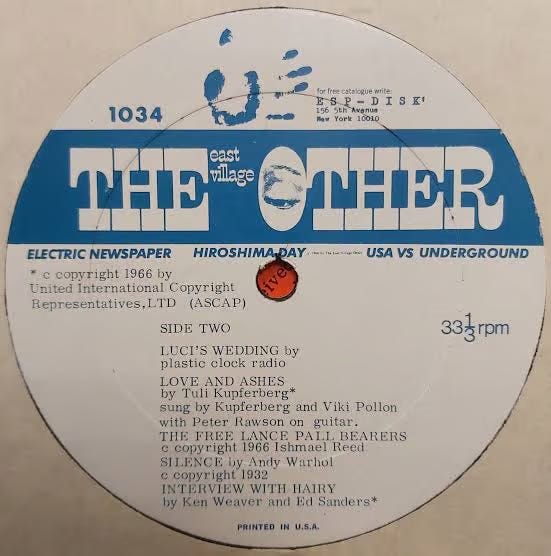
By then, EVO had become a testing ground for whatever the East Village underground was making next.
And soon those experiments found a way to travel much farther.
3. Underground Press Syndicate
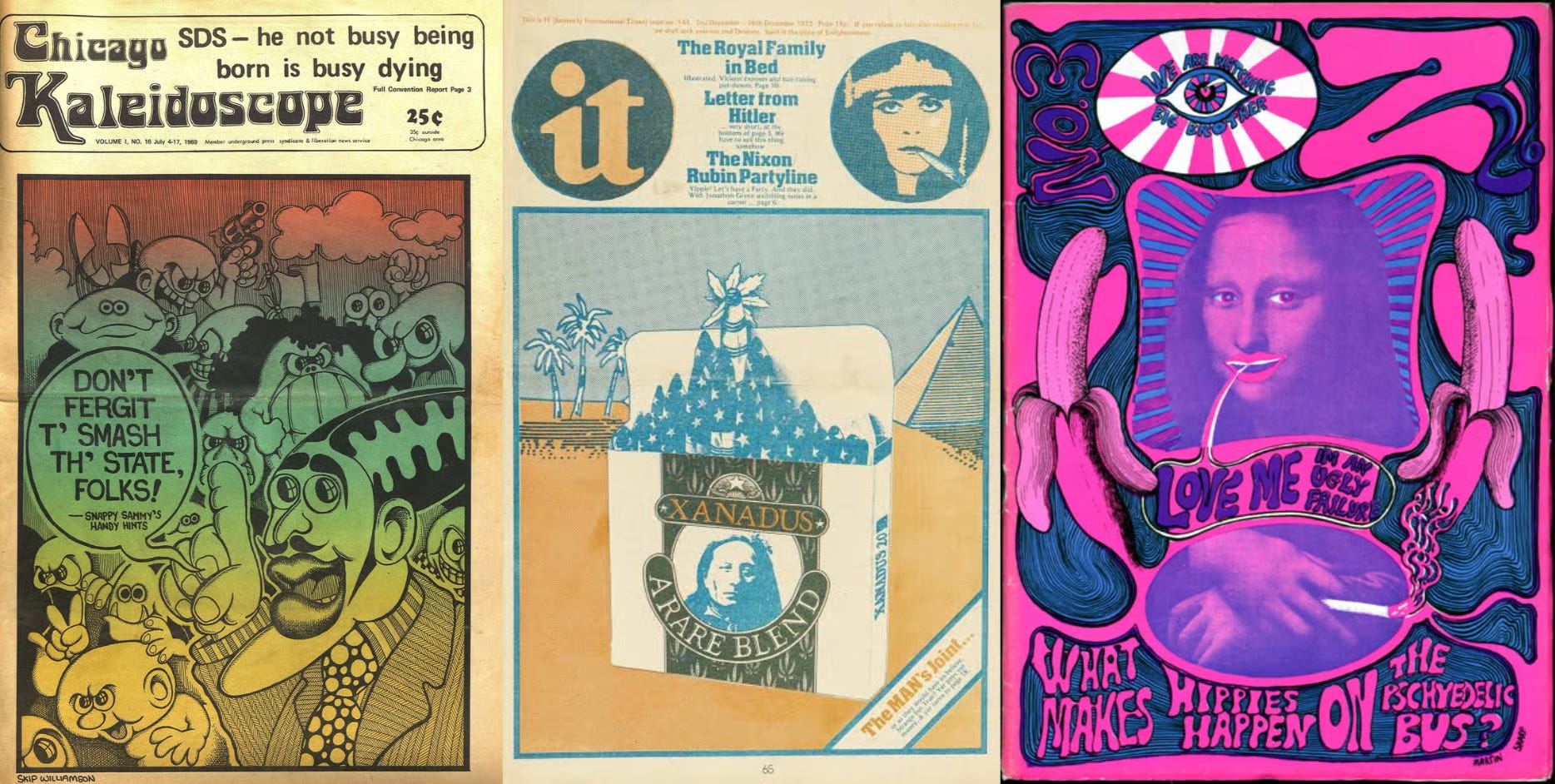
In 1966, five underground newspapers built something strangely similar to an analog internet.
The East Village Other, Los Angeles Free Press, Berkeley Barb, The Paper in East Lansing, and Detroit’s Fifth Estate formed the Underground Press Syndicate, or UPS.6
Its defining rule was simple: members could freely reprint one another’s work.
That rule transformed a collection of independent newspapers into a decentralized network.
An article published in Detroit could be picked up in Berkeley, reprinted elsewhere, and continue spreading without anyone asking permission. Each paper remained local, but its ideas could travel through the entire system.
Decades before the web, UPS had created a kind of peer-to-peer information network.
The model fit naturally within the psychedelic movement. Communal living and collective ownership were already challenging conventional ideas about private property. UPS extended a similar logic to information: if an idea was worth sharing, let it circulate.
By 1971, the syndicate reportedly connected more than 270 publications across North America and Europe.
The resemblance to the internet is striking, although the infrastructure was painfully analog. There were no hyperlinks or repost buttons. A newspaper had to travel through the mail, then someone had to physically reproduce its contents and send thousands of new copies back into circulation.
Ideas went viral at the speed of the postal service.
Yet the effect would feel familiar to anyone who has stumbled into an online community and realized that people elsewhere share their obscure interests.
A reader in a small college town could open a local paper and find themselves plugged into a conversation unfolding thousands of miles away. Geography suddenly mattered a little less. What had seemed like an isolated local scene revealed itself as part of a much larger culture.
The network circulated information, but more subtly, it circulated belonging.
In that sense, UPS did something the internet would later do at enormous scale: it gave a dispersed culture a way to discover itself.
Quotes
“Were it left to me to decide whether we should have a government without newspapers or newspapers without a government, I should not hesitate a moment to prefer the latter.”
— Thomas Jefferson
“The medium is the message.”
— Marshall McLuhan
Trip Thought
A shower thought, but for psychedelics.
Information is a little like a psychedelic. It changes consciousness by changing what we notice.
What becomes possible when the psychedelic media that expands our minds is grounded in curiosity, integrity, and a commitment to collective transformation?
Community Bulletin
🎬 Documentary: Unbecoming, a new original documentary from Muse Storytelling, follows two people through a powerful 5-MeO-DMT protocol. The world premiere is Tuesday, September 22, and you can watch it live online. Learn more and join the premiere here.
🍄 Microdosing Summit: Our friends at The Microdosing Collective are hosting their inaugural Microdosing Summit on October 21, 2026, in Austin, Texas. Use code ARCHIVES for 10% off.
🕯️Candles: Psychedelic Candle Co. makes candles designed to accompany psychedelic journeys, using scent as a way to ground the experience and evoke it again afterward. Use code ARCHIVES20 for 20% off.
Thanks for reading!
If something resonated with you, or if you have thoughts, questions, or ideas for future editions, I’d love to hear from you.
Just reply to this email. I read every response, and your feedback helps shape where this project goes next.
See you next week!
In psychedelic companionship,
- Kyle Sharp