


Welcome to The Weekly Archive, a short trip through psychedelic history.
A trip report is an attempt to describe the indescribable.
This week, we’re exploring famous trip reports and the lessons they carried home.
Here are 3 artifacts, 2 quotes, and 1 trip thought for the journey.
Artifacts
1. Aldous Huxley Opens the Doors of Perception
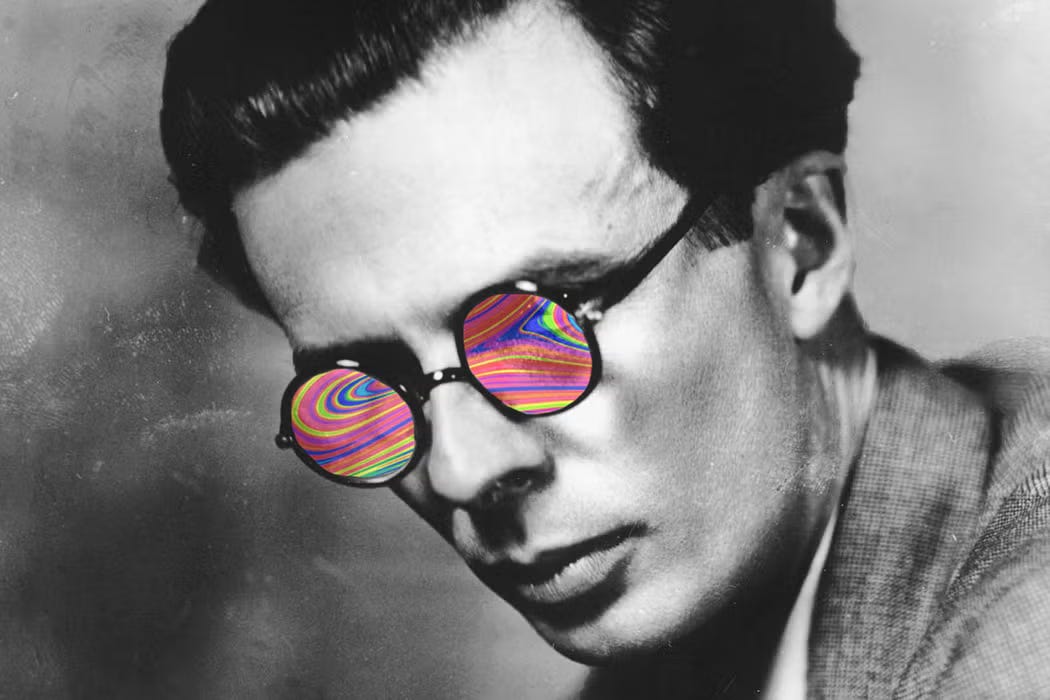
On May 4, 1953, Aldous Huxley swallowed 400 milligrams of mescaline at his home in Los Angeles.
By then, the author was already famous for Brave New World and had spent years studying mysticism and altered states of consciousness. When he learned that British psychiatrist Humphry Osmond was researching mescaline, Huxley invited him to Los Angeles and volunteered as a subject.
The experience became the basis for The Doors of Perception, published the following year.
From his reading, Huxley expected mescaline to produce a spectacular world of inner visions.
What happened surprised him:
“I saw no landscapes, no enormous spaces, no magical growth and metamorphosis of buildings, nothing remotely like a drama or a parable.”1
The great change, he wrote, occurred in the realm of “objective fact.”
About ninety minutes after taking mescaline, Huxley found himself staring at a small glass vase containing three flowers: a rose, a carnation, and an iris.
Suddenly, they appeared unimaginably significant.
“I was seeing what Adam had seen on the morning of his creation – the miracle, moment by moment, of naked existence.”
Osmond asked whether it was agreeable.
“Neither agreeable nor disagreeable,” Huxley replied. “It just is.”
Huxley felt he was encountering existence before the mind had divided it into names, categories, or practical uses.
He explained:
“What rose and iris and carnation so intensely signified was nothing more, and nothing less, than what they were – a transience that was yet eternal life.”
Soon, ordinary objects everywhere took on the same extraordinary significance.
Then Huxley looked at a chair:
“The legs, for example, of that chair – how miraculous their tubularity, how supernatural their polished smoothness! I spent several minutes – or was it several centuries? – not merely gazing at those bamboo legs, but actually being them – or rather being myself in them; or, to be still more accurate (for “I” was not involved in the case, nor in a certain sense were “they”) being my Not-self in the Not-self which was the chair.”
A simple chair had become miraculous.
Trying to explain why, Huxley turned to a concept he called the “reducing valve.” The idea is that reality contains far more information than we could possibly absorb, so the nervous system narrows awareness to the “measly trickle” useful for survival and everyday life. Beyond that filter, Huxley speculated, lies a vastly larger field of awareness he called “Mind at Large.”
Mescaline, he believed, temporarily loosened the valve.
“This is how one ought to see, how things really are” Huxley kept thinking.
Then came the complication.
If everything appeared infinitely meaningful, ordinary life became difficult to care about. Why try to accomplish anything when the folds of your trousers contain the mystery of existence?
More troublingly, Huxley wondered: “What about other people? What about human relations?”
The trip had made objects overwhelmingly significant while weakening his interest in the practical world of persons, responsibilities, and action. Huxley recognized that nobody could live permanently in this state.
That reservation became an essential part of his interpretation.
Huxley explained:
“I am not so foolish as to equate what happens under the influence of mescalin or of any other drug… with the realization of the end and ultimate purpose of human life: Enlightenment.”
He went on:
“All I am suggesting is that the mescalin experience is what Catholic theologians call ‘a gratuitous grace,’ not necessary to salvation but potentially helpful and to be accepted thankfully, if made available. To be shaken out of the ruts of ordinary perception, to be shown for a few timeless hours the outer and the inner world, not as they appear to an animal obsessed with survival or to a human being obsessed with words and notions, but as they are apprehended, directly and unconditionally, by Mind at Large – this is an experience of inestimable value to everyone and especially to the intellectual.”
For a few hours, Huxley had expected to see another world. What astonished him was this one.
And when the door closed again, he believed something remained:
“The man who comes back through the Door in the Wall will never be quite the same as the man who went out. He will be wiser but less cocksure, happier but less self-satisfied, humbler in acknowledging his ignorance yet better equipped to understand the relationship of words to things, of systematic reasoning to the unfathomable Mystery which it tries, forever vainly, to comprehend.”
In essence, they will be more aware of the enormous distance between our descriptions of reality and reality itself.
That may be the enduring power of Huxley’s trip. His great psychedelic vision was a vase, a rose, a chair.
Things he had seen a thousand times, suddenly seen as if for the first time.
2. Ram Dass and the Disappearing Self
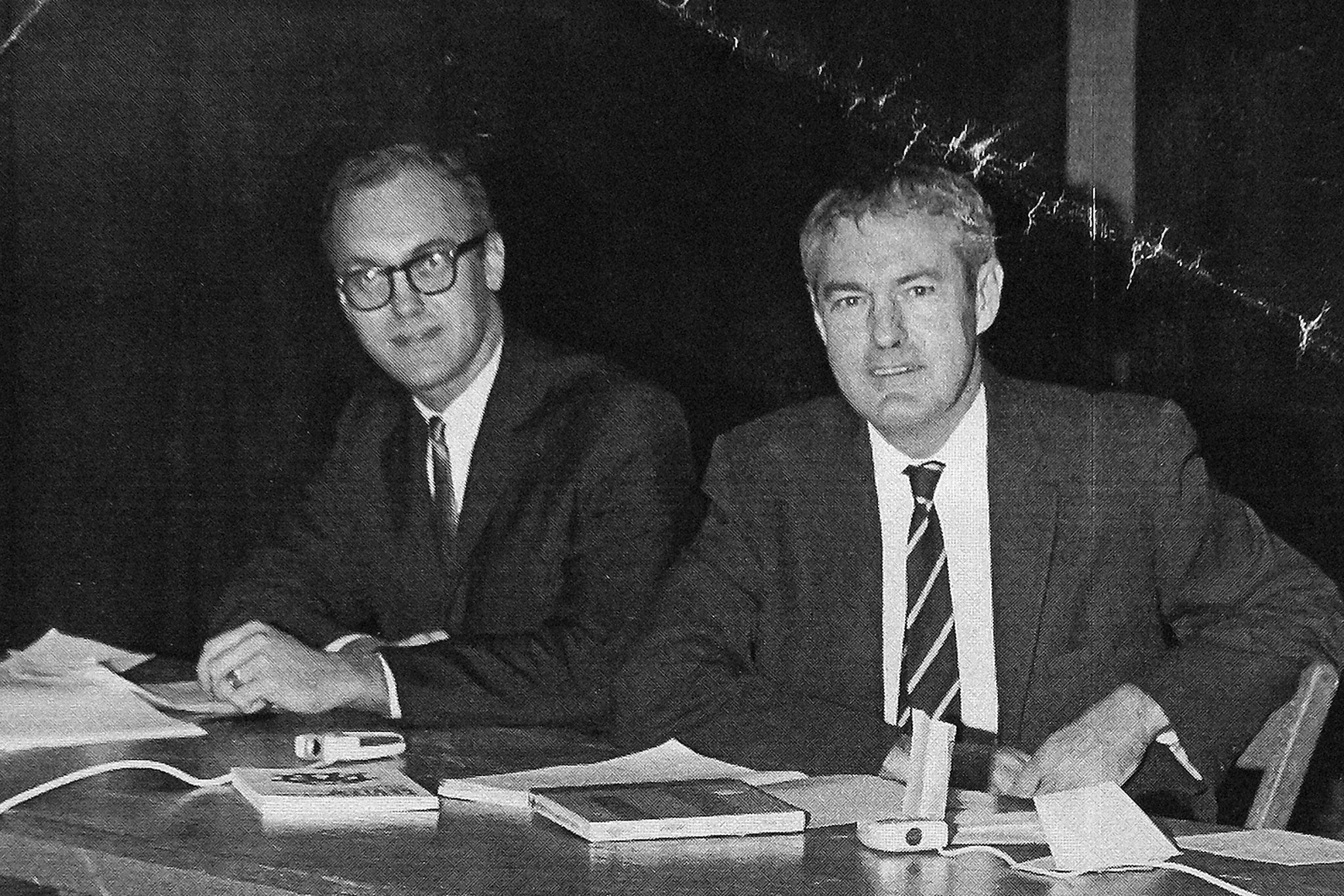
Before he became Ram Dass, the influential spiritual teacher, Richard Alpert was a young Harvard professor who thought he had a pretty good idea of who he was.
By 1961, the 29-year-old psychologist had a Ph.D. from Stanford and an appointment at Harvard, where he taught courses on personality and human motivation. He had a large office, assistants, and the outward trappings of a young academic on the rise.
Down the hall was another psychologist named Timothy Leary.
The two became friends, and after Leary returned from Mexico profoundly affected by an experience with psilocybin mushrooms, he began exploring psychedelics at Harvard. Alpert was curious. On March 6, 1961, during a snowstorm in Cambridge, Leary gave him psilocybin.
Alpert would later describe the night as the moment his life split open:
“On March 6, 1961, Timothy Leary gave me psilocybin and it changed my life. It changed my life in the sense that it undercut the models I had of who I thought I was. All the socialization and child development that had left me with a very strong somebody-ness, it cut that out.”2
Sitting alone in Leary’s living room, Alpert began seeing versions of himself appear across the room.
First came the professor in his cap and gown. Then the cosmopolitan bachelor. Then the lover, the wise man, the kind person. One by one, the identities he had spent his life constructing appeared before him and disappeared.3
Eventually, even “Richard Alpertness” began to go.
Then his body vanished.
He panicked. As far as Alpert understood, if his personality, identity, and body were gone, there should have been nothing left.
Yet something was still there, watching.
“And of course there was fear in losing that familiar identity. But there was always also wonder because I touched a place in myself that was behind all my social roles… it was a presence. Instead of being good or this or that, or achiever or anything, I experienced a place in myself where I just say, I am. Not I am this or I am that, just I am.”2
What surprised him was how familiar this state felt.
“Even though I had not been in that space since probably childhood, before I developed my conceptual structures of mind, that place was extremely familiar to me.”
The experience also heightened his appreciation for the beauty of the world.
“I looked out at the forms and it was as if I saw the preciousness of all the forms. The incredible beauty of the stuff of life. It was like God’s paintbrush at work. I looked at people and they were so beautiful. I looked at things and they were beautiful.”
A few hours later, it was gone.
“Well, a few hours later, all I had was the memory. I came down and that began a journey.”
For Alpert, this became the central problem.
Psilocybin had given him an experience that seemed to exist outside the psychological models he taught at Harvard. More personally, it had shown him a version of himself that felt strangely more fundamental than the identity he returned to when the drug wore off.
“That experience imprinted so deeply in my mind because it showed me who I was that I hadn’t known I was. And yet it was familiar and it was my true self.”
Then his old identity returned.
“As the drug wore off and my ego structures reimposed themselves like a prison of my mind and came back to my familiar definition of myself, I felt trapped in it. And yet I couldn’t push away the prison.”
For the next several years, Alpert kept returning to psychedelics, trying different substances, settings, rituals, and combinations in search of a way to make the state last.
The problem remained stubbornly simple.
He always came down.
That problem would eventually take him to India, where Richard Alpert became Ram Dass. In retrospect, his first psilocybin experience had given him less of an answer than a question that would organize the rest of his life:
If the person you spend your life becoming can temporarily disappear, who is still there to notice?
3. Cary Grant Unscrews Himself

By the late 1950s, Cary Grant had become the personification of Hollywood sophistication.
Born Archibald Leach into poverty in Bristol, England, he came to America and remade himself into one of the world’s most famous actors.
Yet behind the immaculate exterior was a painful childhood, several failed marriages, and a persistent uncertainty about who he really was:
“I have spent the greater part of my life fluctuating between Archie Leach and Cary Grant, unsure of either, suspecting each.”4
At 54, Grant began taking LSD under the supervision of Beverly Hills physician Mortimer Hartman. Over the next two years, he underwent more than 100 sessions.
Reflecting on the therapy, Grant said:
“I have been through a psychiatric experience which has completely changed me. I was horrendous. I had to face things about myself which I never admitted, which I didn’t know were there. I found I was hiding behind all kinds of defenses, hypocrisies and vanities. I had to get rid of them layer by layer. The moment when your conscious meets your subconscious is a hell of a wrench. With me, there came a day when I saw the light.”5
The process began with a surprisingly simple lesson.
“When I first started under LSD, I found myself turning and turning on the couch.”
Grant asked Hartman why he was turning and when it would stop.
“When you stop it,” the doctor replied.
“It was like a revelation to me, taking complete responsibility for one’s own actions. I thought, ‘I’m unscrewing myself.’”6
The sessions could be grueling.
“I would run the gamut of emotions from deep pain with tears running down my face to light-headed, almost drunken laughter.”
They could also get considerably stranger.
“In one LSD dream I imagined myself as a giant penis launching off from Earth like a spaceship.”6
Grant eventually developed his own metaphor for what was happening. Each session seemed to erase a little more of an old recording:
“When each session ended, I knew that I had cleaned off a little more of my tape. It took two years, but it was necessary for my evolution.”
In 1959, while still undergoing LSD therapy and making some of the most celebrated films of his career, Grant tried to explain what he had discovered through his therapy:
“I know that, all my life, I’ve been going around in a fog. You’re just a bunch of molecules until you know who you are. You spend all your time getting to be a big Hollywood actor. But then what? You’ve reached a comfortable plateau, and you want to stay on it; you resist change. One day, after many weeks of LSD, my last defense crumbled. To my delight, I found I had a tough inner core of strength.”7
For a man who had spent decades learning how to become Cary Grant, LSD seemed to help him rediscover Archie Leach.
“During my LSD sessions, I would learn a great deal. And the result was a rebirth… I finally got where I wanted to go.”4
Quotes
“I realized people were not having LSD experiences; they were having experiences of themselves.”
— Stanislav Grof, MD, PhD
“The potential of the psychedelic drugs to provide access to the interior universe is, I believe, their most valuable property.”
— Alexander Shulgin
Trip Thought
A shower thought, but for psychedelics.
The trip report can be a crucial part of the trip.
Putting a psychedelic experience into words forces us to decide what mattered. Sharing those words helps crystallize the meaning for ourselves, while leaving a trail marker for others exploring the same strange terrain.
So write down the weird stuff. Tell your friends. Compare notes. Maybe we’ll make a little more sense of it together.
Community Bulletin
🍄 Microdosing Summit: Our friends at The Microdosing Collective are hosting their inaugural Microdosing Summit on October 21, 2026, in Austin, Texas. Use code ARCHIVES for 10% off.
📚Books: Our friends at Synergetic Press publish psychedelic classics including Mystic Chemist, Birth of a Psychedelic Culture, and Zig Zag Zen: Buddhism & Psychedelics. Use code ARCHIVES20 for 20% off.
🕯️Candles: Psychedelic Candle Co. makes candles designed to accompany psychedelic journeys, using scent as a way to ground the experience and evoke it again afterward. Use code ARCHIVES20 for 20% off.
Thanks for reading!
If something resonated with you, or if you have thoughts, questions, or ideas for future editions, I’d love to hear from you.
Just reply to this email. I read every response, and your feedback helps shape where this project goes next.
See you next week!
In psychedelic companionship,
- Kyle Sharp
I do find the reducing valve metaphor to be really apt and helpful. Just practically, as a means of making our way through the world, it helps to be able to quickly assess things for the degree to which they "matter."
I'm speaking practically though. I don't think a psychedelic experience, in which everything takes on immense significance, is false in any way, but rather unsustainable. I think Terrence Mckenna said from time to time that the goal during a trip should be like a whaler or a fisherman, to reach down into the abyss and hopefully pull up one big idea or revelation that you can take back to ordinary life.
I also just really love Doors of Perceptions. There are a million little throwaway lines that really resonate with me. He writes something like the reason worshipers put flowers on an alter is that they are returning something that know or obscurely feel belongs to heaven. I love that.