

Welcome to The Weekly Archive, a short trip through psychedelic history.
Animation holds a special place in psychedelia.
This week, we’re exploring three remarkable films that show what the medium can do.
Here are 3 artifacts, 2 quotes, and 1 trip thought for the journey.
Artifacts
1. The Beatles’ Yellow Submarine (1968)
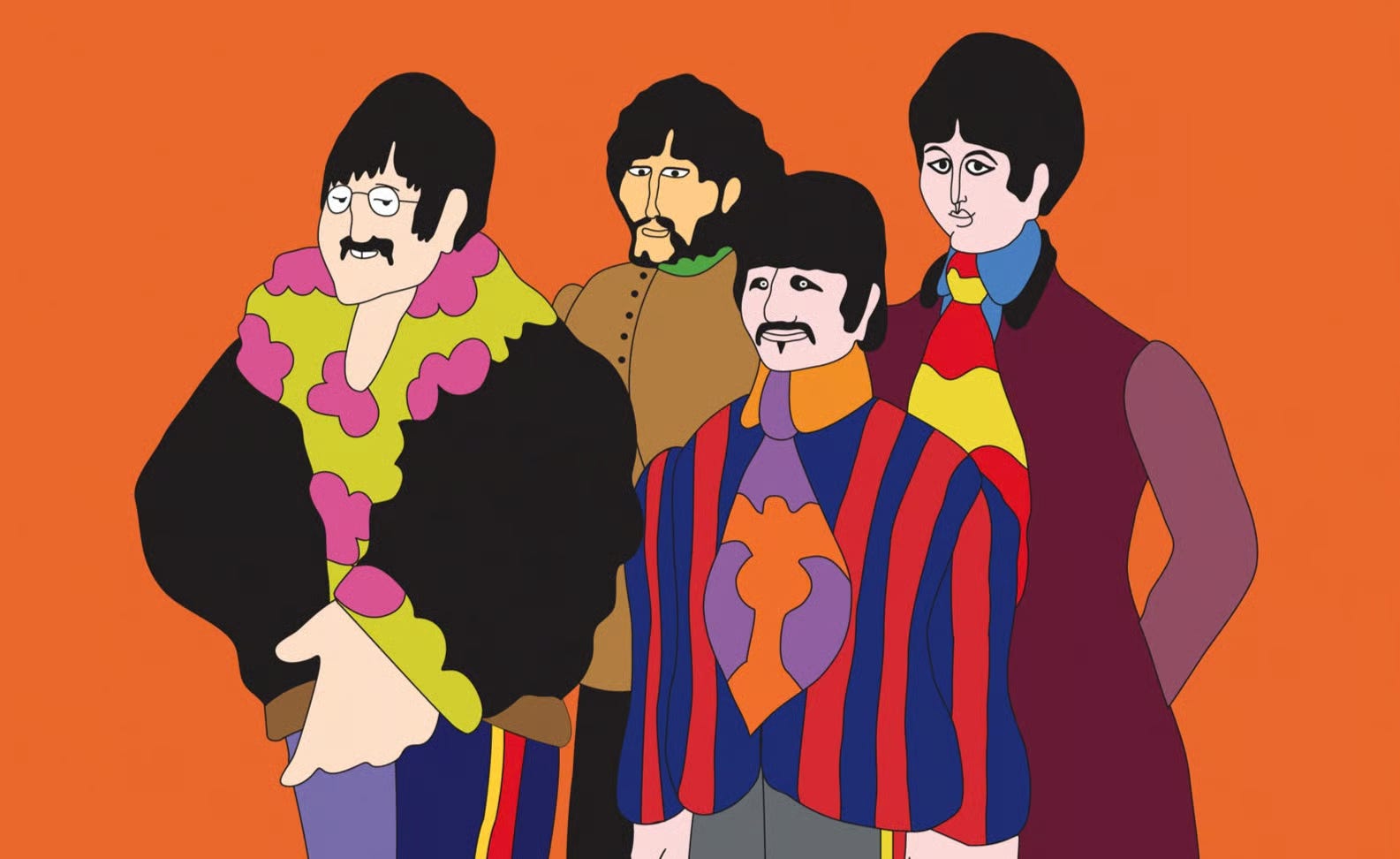
Yellow Submarine begins like a psychedelic fairy tale.
Deep beneath the sea lies Pepperland, a mythical paradise invaded by the music-hating Blue Meanies. One survivor escapes in a yellow submarine and recruits the Beatles, who come to save Pepperland with the one force the Meanies cannot stand: music.
Released in 1968, Yellow Submarine became one of the defining visual works of the psychedelic era.
That same year, film critic Roger Ebert praised it as “the most original and inventive feature-length animated cartoon since the days when Walt Disney was still thinking up innovations.”1
Ebert went on:
“The beauty of “Yellow Submarine” is that it casts this objective universe aside and sails in a world of pure fantasy… it is beautifully simple and childlike on one level, and erudite and deep on another.”1
The film captured the spirit of the sixties in concentrated form: pop psychedelia, anti-authoritarian playfulness, and the countercultural faith that music and love might actually change the world.
Strangely, the Beatles themselves almost missed the boat.
The film came from the same production company behind The Beatles Saturday morning cartoon series, which the band reportedly disliked. They approached the new project cautiously and declined to voice their animated counterparts.
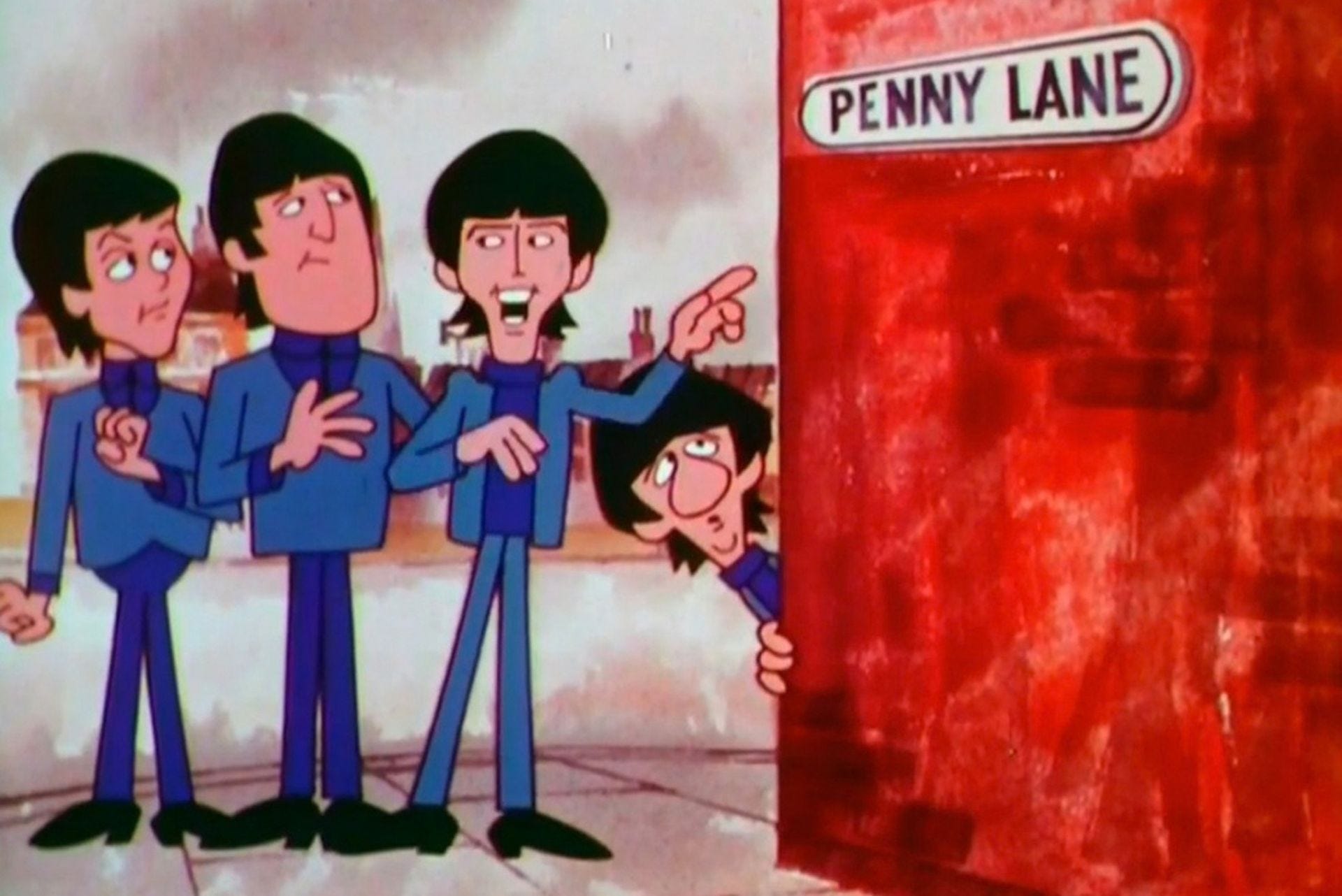
The band’s attitude began to change once they saw what the artists were creating, eventually agreeing to film a live-action ending.2
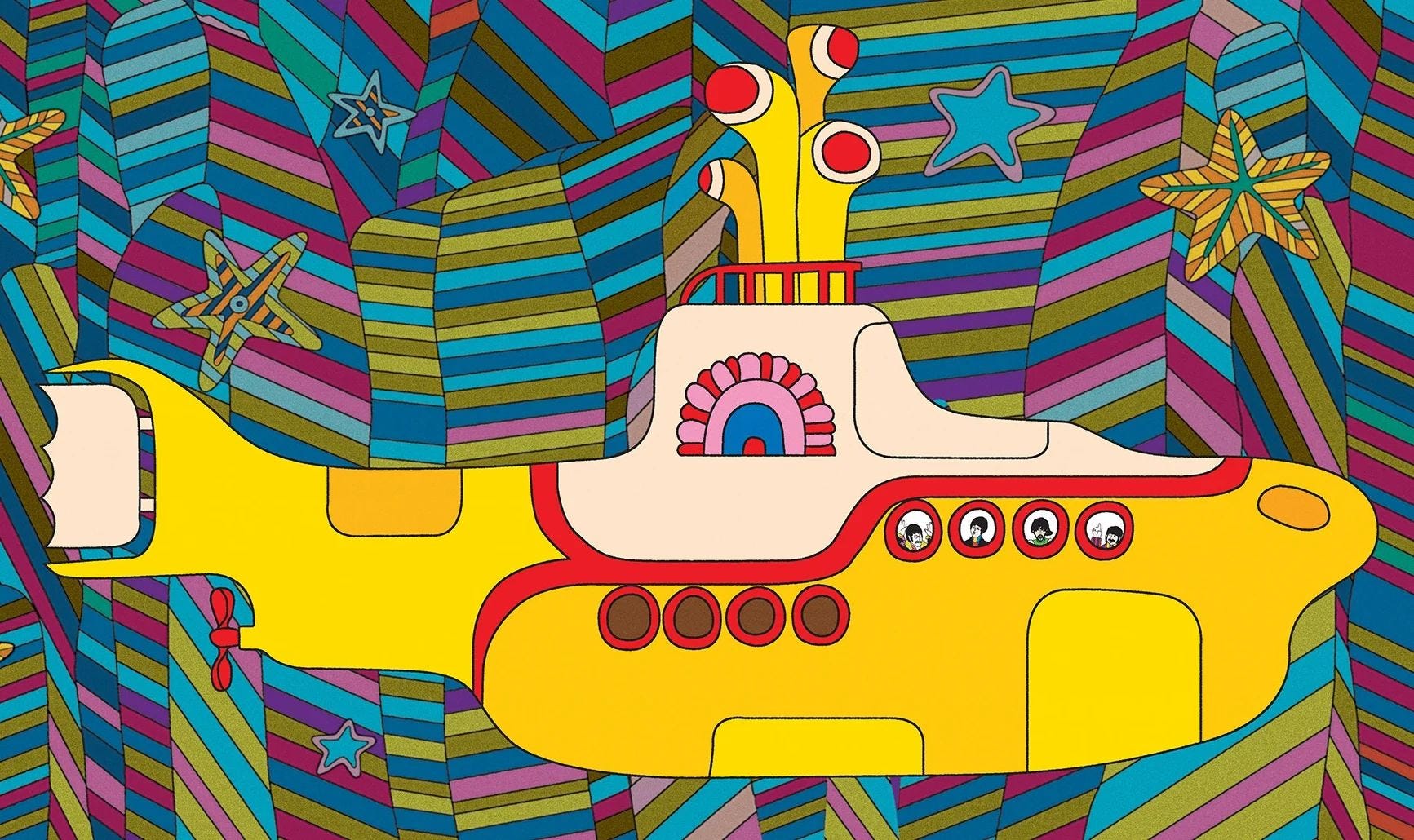
At the center of the film’s visual universe was Heinz Edelmann, a German-based illustrator whose electric colors and strange creatures gave Pepperland its unmistakable look.
Director George Dunning invited Edelmann to join the project after seeing his illustrations in a German magazine. When Edelmann arrived in London, there was no finished script and little clarity about what, exactly, he was supposed to create.
After weeks of frustration, he was ready to leave.
Just before an important presentation to producer Al Brodax, Edelmann had been asked to design the Sea of Monsters sequence. Instead, over the course of a weekend, he drew an assortment of bizarre villains as something close to a farewell gesture.
“I thought, well, here’s your hand, let me go home,” Edelmann later recalled. “Somehow, to his credit, the producer liked it.”3
Those drawings became the Blue Meanies, the Flying Glove, and other creatures that helped give the wandering production its story.
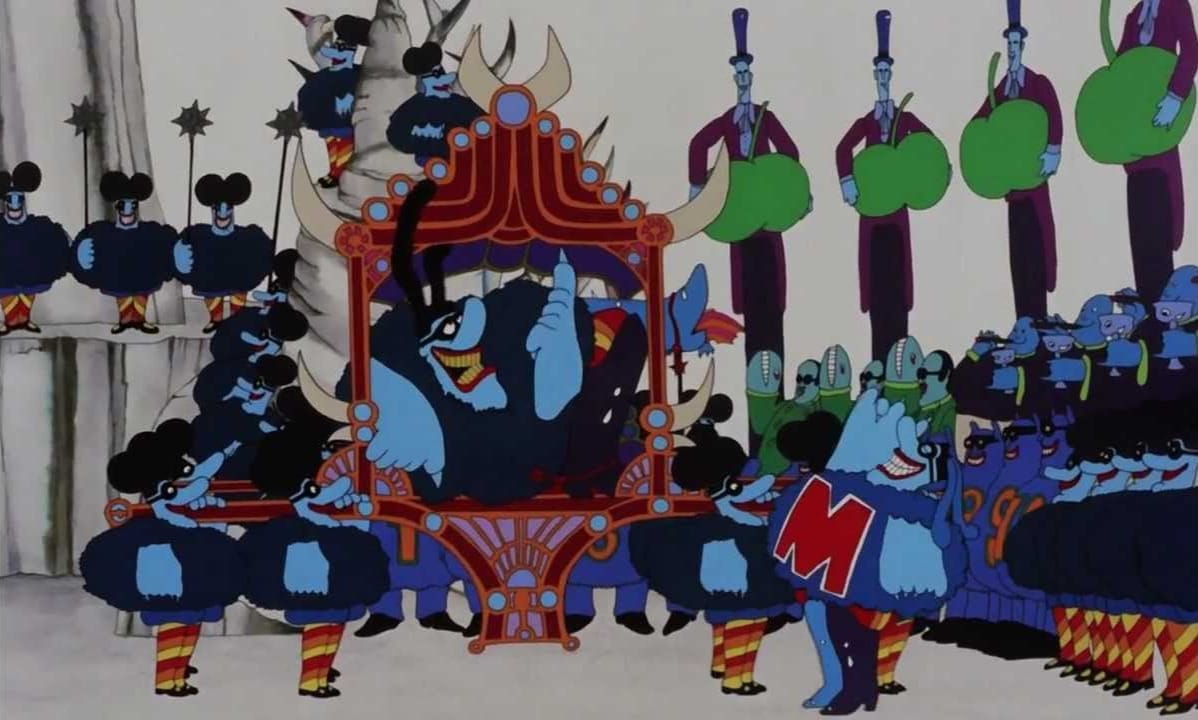
That same spirit of experimentation shaped the film’s animation.
Yellow Submarine mixed traditional cel animation with collage, photography, rotoscoping, pop-art graphics, optical effects, and sequences that radically changed style from one song to the next. This collision of styles was a creative breakthrough.
The result was a film that captured the psychedelic ethos of the sixties while expanding what an animated film could be.
2. Fantastic Planet (La Planète Sauvage) (1973)
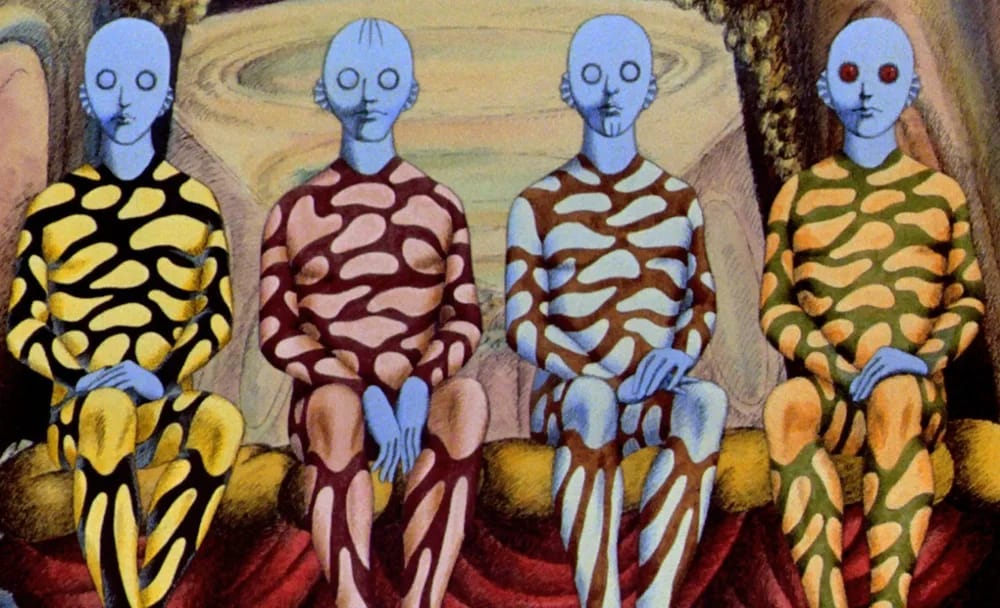
Released in 1973, René Laloux’s Fantastic Planet (La Planète Sauvage) is one of cinema’s most distinctive psychedelic visions and a biting political allegory.
On a planet of giant blue aliens, human beings occupy a humbling place in the natural order: they are either pets or pests, at the mercy of a species that considers them incapable of higher thought.
The film unfolds on the planet Ygam, where the towering Draags dominate the tiny, humanlike Oms. Some Oms are kept as household companions, and those living in the wild face periodic extermination.
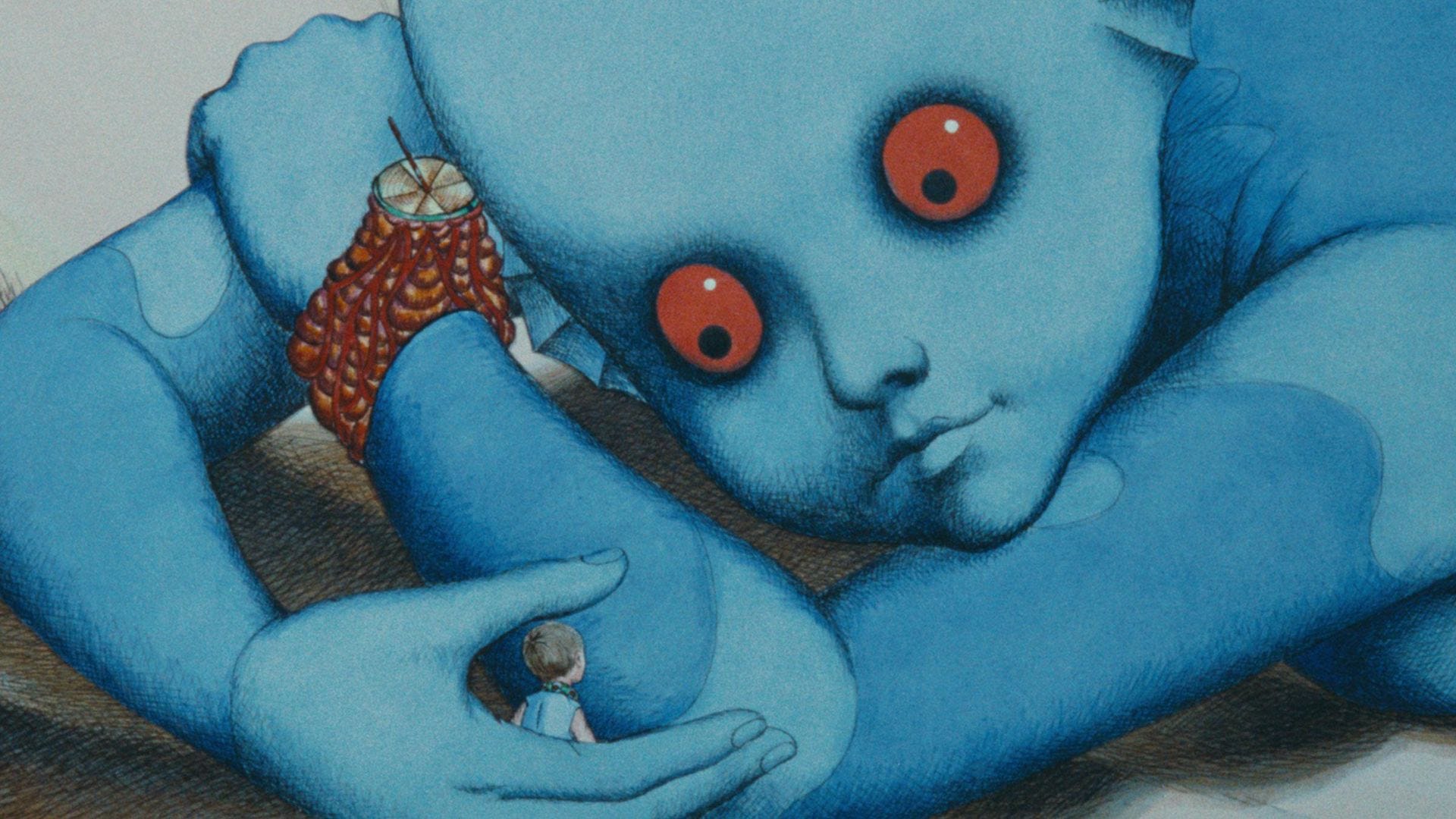
One captive Om, a boy named Terr, secretly absorbs the lessons given to his young Draag owner. He learns their language and science, gradually understanding the society that controls him. When he escapes with their educational device, he shares its knowledge with the wild Oms. What began as a private education becomes the foundation for collective resistance.
Knowledge is central to the film’s politics. The Draags’ authority depends partly on the assumption that the Oms are incapable of higher thought. Learning gives the Oms the tools to challenge both that belief and the conditions imposed on them.
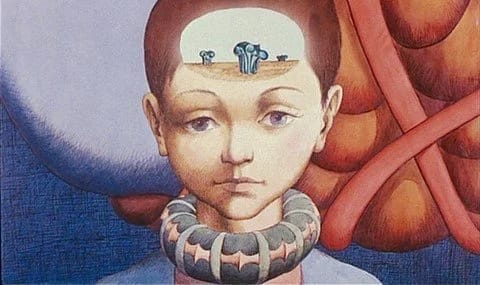
This struggle unfolds within an astonishingly strange world. Designed by surrealist artist Roland Topor, Ygam is filled with bizarre organisms and landscapes that seem suspended between beauty and menace. The animation preserves the delicate textures of the drawings, making the whole world feel like an antique engraving brought to life.
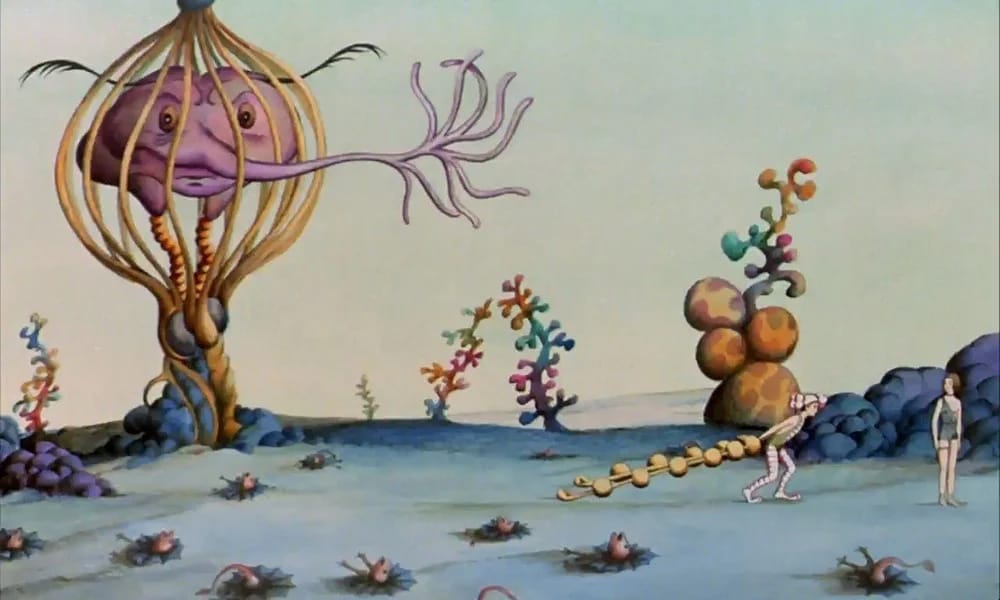
Alain Goraguer’s soundtrack deepens the trance. Psychedelic jazz, wah-wah guitar, and eerie electronic sounds drift through the alien landscape. Together, the images and music create the feeling of entering a world whose underlying logic remains just beyond your grasp.
That disorientation gives the political critique its force. Seeing humans dressed up as pets or exterminated as vermin makes familiar hierarchies suddenly disturbing. The Draags’ serene confidence in their own superiority invites uncomfortable questions about colonialism and our treatment of other living beings.
Animated in Czechoslovakia amid the upheaval surrounding the 1968 Soviet invasion, the film’s story of domination and resistance carries a particular historical resonance.4 It won a Special Prize at Cannes in 1973 and became a countercultural classic.
Fantastic Planet shows how naturally animation can bring surrealism and political critique together. Its imagined world unsettles our assumptions about our own, asking whose intelligence we recognize, whose lives we value, and what becomes possible when knowledge is shared.
3. Waking Life (2001)
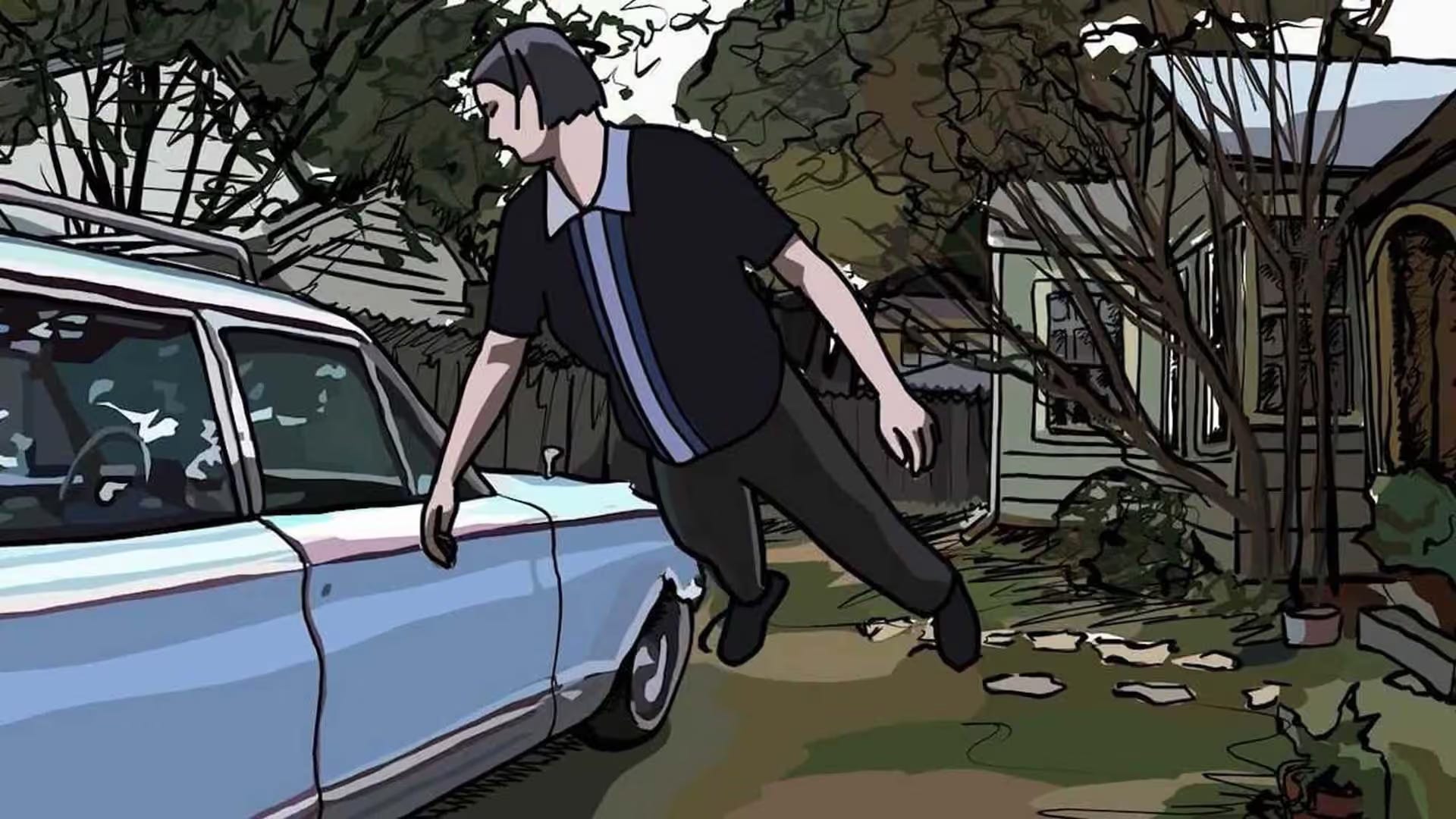
Released in 2001, Richard Linklater’s Waking Life is an animated odyssey through the liminal space between waking and dreaming.
The film follows a young man who stumbles into conversations with strangers about the nature of existence. How can we tell whether we’re awake or dreaming? Do we freely choose our actions, or does our biology determine them? Can language ever fully convey what another person feels?
The conversations resemble the long, searching discussions that sometimes unfold on psychedelics, when life’s biggest questions feel suddenly within reach.
Gradually, the main character realizes he’s dreaming, but each time he thinks he’s woken up, he finds himself inside another dream.
Linklater traced the premise to a lucid dream he had at eighteen, in which he became aware he was dreaming but could not seem to wake up. He carried the experience with him for years, wondering how to turn it into a film. The breakthrough came when he discovered an animation technique that could make the world look the way the dream had felt.5

That technique was digital rotoscoping. Linklater filmed real people, then had artists draw over the footage. The animation preserves the actors’ natural movements and expressions while allowing their faces and surroundings to shift and ripple. The technique is perfect for a film about questioning reality.
One of the film’s most memorable scenes, “The Holy Moment,” explores the idea that every moment is sacred, though we rarely recognize it. Filmmaker Caveh Zahedi, appearing as himself, reflects on this with a rambling earnestness:
“This moment, you know, it’s holy. But, like, we walk around like it’s not holy. We walk around, like there’s some holy moments and there are all the other moments that are not holy… but this moment is holy, right?”6
He wonders how anyone could remain fully open to that awareness:
“It’s like holy, holy, holy, moment by moment. But like who can live that way, you know?”
If he truly saw the person sitting across from him as holy, he explains, he might stop talking, look into their eyes, and begin to cry. Such openness would break through the social conventions that keep our encounters comfortable and familiar.
Then he and his companion try it, falling silent and looking into each other’s eyes as the animation pulses around them. By the end of the scene, their figures dissolve into clouds.
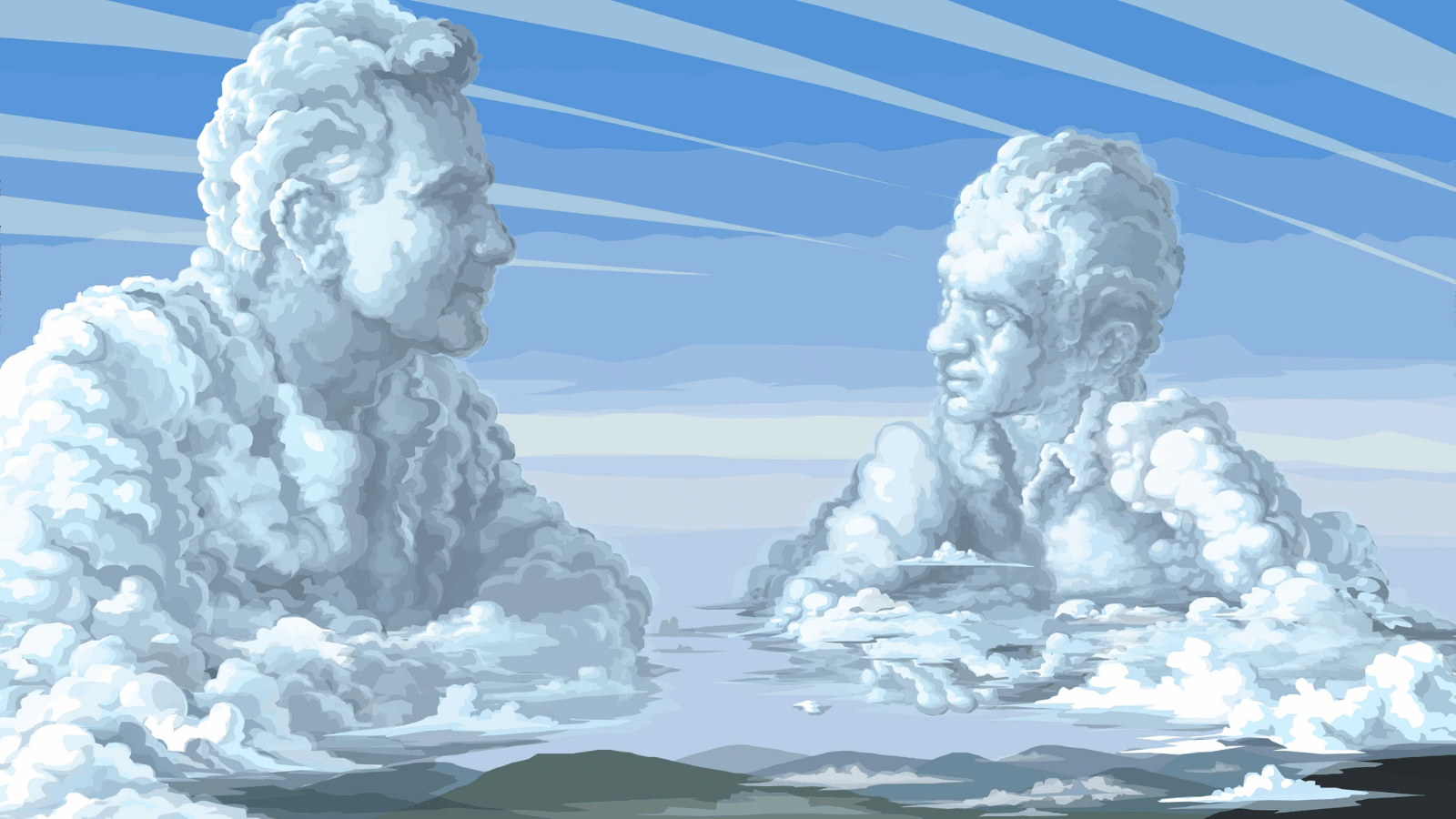
The encounter captures something deeply psychedelic: suddenly recognizing the sacredness of an ordinary moment. That sacredness was always there, we just hadn’t noticed it.
The film gives wandering conversations and moments of wonder the weight usually reserved for dramatic events. It makes thinking feel like an adventure, with the possibility that something a stranger says might change your life.
Long after it ends, the film’s central question remains: how much of the world are we passing through without really noticing?
Quotes
“There is no form of film with more freedom than animation. You can do absolutely anything you want with movement, dimension, color, shapes, perspective and anything else that occurs to you.”
— Roger Ebert
“Your brain isn’t a videotape, it’s a theatrical production.”
— Richard Linklater
Trip Thought
A shower thought, but for psychedelics.
Animation is kind of perfect for telling psychedelic stories. If you can imagine a world, you can create it.
There’s also something special about a film whose ideas are as psychedelic as its images. Long after a trip ends, these films can offer a way back into some of that wonder.
Community Bulletin
🍄 Microdosing Summit: Our friends at The Microdosing Collective are hosting their inaugural Microdosing Summit on October 21, 2026, in Austin, Texas. Use code ARCHIVES for 10% off.
📚Books: Our friends at Synergetic Press publish psychedelic classics including Mystic Chemist, Birth of a Psychedelic Culture, and Zig Zag Zen: Buddhism & Psychedelics. Use code ARCHIVES20 for 20% off.
🕯️Candles: Psychedelic Candle Co. makes candles designed to accompany psychedelic journeys, using scent as a way to ground the experience and evoke it again afterward. Use code ARCHIVES20 for 20% off.
Thanks for reading!
If something resonated with you, or if you have thoughts, questions, or ideas for future editions, I’d love to hear from you.
Just reply to this email. I read every response, and your feedback helps shape where this project goes next.
See you next week!
In psychedelic companionship,
- Kyle Sharp
Sources: