

Welcome to The Weekly Archive, a short trip through psychedelic history.
To celebrate Halloween and Día de los Muertos (the Day of the Dead), we’re revisiting two moments in San Francisco’s psychedelic counterculture.
First, Halloween 1966, when Ken Kesey and the Merry Pranksters held their final Acid Test and the Diggers transformed Haight-Ashbury into a surreal street theater. Then, October 1967, when the Diggers staged “The Death of the Hippie,” a mock funeral for the increasingly commercialized counterculture.
Together, these moments capture the psychedelic movement wrestling with what it wanted to become.
Here are 3 artifacts, 2 quotes, and 1 trip thought for the journey.
In partnership with

This time of year, some of the scariest things are ghosts, goblins, and the never-ending stream of thoughts that haunt our minds.
Luckily, there’s a simple practice for working with that last one: Zen meditation.
Our friends at The Way have created a guided meditation program led by Zen Master Henry Shukman. It draws on an ancient approach to meditation training: one teacher, one system, one path.
Step by step, it helps you build a meditation practice, better understand your mind, and navigate the spooky thoughts in your noggin.
Try The Way free for 30 days below.
Artifacts:
1. The Halloween Acid Test Graduation
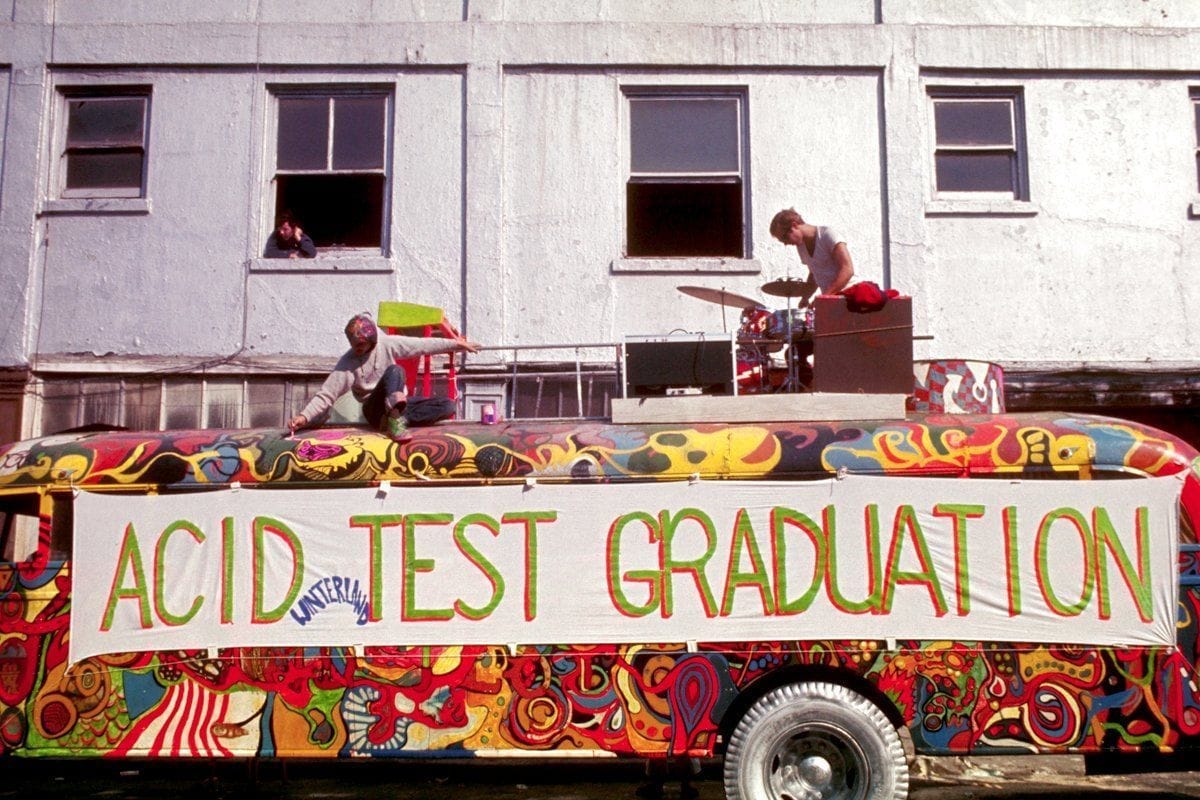
On Halloween night in 1966, Ken Kesey invited the psychedelic movement to graduate from acid. But not everyone was ready to leave school.
Over the previous year, Kesey and the Merry Pranksters had helped turn LSD into a cultural phenomenon through the iconic Acid Tests. These gatherings invited partygoers to experiment with LSD — often served in buckets of Kool-Aid — while dancing to live music from the Grateful Dead amid psychedelic light shows.
But by autumn, the man at the center of the Acid Tests was facing prison.
Following marijuana arrests, Kesey had faked his own suicide and fled to Mexico in early 1966. After months away, he secretly returned to California, where the FBI arrested him in October.1
His lawyers offered the courts an intriguing proposition: release Kesey, and he would publicly encourage young people to move beyond LSD. The promise of an “Acid Test Graduation” helped secure his release on bail.2
The arrangement made some people suspicious. California had banned LSD just weeks earlier, on October 6, 1966, and now one of its most recognizable advocates was telling people to give it up. Had the authorities gotten to him?
Yet Kesey had already begun questioning where repeated trips were taking him. While in Mexico, he had considered whether the awareness opened by LSD could become a lasting way of experiencing life.
In an interview just days before the graduation, Kesey declared,
“It’s time to graduate from acid ... I think a lot of the heads are tired.”3
The graduation was scheduled for Halloween at Winterland, but those plans collapsed. A smaller gathering took place in a warehouse on Harriet Street, with music from the Anonymous Artists of America. Diplomas were handed out to the psychedelic graduates.4
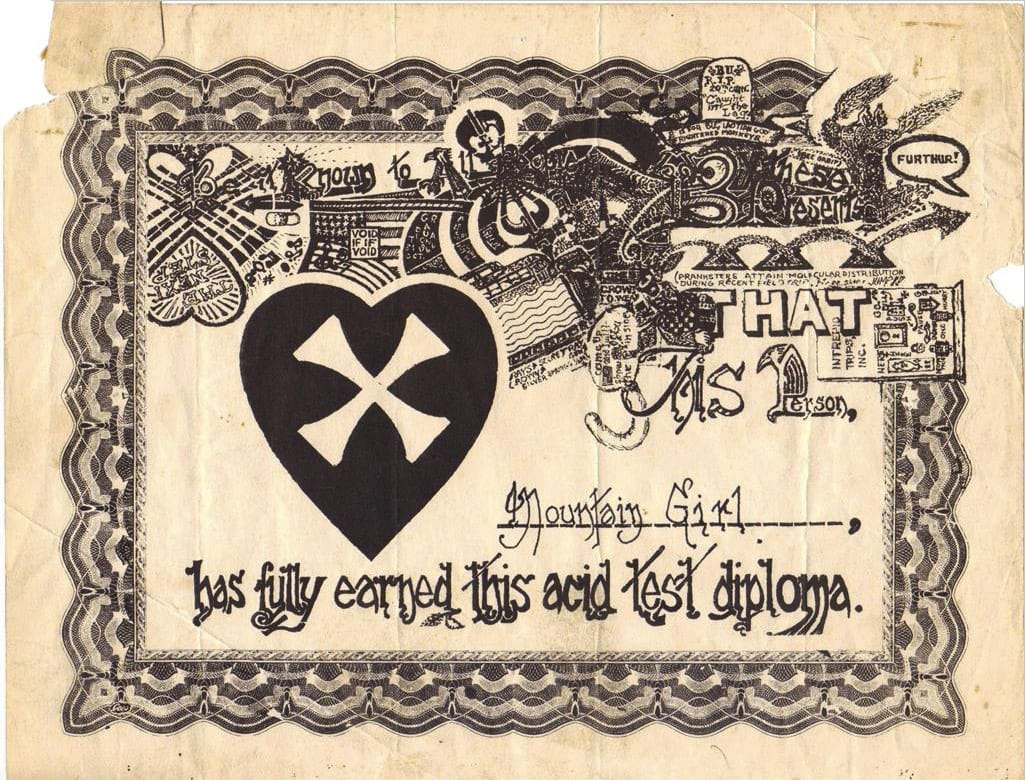
The ceremony offered no clear curriculum for what came next. Kesey’s legal predicament complicated his message, and the movement was hardly finished experimenting with LSD.
Still, the graduation raised a question that psychedelic culture would keep returning to: what do you do with what you’ve seen?
Whatever Kesey’s motives, the idea of an Acid Test Graduation provided an interesting framework. After all, the value of an education lies in what you do with it after graduation.
2. The Diggers’ Halloween Happening (1966)
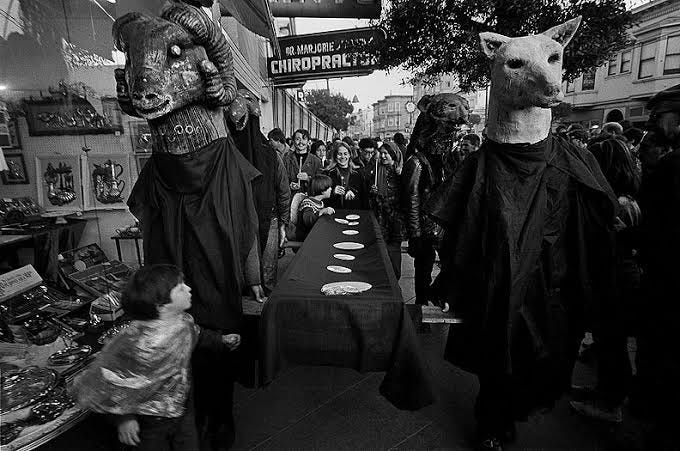
On the same Halloween night that Ken Kesey staged his Acid Test Graduation, San Francisco police found themselves arresting two eight-foot puppets on Haight street.
The puppets belonged to the Diggers, an anarchist commune that had recently emerged from the San Francisco Mime Troupe. They believed social change could begin by acting as though a different society already existed. That autumn, they had started serving free meals every day in Golden Gate Park’s Panhandle. Their larger ambition was a world where food, clothing, and public space were freely shared.5
For October 31, 1966, they advertised a “Full Moon Public Celebration of Halloween” at the intersection of Haight and Ashbury.
At around 5:30 p.m., twenty Diggers carried a towering yellow wooden frame to the corner. They called it the “Frame of Reference.” Two giant puppets performed an improvised skit, walking in and out of the frame and debating which side was inside and which was outside.
The Diggers also handed out about seventy-five miniature “frames of reference” that people could wear around their necks and look through. The bit had a philosophical point: change the frame, and the same world might look entirely different.
Next came the game of “Intersection.” Participants crossed the streets in different directions, trying to trace triangles and squares with their footsteps. The Diggers had turned a busy intersection into a giant game board.
By six o’clock, roughly 600 people had gathered. Some stepped off buses or left their cars to join in. Children wandered among the crowd with Halloween costumes and trick-or-treat bags.
Then five police cars arrived, blocking the intersection themselves.6
According to the Berkeley Barb, “the fuzz told the puppets that they were creating a public nuisance by walking in and out of the Frame of Reference, and that if they continued they would be arrested.”
One cop said: “We warn you that if you don’t remove yourselves from the area you’ll be arrested for blocking a public thoroughfare.”
A puppet replied, “Who is the public?”
The officer answered, “I couldn’t care less; I’ll take you in. Now get a move on.”
To which the puppet responded, “I declare myself public — I am a public. The streets are public. The streets are free.”
The puppets continued walking. Police grabbed them and their puppeteers, arrested five Diggers, and loaded them into the paddy wagon. As the crowd chanted “Frame-up! Frame-up!” the arrested Diggers answered, “Pub-lic! Pub-lic!”.
But the party wasn’t over. After the officers departed, people resumed the Intersection game. Someone set up a record player, and the street became a dance floor.
A month later, the charges against the five Diggers were dismissed.6
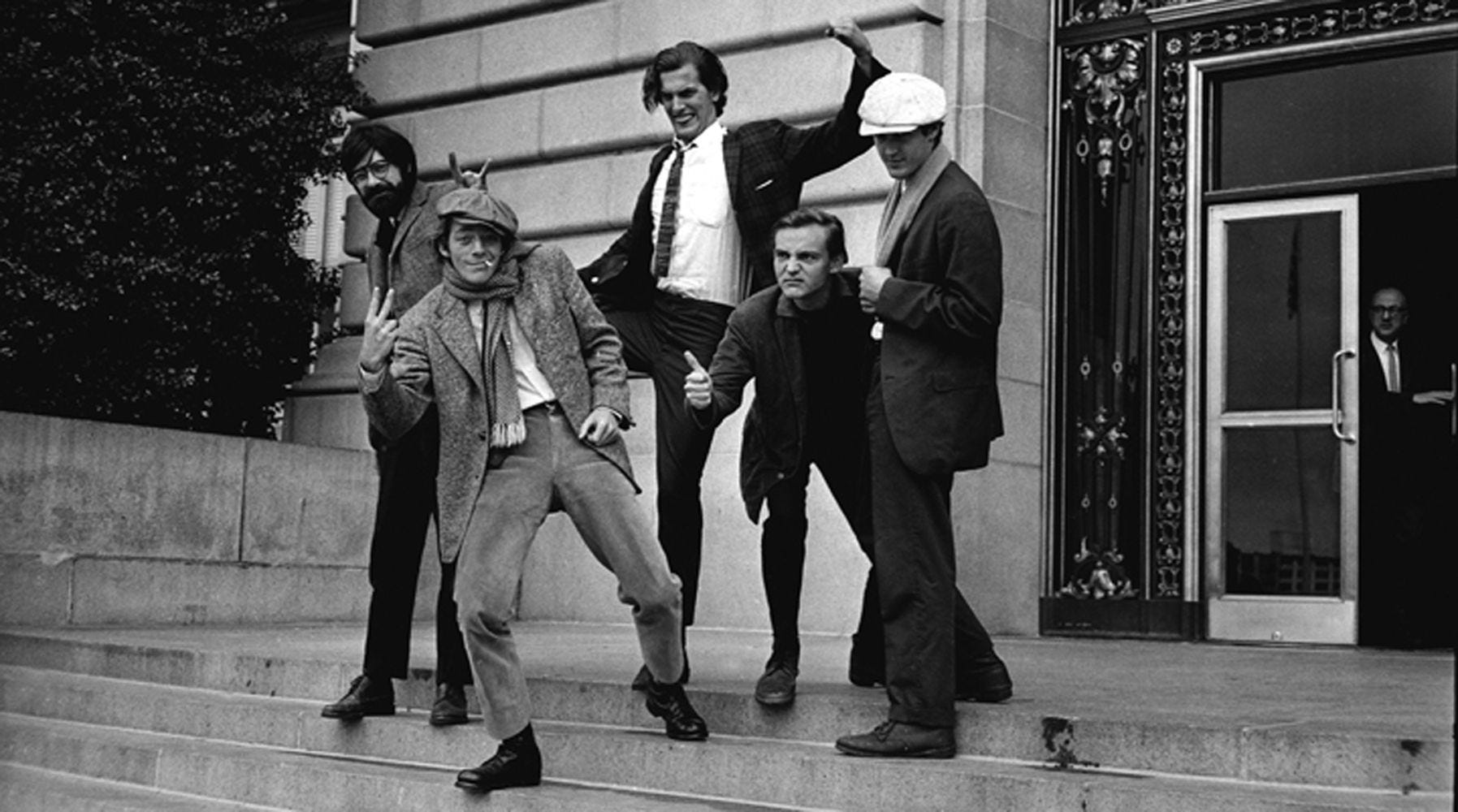
This particular experiment in public freedom had lasted only an evening, but it illustrated the idea at the heart of their movement: you could begin to change society by behaving as though a different world was actually possible.
Kesey’s graduation raised the question of what came after the psychedelic experience. For the Diggers, changing your frame of reference was only useful if you were willing to walk through it.
3. The Death of the Hippie
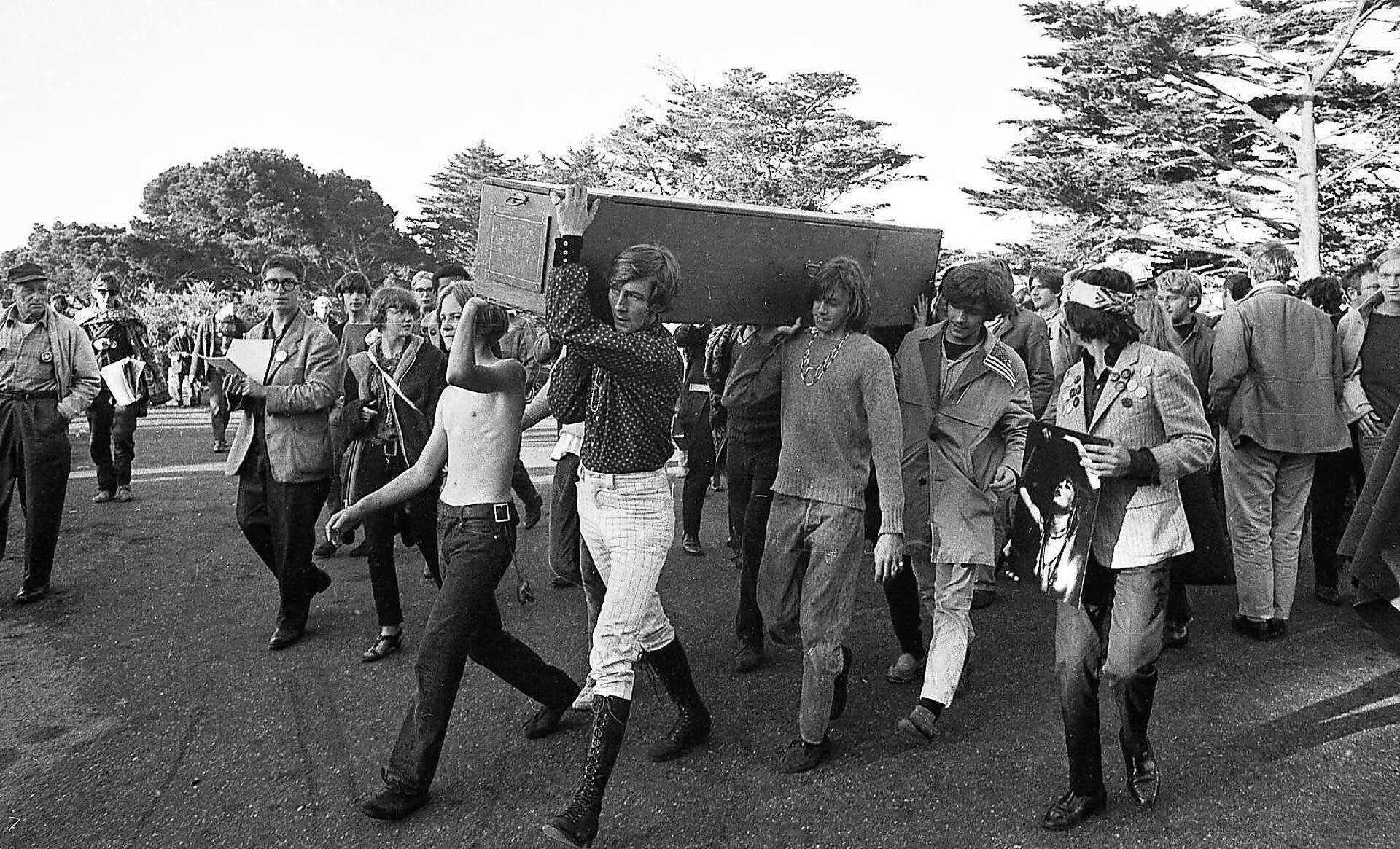
On October 6, 1967, the hippies of San Francisco gathered to attend their own funeral.
Only months earlier, Haight-Ashbury had become the epicenter of the Summer of Love. Drawn by stories of free love and a new way of living, tens of thousands of young people had descended on the neighborhood.
The media followed, turning Haight-Ashbury into a spectacle for curious tourists. Before long, businesses were finding ways to package and sell the counterculture to the masses.
By autumn, the neighborhood was struggling under the weight of its newfound fame. Overcrowding and rising crime had complicated the utopian vision that originally drew people there.7
For the Diggers, the counterculture was losing sight of what made it radical.
The media had turned the hippie into an image that businesses could sell, making it possible to buy the look of rebellion without embracing its ideals. A movement that sought to challenge consumer society was becoming another product of it, threatening its potential for real social change.
So the Diggers decided to bury the hippie.
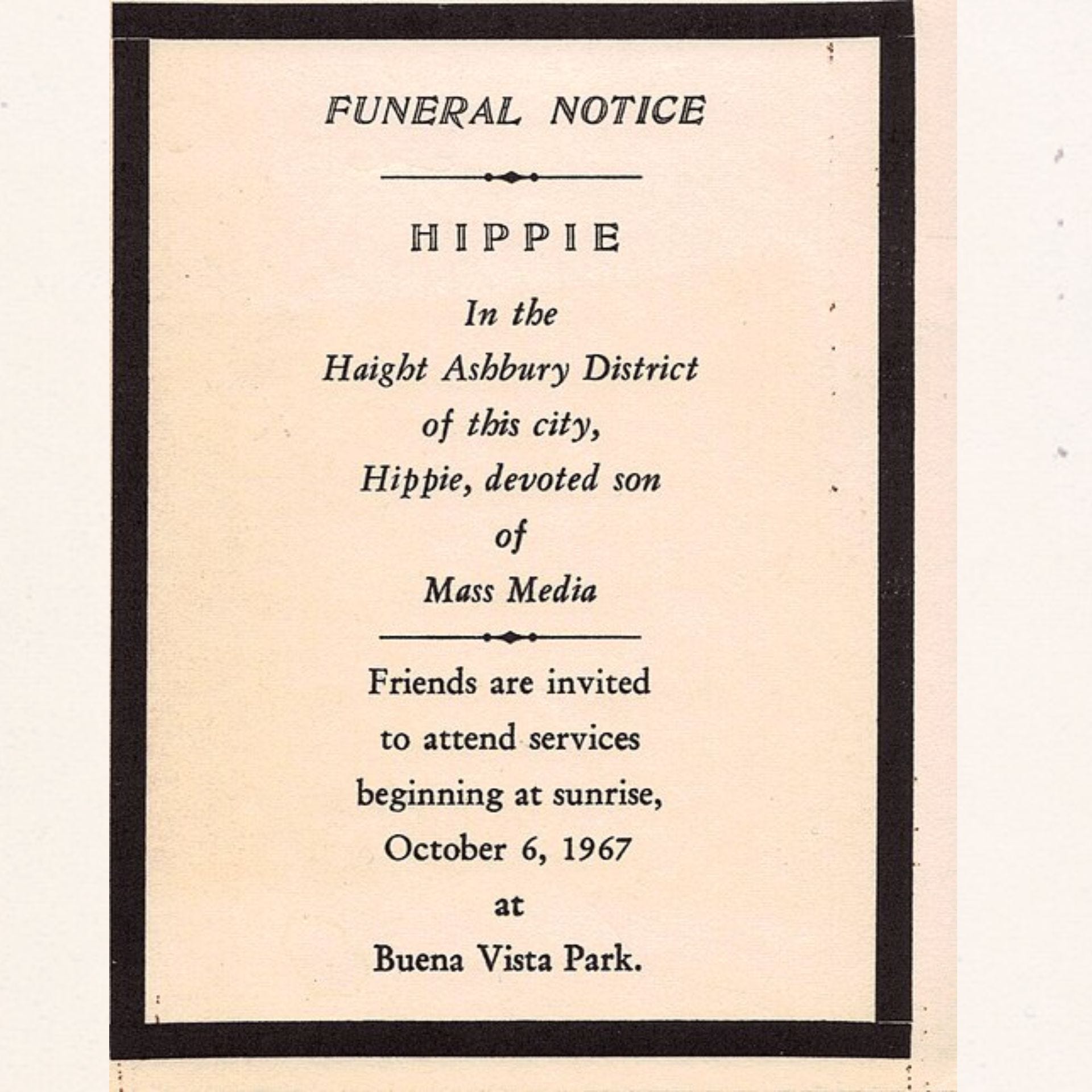
Black-bordered funeral notices appeared throughout the Haight, announcing the death of “Hippie, devoted son of Mass Media.” Friends were invited to attend services at sunrise on October 6, exactly one year after California had outlawed LSD.4
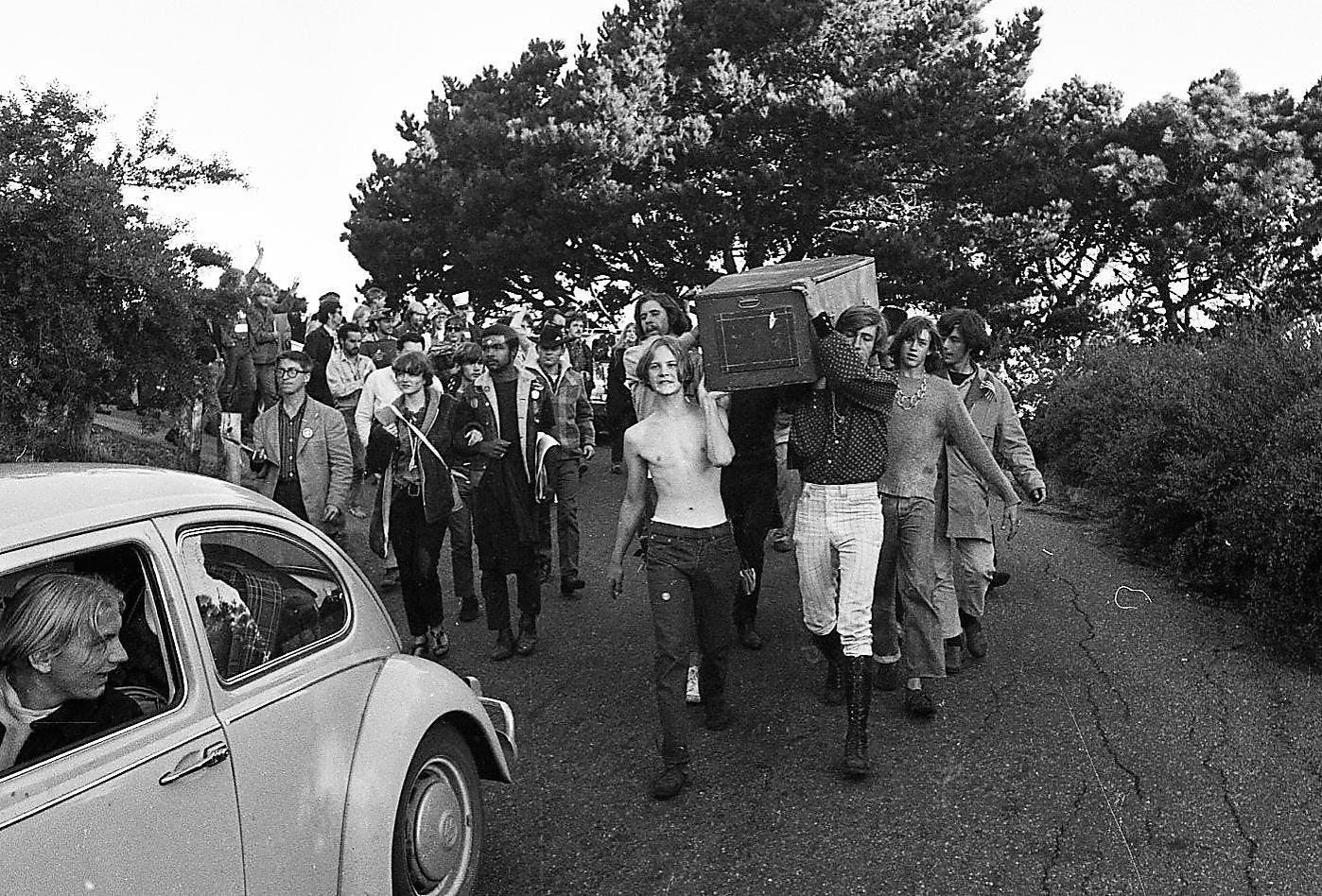
The funeral was organized by members of the Diggers and other Haight-Ashbury residents, including Ron Thelin, co-founder of the Psychedelic Shop, which was closing its doors.8
That morning, mourners gathered before dawn and carried a flower-covered coffin through the neighborhood. Inside were the remnants of hippie life: love beads, shorn hair, wilted flowers, marijuana, and discarded newspapers. A bugle played "Taps" as the procession made its way toward Buena Vista Park.
There, participants gathered around a ceremonial fire, burning newspapers and other symbols of the hippie identity.
The symbolism went beyond saying goodbye to the Summer of Love. In a manifesto distributed for the occasion, the Diggers declared:
“MEDIA CREATED THE HIPPIE WITH YOUR HUNGRY CONSENT.”9
They argued that the media had manufactured a caricature of the counterculture, one that young people had increasingly come to embrace themselves. The word hippie had become another straightjacket, another set of expectations to conform to.
In its place, the Diggers proclaimed the “Birth of Free Man.” They wanted people to reclaim the freedom to create their own lives and put their ideals into practice.9
Of course, there was an irony in staging a media spectacle to protest the influence of the media. The funeral itself was photographed and reported on, and the word hippie proved considerably harder to bury than its organizers had hoped.
The Diggers’ funeral for the hippie carried a warning about how movements lose their power.
The institutions a movement hopes to challenge can gradually absorb its ideas and reshape its goals. What begins as a radical vision for social change can slowly become part of the very system it set out to transform, until its original ambitions are lost.
That warning remains relevant to today’s psychedelic movement. As it gains acceptance within mainstream medicine and commercial markets, is it changing those institutions, or being reshaped to serve their interests?
Quotes
“I am ashamed to think how readily we capitulate to badges and names, to large societies and dead institutions.”
— Ralph Waldo Emerson
“Remembering that you are going to die is the best way I know to avoid the trap of thinking you have something to lose.”
— Steve Jobs
Trip Thought
A shower thought, but for psychedelics
On Halloween, we know we’re wearing costumes. The rest of the year, we often forget. We put on the mask of the person we think we’re supposed to be.
Even an identity built around freedom can become another set of expectations. We can get so caught up in looking the part that we lose sight of the values that drew us to it.
Psychedelics can help us notice these everyday costumes and question them. Is the person we’re trying to appear to be getting in the way of how we actually want to live?
Community Bulletin
🧘Meditation App: The Way is a guided meditation program led by Zen master Henry Shukman, designed to help build a deeper, more consistent practice. Use this link for 30 days free.
📚 New Book: In Ordinary Mystics, Matt Zemon bridges the clinical lab and the candlelit ceremony, exploring what happens when ordinary people approach psychedelics as a sacrament and encounter the Sacred directly. Check it out here.
🍄 Psychedelic Speakeasy: The Phoenix Rising Psychedelic Speakeasy is coming to Nashville, TN, on Thursday, November 5, 2026! Join fellow psychonauts for an evening of visionary art, music, and fascinating conversations about psychedelic culture. Learn more and grab your tickets here.
Thanks for reading!
If something resonated with you, or if you have thoughts, questions, or ideas for future editions, I’d love to hear from you.
Just reply to this email. I read every response, and your feedback helps shape where this project goes next.
See you next week!
In psychedelic companionship,
- Kyle Sharp